Kobayashi Hiromi, Takahashi Kuniaki, Mizuno Nobuyuki, Kutsuna Haruo, Ishii Masamitsu
Department of Dermatology, Osaka City University Graduate School of Medicine, Osaka, Japan.
Evid Based Complement Alternat Med. 2004 Sep 1;1(2):145-155. doi: 10.1093/ecam/neh026.
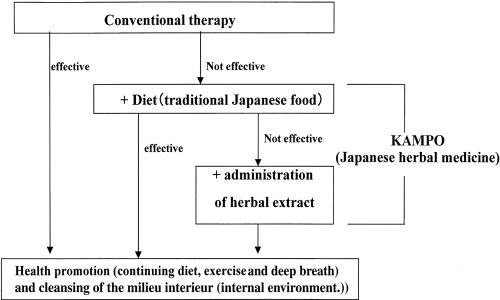
In the first part of this Review, we presented case-series where Kampo treatment was introduced for those atopic dermatitis (AD) patients who had failed with conventional therapy, in an attempt to prove that there exists a definite subgroup of AD patients for whom Kampo treatment is effective. In this second part, we will first provide the summary of the results for 140 AD patients we treated in 2000. The results suggest that Kampo treatment is effective for more than half of AD patients who fail with conventional therapy. In the Discussion, we will examine the evidential basis for conventional AD therapy and discuss how Kampo treatment should be integrated into the guidelines for AD therapy. We contend that Kampo treatment should be tried before systematic immunosuppressive agents are considered. As each Kampo treatment is highly individualized, it should be regarded more as 'art' than technology, and special care should be taken to assess its efficacy in clinical trial.
在本综述的第一部分,我们展示了一些病例系列,其中针对那些常规治疗失败的特应性皮炎(AD)患者引入了汉方治疗,试图证明确实存在一部分AD患者,汉方治疗对他们有效。在第二部分,我们将首先提供2000年我们治疗的140例AD患者的结果总结。结果表明,汉方治疗对超过一半的常规治疗失败的AD患者有效。在讨论部分,我们将审视常规AD治疗的证据基础,并讨论汉方治疗应如何纳入AD治疗指南。我们认为,在考虑使用系统性免疫抑制剂之前应尝试汉方治疗。由于每种汉方治疗都是高度个体化的,它应更多地被视为“艺术”而非技术,并且在临床试验中评估其疗效时应格外小心。