Denk Winfried, Horstmann Heinz
Max Planck Institute for Medical Research, Heidelberg, Germany.
PLoS Biol. 2004 Nov;2(11):e329. doi: 10.1371/journal.pbio.0020329. Epub 2004 Oct 19.
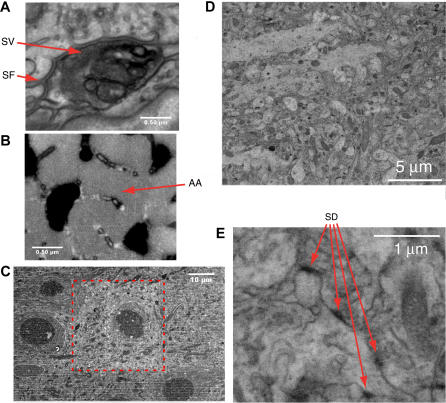
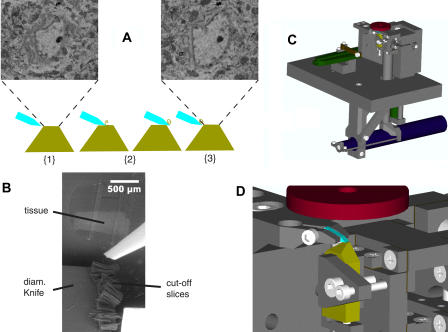
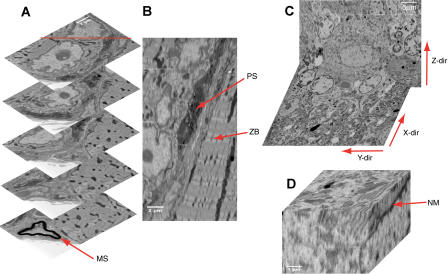
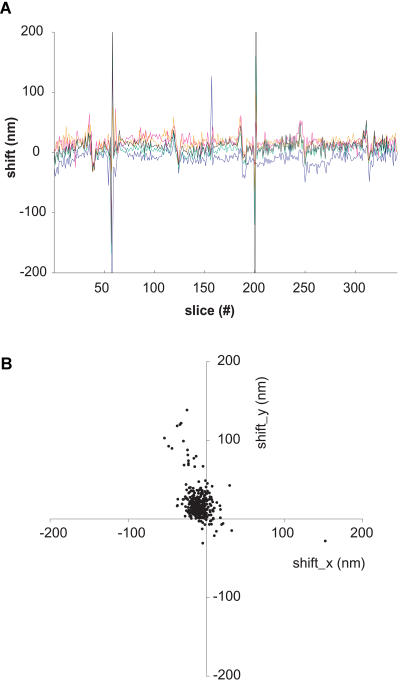
Three-dimensional (3D) structural information on many length scales is of central importance in biological research. Excellent methods exist to obtain structures of molecules at atomic, organelles at electron microscopic, and tissue at light-microscopic resolution. A gap exists, however, when 3D tissue structure needs to be reconstructed over hundreds of micrometers with a resolution sufficient to follow the thinnest cellular processes and to identify small organelles such as synaptic vesicles. Such 3D data are, however, essential to understand cellular networks that, particularly in the nervous system, need to be completely reconstructed throughout a substantial spatial volume. Here we demonstrate that datasets meeting these requirements can be obtained by automated block-face imaging combined with serial sectioning inside the chamber of a scanning electron microscope. Backscattering contrast is used to visualize the heavy-metal staining of tissue prepared using techniques that are routine for transmission electron microscopy. Low-vacuum (20-60 Pa H(2)O) conditions prevent charging of the uncoated block face. The resolution is sufficient to trace even the thinnest axons and to identify synapses. Stacks of several hundred sections, 50-70 nm thick, have been obtained at a lateral position jitter of typically under 10 nm. This opens the possibility of automatically obtaining the electron-microscope-level 3D datasets needed to completely reconstruct the connectivity of neuronal circuits.
在许多长度尺度上的三维(3D)结构信息在生物学研究中至关重要。现已有出色的方法来获取原子水平的分子结构、电子显微镜水平的细胞器结构以及光学显微镜水平的组织结构。然而,当需要在数百微米范围内重建三维组织结构,且分辨率要足以追踪最细的细胞突起并识别诸如突触小泡等小细胞器时,就存在差距。不过,此类三维数据对于理解细胞网络至关重要,尤其是在神经系统中,需要在相当大的空间体积内完整重建细胞网络。在此,我们证明通过在扫描电子显微镜腔室内结合连续切片进行自动块面成像,可以获得满足这些要求的数据集。背散射对比度用于可视化使用透射电子显微镜常规技术制备的组织的重金属染色。低真空(20 - 60 Pa H₂O)条件可防止未镀膜块面带电。分辨率足以追踪最细的轴突并识别突触。已获得数百个厚度为50 - 70 nm的切片堆栈,其横向位置抖动通常在10 nm以下。这开启了自动获取完全重建神经元回路连接所需的电子显微镜水平三维数据集的可能性。