Baheiraei Azam, Pocock Nicholas A, Eisman John A, Nguyen Nguyen D, Nguyen Tuan V
Bone and Mineral Research Program, Garvan Institute of Medical Research, St Vincent's Hospital, University of New South Wales, Sydney, Australia.
BMC Musculoskelet Disord. 2005 Jun 24;6:34. doi: 10.1186/1471-2474-6-34.
While risk factors of osteoporosis in Western populations have been extensively documented, such a profile has not been well studied in Caucasians of non-European origin. This study was designed to estimate the modifiable distribution and determinants of bone mineral density (BMD) among Iranian women in Australia.
Ninety women aged 35 years and older completed a questionnaire on socio-demographic and lifestyle factors. BMD was measured at the lumbar spine (LS) and femoral neck (FN) using DXA (GE Lunar, WI, USA), and was expressed in g/cm2 as well as T-score.
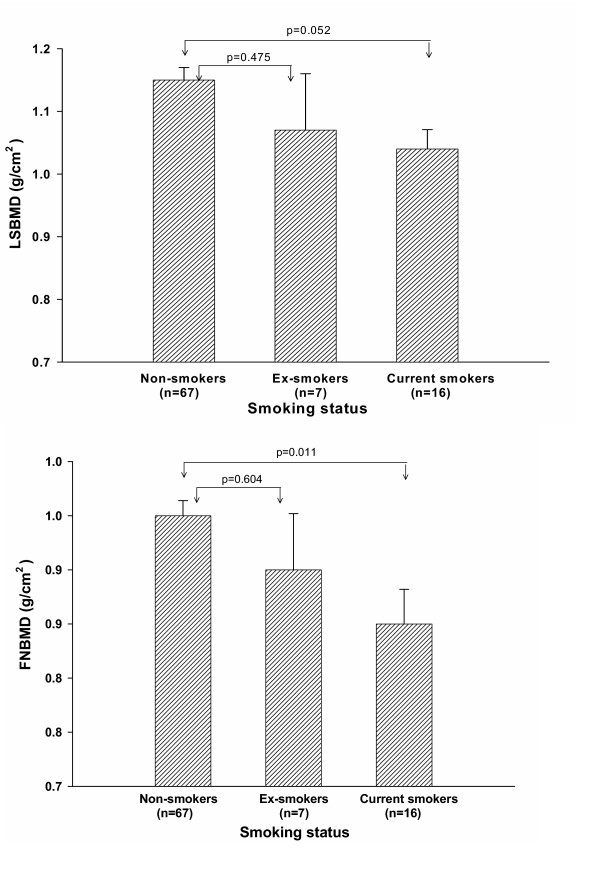
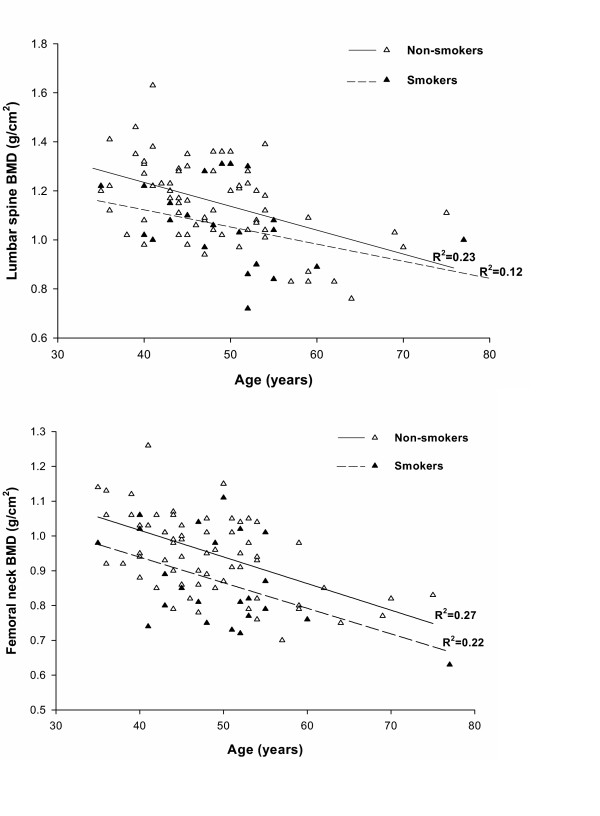
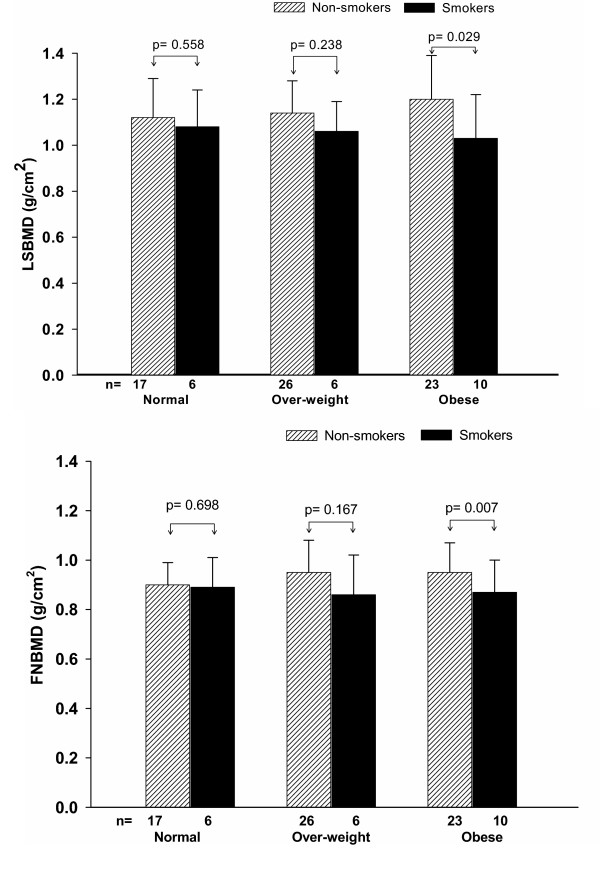
In multiple regression analysis, advancing age, lower body mass index (BMI), and smoking were independently associated with LS and FN BMD, with the 3 factors collectively accounting for 30% and 38% variance of LS and FN BMD, respectively. LS and FN BMD in smokers was 8% lower than that in non-smokers. Further analysis of interaction between BMI and smoking revealed that the effect of smoking was only observed in the obese group (p = 0.029 for LSBMD and p = 0.007 for FNBMD), but not in the overweight and normal groups. Using T-scores from two bone sites the prevalence of osteoporosis (T-scores <or= -2.5) was 3.8% and 26.3% in pre-and post-menopausal women, respectively. Among current smokers, the prevalence was higher (31.3%) than that among ex-smokers (28.6%) and non-smokers (7.5%).
These data, for the first time, indicate that apart from advancing age and lower body mass index, cigarette smoking is an important modifiable determinant of bone mineral density in these Caucasians of non-European origin.
虽然西方人群骨质疏松症的风险因素已有大量文献记载,但在非欧洲裔的高加索人群中尚未得到充分研究。本研究旨在评估澳大利亚伊朗裔女性中可改变的骨矿物质密度(BMD)分布及其决定因素。
90名35岁及以上的女性完成了一份关于社会人口学和生活方式因素的问卷。使用双能X线吸收法(DXA,美国威斯康星州GE Lunar公司)测量腰椎(LS)和股骨颈(FN)的骨密度,并以g/cm²和T值表示。
在多元回归分析中,年龄增长、较低的体重指数(BMI)和吸烟与LS和FN的骨密度独立相关,这三个因素分别占LS和FN骨密度变异的30%和38%。吸烟者的LS和FN骨密度比不吸烟者低8%。对BMI和吸烟之间相互作用的进一步分析表明,吸烟的影响仅在肥胖组中观察到(LS骨密度p = 0.029,FN骨密度p = 0.007),而在超重和正常组中未观察到。根据两个骨部位的T值,绝经前和绝经后女性骨质疏松症(T值≤ -2.5)的患病率分别为3.8%和26.3%。在当前吸烟者中,患病率高于既往吸烟者(28.6%)和不吸烟者(7.5%)。
这些数据首次表明,除了年龄增长和较低的体重指数外,吸烟是这些非欧洲裔高加索人骨矿物质密度的一个重要可改变决定因素。