Backes Christina, Kuentzer Jan, Lenhof Hans-Peter, Comtesse Nicole, Meese Eckart
Department of Human Genetics Building 60 Medical School, University of Saarland, 66421 Homburg/Saar, Germany.
Nucleic Acids Res. 2005 Jul 1;33(Web Server issue):W208-13. doi: 10.1093/nar/gki433.
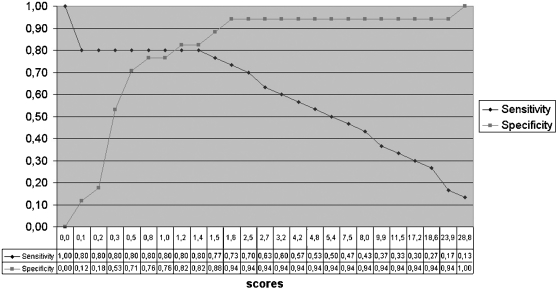
Caspases and granzyme B are proteases that share the primary specificity to cleave at the carboxyl terminal of aspartate residues in their substrates. Both, caspases and granzyme B are enzymes that are involved in fundamental cellular processes and play a central role in apoptotic cell death. Although various targets are described, many substrates still await identification and many cleavage sites of known substrates are not identified or experimentally verified. A more comprehensive knowledge of caspase and granzyme B substrates is essential to understand the biological roles of these enzymes in more detail. The relatively high variability in cleavage site recognition sequence often complicates the identification of cleavage sites. As of yet there is no software available that allows identification of caspase and/or granzyme with cleavage sites differing from the consensus sequence. Here, we present a bioinformatics tool 'GraBCas' that provides score-based prediction of potential cleavage sites for the caspases 1-9 and granzyme B including an estimation of the fragment size. We tested GraBCas on already known substrates and showed its usefulness for protein sequence analysis. GraBCas is available at http://wwwalt.med-rz.uniklinik-saarland.de/med_fak/humangenetik/software/index.html.
半胱天冬酶和颗粒酶B是蛋白酶,它们在底物中天冬氨酸残基的羧基末端进行切割时具有相同的主要特异性。半胱天冬酶和颗粒酶B都是参与基本细胞过程的酶,在凋亡性细胞死亡中起核心作用。尽管已经描述了各种靶标,但许多底物仍有待鉴定,并且已知底物的许多切割位点尚未被鉴定或经实验验证。更全面地了解半胱天冬酶和颗粒酶B的底物对于更详细地理解这些酶的生物学作用至关重要。切割位点识别序列中相对较高的变异性常常使切割位点的鉴定变得复杂。到目前为止,还没有软件能够识别与共有序列不同的半胱天冬酶和/或颗粒酶的切割位点。在此,我们展示了一种生物信息学工具“GraBCas”,它能基于评分预测半胱天冬酶1-9和颗粒酶B的潜在切割位点,包括片段大小的估计。我们在已知底物上测试了GraBCas,并展示了其在蛋白质序列分析中的实用性。可通过http://wwwalt.med-rz.uniklinik-saarland.de/med_fak/humangenetik/software/index.html获取GraBCas。