Wen Tingyi, Oussenko Irina A, Pellegrini Olivier, Bechhofer David H, Condon Ciarán
CNRS UPR 9073, Université de Paris 7-Denis Diderot, Institut de Biologie Physico-Chimique 13 rue Pierre et Marie Curie, 75005 Paris, France.
Nucleic Acids Res. 2005 Jun 27;33(11):3636-43. doi: 10.1093/nar/gki675. Print 2005.
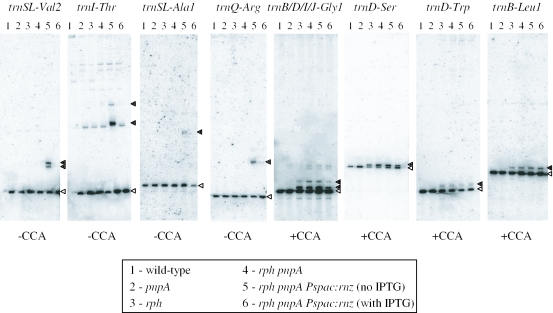
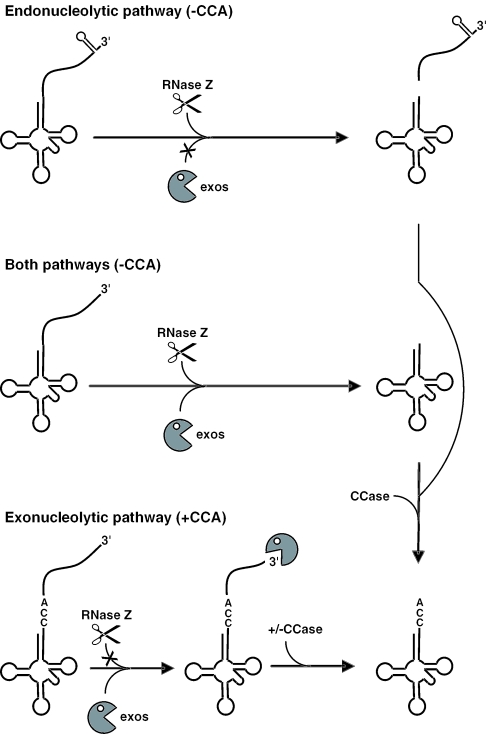
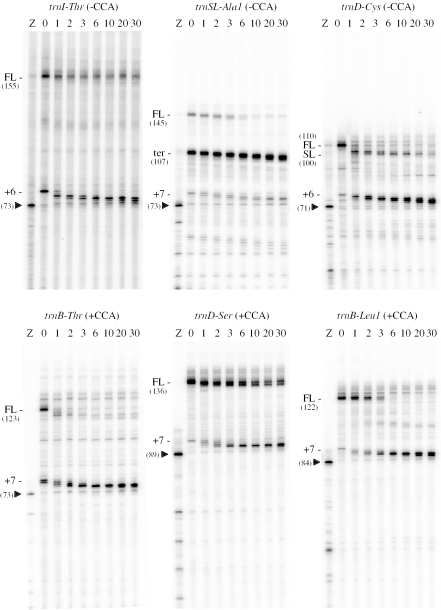
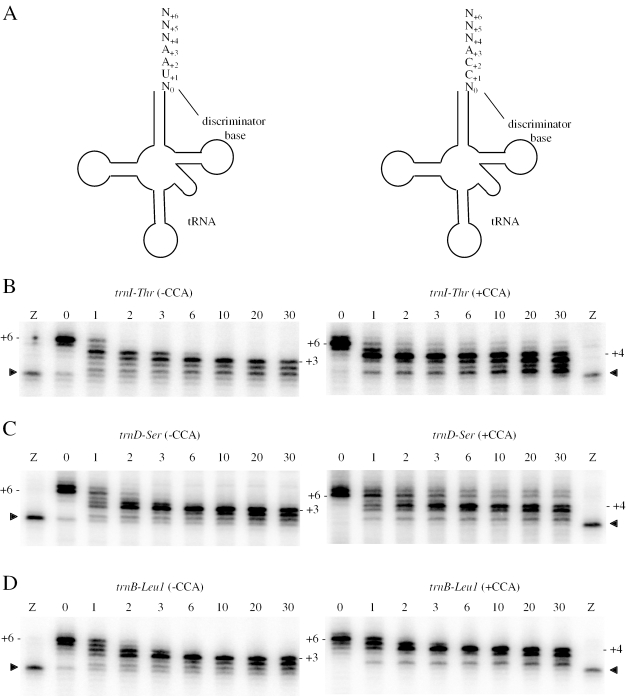
In contrast to Escherichia coli, where all tRNAs have the CCA motif encoded by their genes, two classes of tRNA precursors exist in the Gram-positive bacterium Bacillus subtilis. Previous evidence had shown that ribonuclease Z (RNase Z) was responsible for the endonucleolytic maturation of the 3' end of those tRNAs lacking an encoded CCA motif, accounting for about one-third of its tRNAs. This suggested that a second pathway of tRNA maturation must exist for those precursors with an encoded CCA motif. In this paper, we examine the potential role of the four known exoribonucleases of B.subtilis, PNPase, RNase R, RNase PH and YhaM, in this alternative pathway. In the absence of RNase PH, precursors of CCA-containing tRNAs accumulate that are a few nucleotides longer than the mature tRNA species observed in wild-type strains or in the other single exonuclease mutants. Thus, RNase PH plays an important role in removing the last few nucleotides of the tRNA precursor in vivo. The presence of three or four exonuclease mutations in a single strain results in CCA-containing tRNA precursors of increasing size, suggesting that, as in E.coli, the exonucleolytic pathway consists of multiple redundant enzymes. Assays of purified RNase PH using in vitro-synthesized tRNA precursor substrates suggest that RNase PH is sensitive to the presence of a CCA motif. The division of labor between the endonucleolytic and exonucleolytic pathways observed in vivo can be explained by the inhibition of RNase Z by the CCA motif in CCA-containing tRNA precursors and by the inhibition of exonucleases by stable secondary structure in the 3' extensions of the majority of CCA-less tRNAs.
与大肠杆菌不同,大肠杆菌的所有转运RNA(tRNA)都具有由其基因编码的CCA基序,而在革兰氏阳性细菌枯草芽孢杆菌中存在两类tRNA前体。先前的证据表明,核糖核酸酶Z(RNase Z)负责那些缺乏编码CCA基序的tRNA 3'末端的内切核酸成熟,约占其tRNA的三分之一。这表明对于那些具有编码CCA基序的前体,必定存在第二条tRNA成熟途径。在本文中,我们研究了枯草芽孢杆菌四种已知的外切核糖核酸酶PNPase、RNase R、RNase PH和YhaM在这条替代途径中的潜在作用。在缺乏RNase PH的情况下,含CCA的tRNA前体积累,其比野生型菌株或其他单个外切核酸酶突变体中观察到的成熟tRNA种类长几个核苷酸。因此,RNase PH在体内去除tRNA前体的最后几个核苷酸中起重要作用。单个菌株中存在三个或四个外切核酸酶突变会导致含CCA的tRNA前体尺寸增加,这表明,与大肠杆菌一样,外切核酸途径由多种冗余酶组成。使用体外合成的tRNA前体底物对纯化的RNase PH进行的测定表明,RNase PH对CCA基序的存在敏感。体内观察到的内切核酸和外切核酸途径之间的分工可以通过含CCA的tRNA前体中的CCA基序对RNase Z的抑制以及大多数不含CCA的tRNA的3'延伸中的稳定二级结构对外切核酸酶的抑制来解释。