• 文献检索
  • 文档翻译
  • 深度研究
  • 学术资讯
  • Suppr Zotero 插件Zotero 插件
  • 邀请有礼
  • 套餐&价格
  • 历史记录
应用&插件
Suppr Zotero 插件Zotero 插件浏览器插件Mac 客户端Windows 客户端微信小程序
定价
高级版会员购买积分包购买API积分包
服务
文献检索文档翻译深度研究API 文档MCP 服务
关于我们
关于 Suppr公司介绍联系我们用户协议隐私条款
关注我们

Suppr 超能文献

核心技术专利:CN118964589B侵权必究
粤ICP备2023148730 号-1Suppr @ 2026

文献检索

告别复杂PubMed语法,用中文像聊天一样搜索,搜遍4000万医学文献。AI智能推荐,让科研检索更轻松。

立即免费搜索

文件翻译

保留排版,准确专业,支持PDF/Word/PPT等文件格式,支持 12+语言互译。

免费翻译文档

深度研究

AI帮你快速写综述,25分钟生成高质量综述,智能提取关键信息,辅助科研写作。

立即免费体验

国家行为量表:一种用于接受机械通气的婴幼儿的镇静评估工具。

State Behavioral Scale: a sedation assessment instrument for infants and young children supported on mechanical ventilation.

作者信息

Curley Martha A Q, Harris Sion Kim, Fraser Karen A, Johnson Rita A, Arnold John H

机构信息

Critical Care and Cardiovascular Program, Children's Hospital Boston, Boston, MA, USA.

出版信息

Pediatr Crit Care Med. 2006 Mar;7(2):107-14. doi: 10.1097/01.PCC.0000200955.40962.38.

DOI:10.1097/01.PCC.0000200955.40962.38
PMID:16446601
原文链接:https://pmc.ncbi.nlm.nih.gov/articles/PMC1626525/
Abstract

OBJECTIVE

To develop and test the reliability and validity of the State Behavioral Scale for use in describing sedation/agitation levels in young intubated patients supported on mechanical ventilation.

DESIGN

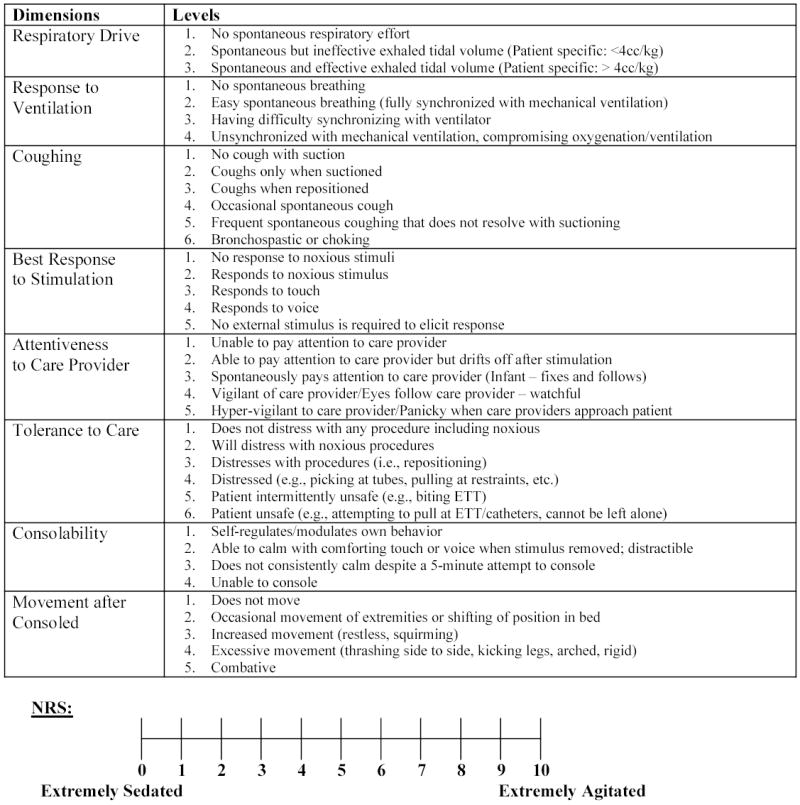
: In this prospective, psychometric evaluation, pairs of trained pediatric critical care nurse evaluators simultaneously and independently assessed a convenience sample of pediatric intensive care unit patients along eight state/behavioral dimensions and a numeric rating scale (NRS) of 0 (extremely sedated) to 10 (extremely agitated). The eight dimensions were derived from the sedation/agitation literature and expert opinion and included respiratory drive, response to ventilation, coughing, best response to stimulation, attentiveness to careprovider, tolerance to care, consolability, and movement after consoled, each with 3-5 levels.

SETTING

An 18-bed pediatric medical-surgical intensive care unit and 26-bed pediatric cardiovascular intensive care unit in a university-affiliated academic children's hospital.

PATIENTS

A total of 91 intubated mechanically ventilated patients 6 wks to 6 yrs of age provided a median of two observations (interquartile range, 1-3) for a total of 198 sets of observations. Excluded were postoperative patients or those receiving neuromuscular blockade.

INTERVENTIONS

Patients were observed for 1 min, and then incremental levels of stimulation were applied until patient response. After 2 mins of consoling, the state behavioral assessment and NRS were completed.

MEASUREMENTS

Weighted kappa and intraclass coefficients were generated to assess interrater reliability of the eight dimension and NRS ratings. Distinct state behavior profiles were empirically identified from the dimension ratings using hierarchical cluster analysis using a squared Euclidean distance measure and between-groups linkage. Construct validity of these profiles was assessed by comparing group mean NRS scores using one-way analysis of variance.

MAIN RESULTS

Weighted kappa scores for all 198 dimension ratings ranged from .44 to .76, indicating moderate to good interrater reliability. The intraclass coefficient of .79 was high for NRS ratings. Cluster analysis revealed five distinct state profiles, with mean NRS ratings of 1.1, 2.5, 4.0, 5.3, and 7.6, all of which differed significantly from each other (F = 75.8, p < .001), supporting the profiles' construct validity.

CONCLUSIONS

Based on empirically derived state behavior profiles, we have constructed the State Behavioral Scale to allow systematic description of the sedation-agitation continuum in young pediatric patients supported on mechanical ventilation. Further studies including prospective validation and describing the effect of State Behavioral Scale implementation on clinical outcomes, including the quality of sedation and length of mechanical ventilation, are warranted.
https://cdn.ncbi.nlm.nih.gov/pmc/blobs/3001/1626525/c6a92d528f12/nihms13100f1.jpg
摘要

目的

开发并测试用于描述接受机械通气的年轻插管患者镇静/躁动水平的状态行为量表的信度和效度。

设计

在这项前瞻性心理测量评估中,经过培训的儿科重症监护护士评估人员成对地同时且独立地沿着八个状态/行为维度以及从0(深度镇静)至10(极度躁动)的数字评定量表(NRS)对儿科重症监护病房患者的便利样本进行评估。这八个维度源自镇静/躁动文献及专家意见,包括呼吸驱动、对通气的反应、咳嗽、对刺激的最佳反应、对医护人员的关注度、对护理的耐受性、安抚性以及安抚后的活动,每个维度有3至5个级别。

地点

一所大学附属医院的一个拥有18张床位的儿科内科-外科重症监护病房以及一个拥有26张床位的儿科心血管重症监护病房。

患者

总共91名年龄在6周龄至6岁的接受机械通气的插管患者提供了中位数为两次的观察结果(四分位间距为1至3),共计198组观察结果。排除术后患者或接受神经肌肉阻滞剂治疗的患者。

干预措施

对患者观察1分钟,然后施加逐渐增加的刺激直至患者做出反应。在进行2分钟的安抚后,完成状态行为评估和NRS评定。

测量指标

生成加权kappa系数和组内相关系数以评估八个维度和NRS评定的评定者间信度。使用平方欧几里得距离测度和组间连锁的层次聚类分析从维度评定中凭经验确定不同的状态行为概况。通过使用单因素方差分析比较组均值NRS分数来评估这些概况的结构效度。

主要结果

所有198个维度评定的加权kappa分数范围为0.44至0.76,表明评定者间信度为中等至良好。NRS评定的组内相关系数为0.79,较高。聚类分析揭示了五种不同的状态概况,其平均NRS分数分别为1.1、2.5、4.0、5.3和7.6,所有这些概况彼此间均有显著差异(F = 75.8,p < 0.001),支持了这些概况的结构效度。

结论

基于凭经验得出的状态行为概况,我们构建了状态行为量表,以系统描述接受机械通气的年幼儿科患者的镇静-躁动连续体。有必要开展进一步研究,包括前瞻性验证以及描述状态行为量表的实施对临床结局(包括镇静质量和机械通气时长)的影响。

相似文献

1
State Behavioral Scale: a sedation assessment instrument for infants and young children supported on mechanical ventilation.国家行为量表:一种用于接受机械通气的婴幼儿的镇静评估工具。
Pediatr Crit Care Med. 2006 Mar;7(2):107-14. doi: 10.1097/01.PCC.0000200955.40962.38.
2
Validity and reliability of an intuitive conscious sedation scoring tool: the nursing instrument for the communication of sedation.直观意识镇静评分工具的有效性和可靠性:镇静沟通的护理工具。
Crit Care Med. 2010 Aug;38(8):1674-84. doi: 10.1097/CCM.0b013e3181e7c73e.
3
Motor Activity Assessment Scale: a valid and reliable sedation scale for use with mechanically ventilated patients in an adult surgical intensive care unit.运动活动评估量表:一种适用于成人外科重症监护病房机械通气患者的有效且可靠的镇静量表。
Crit Care Med. 1999 Jul;27(7):1271-5. doi: 10.1097/00003246-199907000-00008.
4
Monitoring sedation status over time in ICU patients: reliability and validity of the Richmond Agitation-Sedation Scale (RASS).对重症监护病房患者的镇静状态进行长期监测:里士满躁动镇静量表(RASS)的可靠性和有效性。
JAMA. 2003 Jun 11;289(22):2983-91. doi: 10.1001/jama.289.22.2983.
5
The COMFORT behavioural scale and the modified FLACC scale in paediatric intensive care.儿科重症监护中的COMFORT行为量表和改良的FLACC量表。
Nurs Crit Care. 2009 May-Jun;14(3):122-30. doi: 10.1111/j.1478-5153.2009.00323.x.
6
Protocolized sedation vs usual care in pediatric patients mechanically ventilated for acute respiratory failure: a randomized clinical trial.程序化镇静与机械通气治疗急性呼吸衰竭患儿的常规护理比较:一项随机临床试验。
JAMA. 2015 Jan 27;313(4):379-89. doi: 10.1001/jama.2014.18399.
7
Clinical reliability and validity of the N-PASS: neonatal pain, agitation and sedation scale with prolonged pain.N-PASS的临床可靠性和有效性:用于长期疼痛的新生儿疼痛、激惹和镇静量表
J Perinatol. 2008 Jan;28(1):55-60. doi: 10.1038/sj.jp.7211861. Epub 2007 Oct 25.
8
Validation of a sedation scale for young mechanically ventilated children: a painful challenge?
Pediatr Crit Care Med. 2006 Mar;7(2):183-4. doi: 10.1097/01.PCC.0000209189.41110.DF.
9
Prospective evaluation of the Sedation-Agitation Scale for adult critically ill patients.成人重症患者镇静-躁动量表的前瞻性评估。
Crit Care Med. 1999 Jul;27(7):1325-9. doi: 10.1097/00003246-199907000-00022.
10
Adaptation to the Intensive Care Environment (ATICE): development and validation of a new sedation assessment instrument.适应重症监护环境(ATICE):一种新型镇静评估工具的开发与验证
Crit Care Med. 2003 Sep;31(9):2344-54. doi: 10.1097/01.CCM.0000084850.16444.94.

引用本文的文献

1
A computer-driven ventilator liberation protocol in pediatric patients: a single-center pilot randomized controlled trial.小儿患者的计算机驱动通气解放方案:一项单中心前瞻性随机对照试验。
Front Pediatr. 2025 Jul 18;13:1594160. doi: 10.3389/fped.2025.1594160. eCollection 2025.
2
Midazolam for sedation of infants in the neonatal intensive care unit.咪达唑仑用于新生儿重症监护病房中婴儿的镇静。
Cochrane Database Syst Rev. 2025 Jul 17;7(7):CD002052. doi: 10.1002/14651858.CD002052.pub4.
3
Cross-cultural adaptation of the State Behavioral Scale to Brazilian Portuguese.

本文引用的文献

1
Weighted kappa: nominal scale agreement with provision for scaled disagreement or partial credit.加权kappa系数:用于衡量名义尺度上的一致性,并考虑了尺度不一致或部分得分的情况。
Psychol Bull. 1968 Oct;70(4):213-20. doi: 10.1037/h0026256.
2
Sedation, analgesia, and neuromuscular blockade in the pediatric intensive care unit: survey of fellowship training programs.儿科重症监护病房中的镇静、镇痛及神经肌肉阻滞:专科培训项目调查
Pediatr Crit Care Med. 2004 Nov;5(6):521-32. doi: 10.1097/01.PCC.0000144710.13710.2E.
3
Sedation assessment: easier said than done!
《国家行为量表》跨文化适应为巴西葡萄牙语版本。
Crit Care Sci. 2025 Mar 24;37:e20250183. doi: 10.62675/2965-2774.20250183. eCollection 2025.
4
Protocolized sedation may reduce ventilation and sedation requirements in the pediatric intensive care unit: a systematic review and meta-analysis.规范化镇静可能降低儿科重症监护病房的通气和镇静需求:一项系统评价与荟萃分析。
Clin Exp Pediatr. 2025 Jun;68(6):406-416. doi: 10.3345/cep.2024.01711. Epub 2025 Feb 19.
5
Association of Obesity With Sedative Dosing, Sedative Response, and Clinical Outcomes in Mechanically Ventilated Critically Ill Children.肥胖与机械通气的危重症儿童镇静药物剂量、镇静反应及临床结局的关联
Crit Care Explor. 2025 Feb 10;7(2):e1214. doi: 10.1097/CCE.0000000000001214. eCollection 2025 Feb 1.
6
A systematic review of dexmedetomidine pharmacology in pediatric patients.小儿患者右美托咪定药理学的系统评价
Clin Transl Sci. 2024 Dec;17(12):e70020. doi: 10.1111/cts.70020.
7
The Decision to Extubate: The Association between Clinician Impressions and Objective Extubation Readiness Criteria in a Pediatric Intensive Care Unit.拔管决策:儿科重症监护病房中临床医生的判断与客观拔管准备标准之间的关联
J Pediatr Intensive Care. 2022 Jan 21;13(3):253-260. doi: 10.1055/s-0041-1741403. eCollection 2024 Sep.
8
Enteral Pentobarbital in the Difficult to Sedate Critically Ill Children.用于难以镇静的危重症儿童的肠内戊巴比妥
J Pediatr Pharmacol Ther. 2024;29(1):32-36. doi: 10.5863/1551-6776-29.1.32. Epub 2024 Feb 7.
9
Evaluation of renal near-infrared spectroscopy for predicting extubation outcomes in the pediatric intensive care setting.评估肾脏近红外光谱法在儿科重症监护环境中预测拔管结果的应用。
Front Pediatr. 2024 Jan 19;11:1326550. doi: 10.3389/fped.2023.1326550. eCollection 2023.
10
Screen time and sleep duration in pediatric critical care: Secondary analysis of a pilot observational study.儿科重症监护中的屏幕时间和睡眠时间:一项试点观察性研究的二次分析。
J Pediatr Nurs. 2024 May-Jun;76:e101-e108. doi: 10.1016/j.pedn.2024.01.025. Epub 2024 Feb 1.
镇静评估:说起来容易做起来难!
Crit Care Nurs Clin North Am. 2004 Sep;16(3):359-64, viii. doi: 10.1016/j.ccell.2004.04.006.
4
An item analysis of the COMFORT scale in a pediatric intensive care unit.儿科重症监护病房中COMFORT量表的项目分析。
Pediatr Crit Care Med. 2002 Apr;3(2):177-180. doi: 10.1097/00130478-200204000-00016.
5
Effect of mechanical ventilator weaning protocols on respiratory outcomes in infants and children: a randomized controlled trial.机械通气撤机方案对婴幼儿呼吸结局的影响:一项随机对照试验
JAMA. 2002 Nov 27;288(20):2561-8. doi: 10.1001/jama.288.20.2561.
6
The Richmond Agitation-Sedation Scale: validity and reliability in adult intensive care unit patients.里士满躁动镇静量表:在成人重症监护病房患者中的效度和信度
Am J Respir Crit Care Med. 2002 Nov 15;166(10):1338-44. doi: 10.1164/rccm.2107138.
7
Origins of the Motor Activity Assessment Scale score: a multi-institutional process.
Crit Care Med. 2000 Aug;28(8):3124. doi: 10.1097/00003246-200008000-00096.
8
Using and understanding sedation scoring systems: a systematic review.使用和理解镇静评分系统:一项系统综述。
Intensive Care Med. 2000 Mar;26(3):275-85. doi: 10.1007/s001340051150.
9
Daily interruption of sedative infusions in critically ill patients undergoing mechanical ventilation.对接受机械通气的重症患者每日中断镇静剂输注。
N Engl J Med. 2000 May 18;342(20):1471-7. doi: 10.1056/NEJM200005183422002.
10
Sedation in the intensive care unit.
Crit Care Med. 2000 Mar;28(3):854-66. doi: 10.1097/00003246-200003000-00041.