Shimoda Hiroshi, Seki Emi, Aitani Michio
Oryza Oil & Fat Chemical Co,, Ltd,, Research & Development Division, 1 Numata Kitagata-cho, Ichinomiya, Aichi 493-8001, Japan.
BMC Complement Altern Med. 2006 Mar 17;6:9. doi: 10.1186/1472-6882-6-9.
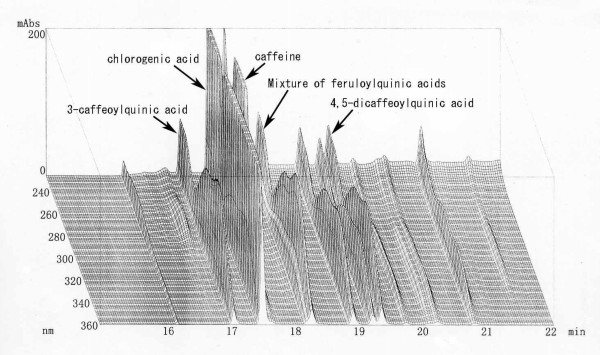
An epidemiological study conducted in Italy indicated that coffee has the greatest antioxidant capacity among the commonly consumed beverages. Green coffee bean is rich in chlorogenic acid and its related compounds. The effect of green coffee bean extract (GCBE) on fat accumulation and body weight in mice was assessed with the objective of investigating the effect of GCBE on mild obesity.
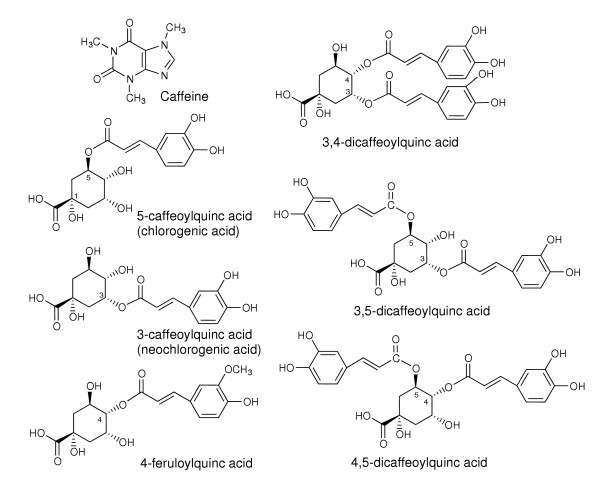
Male ddy mice were fed a standard diet containing GCBE and its principal constituents, namely, caffeine and chlorogenic acid, for 14 days. Further, hepatic triglyceride (TG) level was also investigated after consecutive administration (13 days) of GCBE and its constituents. To examine the effect of GCBE and its constituents on fat absorption, serum TG changes were evaluated in olive oil-loaded mice. In addition, to investigate the effect on hepatic TG metabolism, carnitine palmitoyltransferase (CPT) activity in mice was evaluated after consecutive ingestion (6 days) of GCBE and its constituents (caffeine, chlorogenic acid, neochlorogenic acid and feruloylquinic acid mixture).
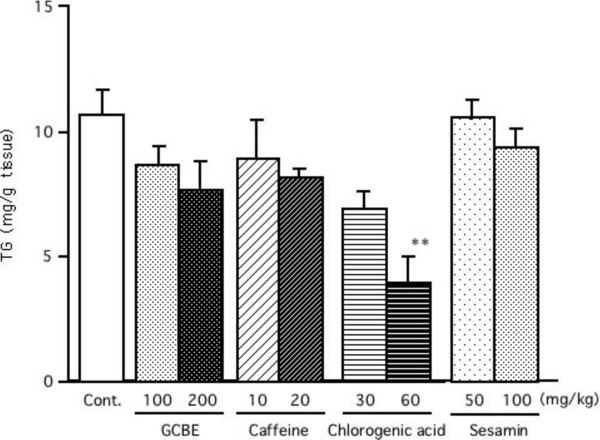
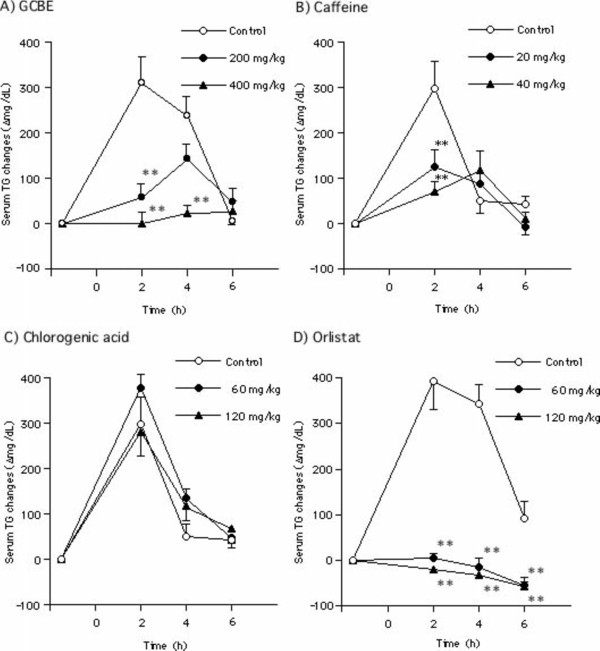
It was found that 0.5% and 1% GCBE reduced visceral fat content and body weight. Caffeine and chlorogenic acid showed a tendency to reduce visceral fat and body weight. Oral administration of GCBE (100 and 200 mg/kg. day) for 13 days showed a tendency to reduce hepatic TG in mice. In the same model, chlorogenic acid (60 mg/kg. day) reduced hepatic TG level. In mice loaded with olive oil (5 mL/kg), GCBE (200 and 400 mg/kg) and caffeine (20 and 40 mg/kg) reduced serum TG level. GCBE (1%), neochlorogenic acid (0.028% and 0.055%) and feruloylquinic acid mixture (0.081%) significantly enhanced hepatic CPT activity in mice. However, neither caffeine nor chlorogenic acid alone was found to enhance CPT activity.
These results suggest that GCBE is possibly effective against weight gain and fat accumulation by inhibition of fat absorption and activation of fat metabolism in the liver. Caffeine was found to be a suppressor of fat absorption, while chlorogenic acid was found to be partially involved in the suppressive effect of GCBE that resulted in the reduction of hepatic TG level. Phenolic compounds such as neochlorogenic acid and feruloylquinic acid mixture, except chlorogenic acid, can enhance hepatic CPT activity.
在意大利进行的一项流行病学研究表明,在常见的消费饮品中,咖啡具有最强的抗氧化能力。生咖啡豆富含绿原酸及其相关化合物。评估了生咖啡豆提取物(GCBE)对小鼠脂肪堆积和体重的影响,目的是研究GCBE对轻度肥胖的作用。
雄性ddy小鼠喂食含GCBE及其主要成分(即咖啡因和绿原酸)的标准饮食14天。此外,在连续给予GCBE及其成分13天后,还研究了肝脏甘油三酯(TG)水平。为了研究GCBE及其成分对脂肪吸收的影响,在橄榄油负荷小鼠中评估血清TG变化。另外,为了研究对肝脏TG代谢的影响,在连续摄入GCBE及其成分(咖啡因、绿原酸、新绿原酸和阿魏酰奎尼酸混合物)6天后,评估小鼠中的肉碱棕榈酰转移酶(CPT)活性。
发现0.5%和1%的GCBE降低了内脏脂肪含量和体重。咖啡因和绿原酸显示出降低内脏脂肪和体重的趋势。连续13天口服GCBE(100和200mg/kg·天)显示出降低小鼠肝脏TG的趋势。在同一模型中,绿原酸(60mg/kg·天)降低了肝脏TG水平。在橄榄油负荷(5mL/kg)的小鼠中,GCBE(200和400mg/kg)和咖啡因(20和40mg/kg)降低了血清TG水平。GCBE(1%)、新绿原酸(0.028%和0.055%)和阿魏酰奎尼酸混合物(0.081%)显著增强了小鼠肝脏CPT活性。然而,单独的咖啡因和绿原酸均未发现能增强CPT活性。
这些结果表明,GCBE可能通过抑制脂肪吸收和激活肝脏脂肪代谢来有效对抗体重增加和脂肪堆积。发现咖啡因是脂肪吸收的抑制剂,而绿原酸部分参与了GCBE导致肝脏TG水平降低的抑制作用。除绿原酸外,新绿原酸和阿魏酰奎尼酸混合物等酚类化合物可增强肝脏CPT活性。