Chakravarti Ritu, Adams Josephine C
Dept. of Cell Biology, Lerner Research Institute, Cleveland Clinic Foundation, Cleveland, OH 44195, USA.
BMC Genomics. 2006 Apr 18;7:83. doi: 10.1186/1471-2164-7-83.
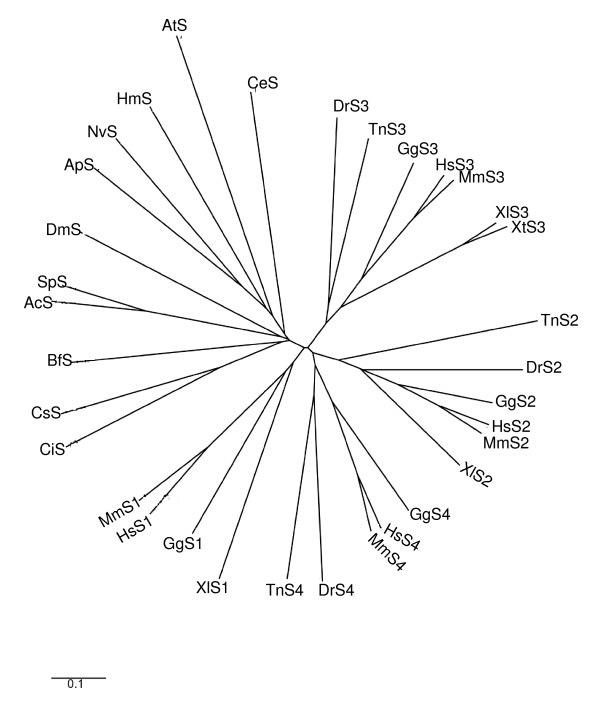
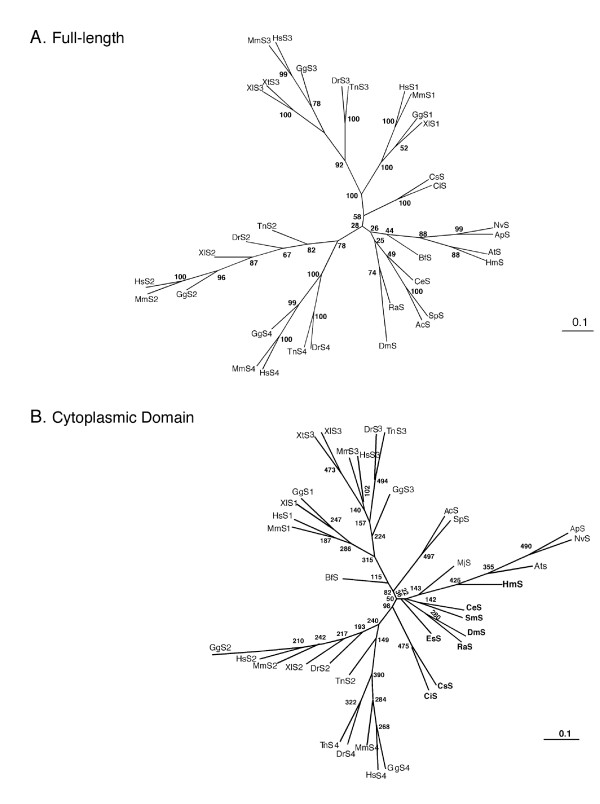
The syndecans are the major family of transmembrane proteoglycans in animals and are known for multiple roles in cell interactions and growth factor signalling during development, inflammatory response, wound-repair and tumorigenesis. Although syndecans have been cloned from several invertebrate and vertebrate species, the extent of conservation of the family across the animal kingdom is unknown and there are gaps in our knowledge of chordate syndecans. Here, we develop a new level of knowledge for the whole syndecan family, by combining molecular phylogeny of syndecan protein sequences with analysis of the genomic contexts of syndecan genes in multiple vertebrate organisms.
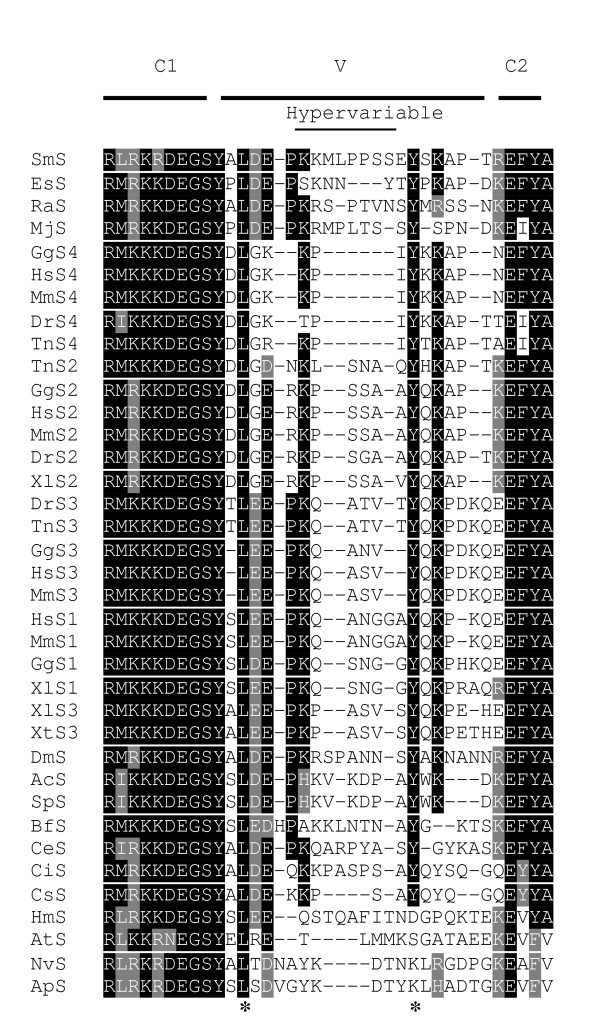
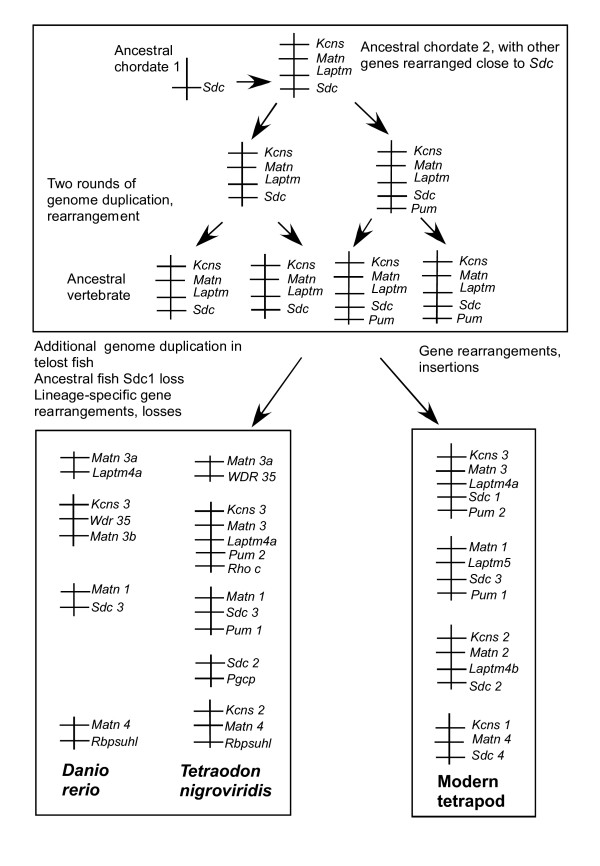
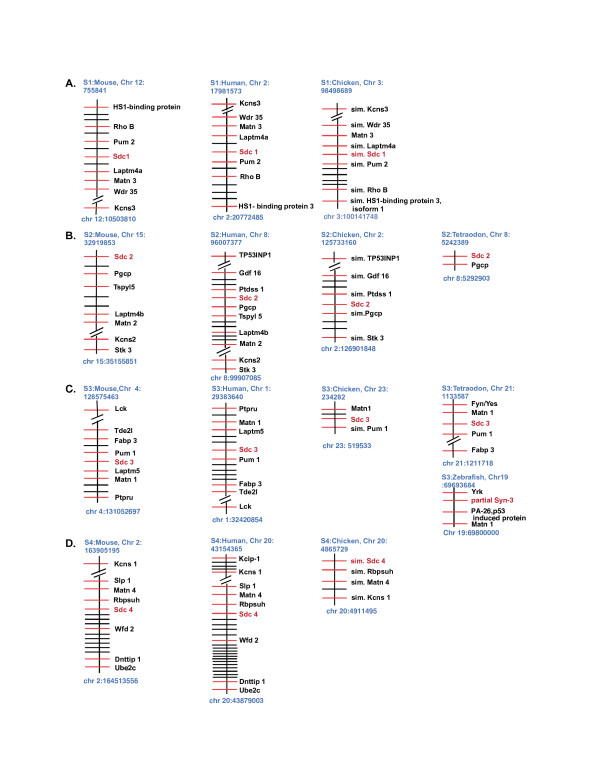
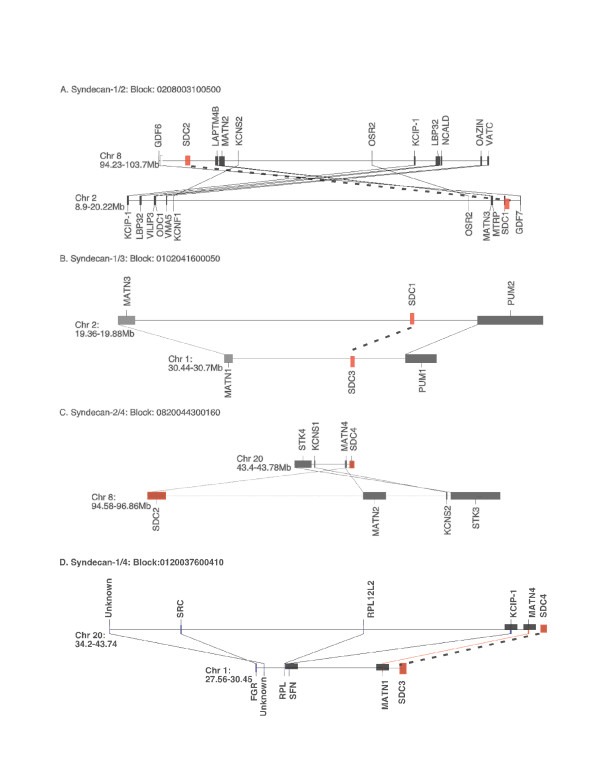
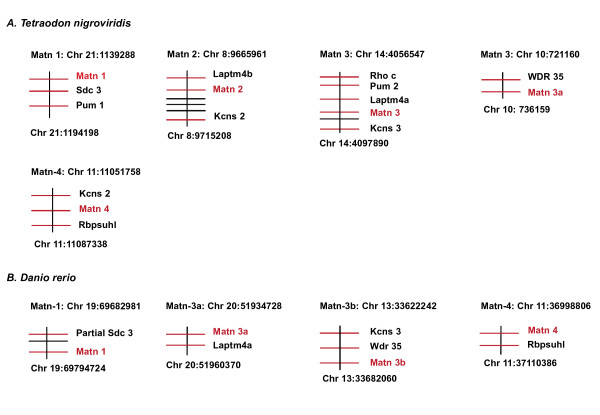
We identified syndecan-encoding sequences in representative Cnidaria and throughout the Bilateria. The C1 and C2 regions of the cytoplasmic domain are highly conserved throughout the animal kingdom. We identified in the variable region a universally-conserved leucine residue and a tyrosine residue that is conserved throughout the Bilateria. Of all the genomes examined, only tetrapod and fish genomes encode multiple syndecans. No syndecan-1 was identified in fish. The genomic context of each vertebrate syndecan gene is syntenic between human, mouse and chicken, and this conservation clearly extends to syndecan-2 and -3 in T. nigroviridis. In addition, tetrapod syndecans were found to be encoded from paralogous chromosomal regions that also contain the four members of the matrilin family. Whereas the matrilin-3 and syndecan-1 genes are adjacent in tetrapods, this chromosomal region appears to have undergone extensive lineage-specific rearrangements in fish.
Throughout the animal kingdom, syndecan extracellular domains have undergone rapid change and elements of the cytoplasmic domains have been very conserved. The four syndecan genes of vertebrates are syntenic across tetrapods, and synteny of the syndecan-2 and -3 genes is apparent between tetrapods and fish. In vertebrates, each of the four family members are encoded from paralogous genomic regions in which members of the matrilin family are also syntenic between tetrapods and fish. This genomic organization appears to have been set up after the divergence of urochordates (Ciona) and vertebrates. The syndecan-1 gene appears to have been lost relatively early in the fish lineage. These conclusions provide the basis for a new model of syndecan evolution in vertebrates and a new perspective for analyzing the roles of syndecans in cells and whole organisms.
Syndecans是动物体内跨膜蛋白聚糖的主要家族,在发育、炎症反应、伤口修复和肿瘤发生过程中的细胞相互作用和生长因子信号传导中发挥多种作用。尽管已从几种无脊椎动物和脊椎动物物种中克隆出Syndecans,但该家族在整个动物界的保守程度尚不清楚,我们对脊索动物Syndecans的了解也存在空白。在这里,我们通过将Syndecan蛋白序列的分子系统发育与多种脊椎动物基因组中Syndecan基因的基因组背景分析相结合,为整个Syndecan家族建立了新的认识水平。
我们在代表性的刺胞动物和整个两侧对称动物中鉴定出了编码Syndecan的序列。细胞质结构域的C1和C2区域在整个动物界高度保守。我们在可变区域中鉴定出一个普遍保守的亮氨酸残基和一个在整个两侧对称动物中都保守的酪氨酸残基。在所有检测的基因组中,只有四足动物和鱼类基因组编码多种Syndecans。在鱼类中未鉴定出Syndecan-1。每个脊椎动物Syndecan基因的基因组背景在人类、小鼠和鸡之间是同线的,这种保守性显然也延伸到了黑青斑河鲀的Syndecan-2和-3。此外,发现四足动物的Syndecans是由同源染色体区域编码的,这些区域也包含matrilin家族的四个成员。虽然在四足动物中matrilin-3和Syndecan-1基因相邻,但在鱼类中这个染色体区域似乎经历了广泛的谱系特异性重排。
在整个动物界,Syndecan的细胞外结构域经历了快速变化,而细胞质结构域的元件则非常保守。脊椎动物的四个Syndecan基因在四足动物中是同线的,并且Syndecan-2和-3基因在四足动物和鱼类之间的同线性很明显。在脊椎动物中,四个家族成员中的每一个都是由同源基因组区域编码的,其中matrilin家族的成员在四足动物和鱼类之间也是同线的。这种基因组组织似乎是在尾索动物(海鞘)和脊椎动物分化之后建立的。Syndecan-1基因似乎在鱼类谱系中相对较早地丢失了。这些结论为脊椎动物Syndecan进化的新模型提供了基础,并为分析Syndecans在细胞和整个生物体中的作用提供了新的视角。