Nyarango Peter M, Gebremeskel Tewolde, Mebrahtu Goitom, Mufunda Jacob, Abdulmumini Usman, Ogbamariam Andom, Kosia Andrew, Gebremichael Andemariam, Gunawardena Disanayike, Ghebrat Yohannes, Okbaldet Yahannes
Orotta School of Medicine, P,O, Box 10549, Asmara, Eritrea.
Malar J. 2006 Apr 24;5:33. doi: 10.1186/1475-2875-5-33.
Malaria is a huge public health problem in Africa that is responsible for more than one million deaths annually. In line with the Roll Back Malaria initiative and the Abuja Declaration, Eritrea and other African countries have intensified their fight against malaria. This study examines the impact of Eritrea's Roll Back Malaria Programme: 2000-2004 and the effects and possible interactions between the public health interventions in use.
This study employed cross-sectional survey to collect data from households, community and health facilities on coverage and usage of Insecticide-Treated Nets (ITNs), Indoor Residual Spraying (IRS), larvicidal activities and malaria case management. Comparative data was obtained from a similar survey carried out in 2001. Data from the Health Management Information System (HMIS) and reports of the annual assessments by the National Malaria Control Programme was used to assess impact. Time series model (ARIMA) was used to assess association.
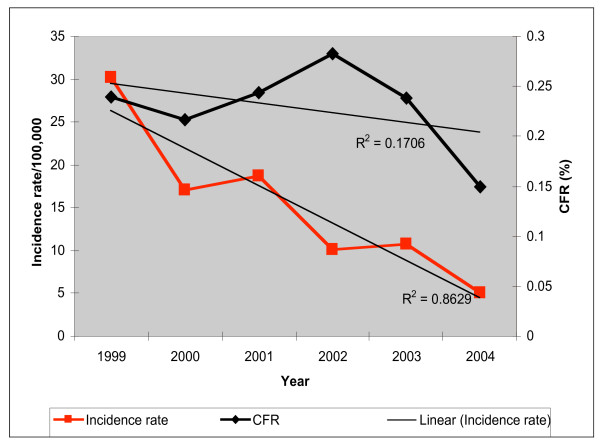
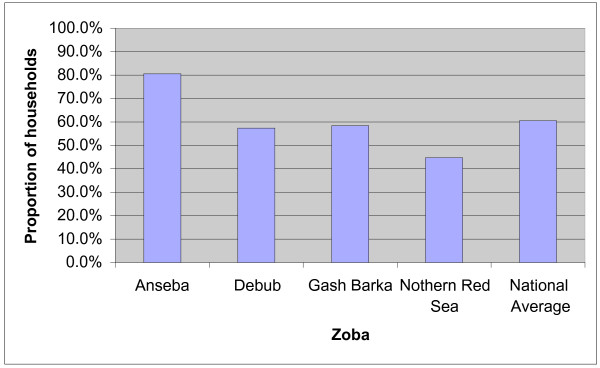
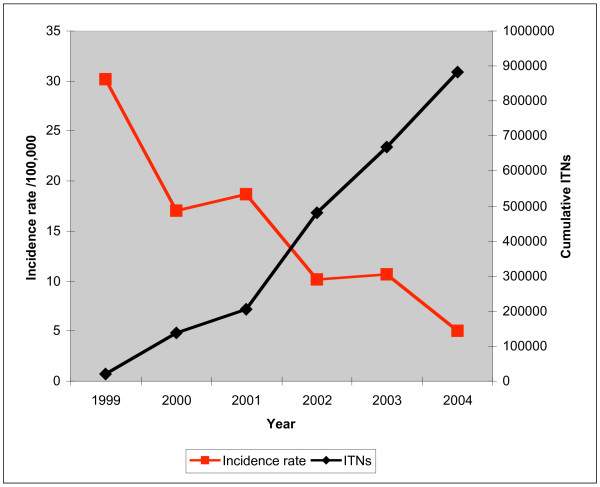
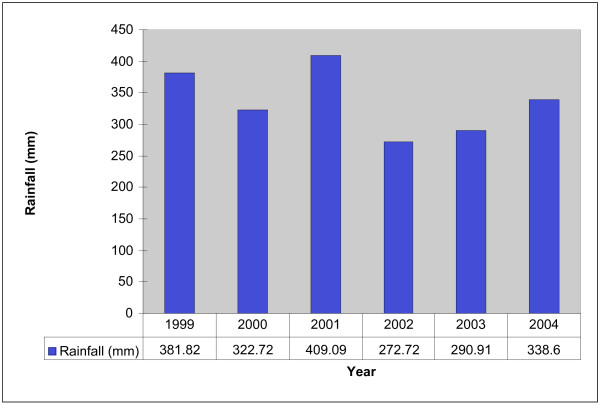
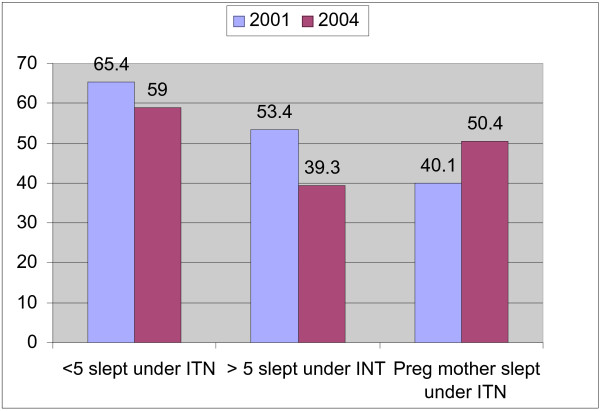
In the period 2000-2004, approximately 874,000 ITNs were distributed and 13,109 health workers and community health agents were trained on malaria case management. In 2004, approximately 81% households owned at least one net, of which 73% were ITNs and 58.6% of children 0-5 years slept under a net. The proportion of malaria cases managed by community health agents rose from 50% in 1999 to 78% in 2004. IRS coverage increased with the combined amount of DDT and Malathion used rising from 6,444 kg, in 2000 to 43,491 kg, in 2004, increasing the population protected from 117,017 to 259,420. Drug resistance necessitated regimen change to chloroquine plus sulfadoxine-pyrimethamine. During the period, there was a steep decline in malaria morbidity and case fatality by 84% and 40% respectively. Malaria morbidity was strongly correlated to the numbers of ITNs distributed (beta = -0.125, p < 0.005) and the amount (kg) of DDT and Malathion used for IRS (beta = -2.352, p < 0.05). The correlation between malaria case fatality and ITNs, IRS, population protected and annual rainfall was not statistically significant.
Eritrea has within 5 years attained key Roll Back Malaria targets. ITNs and IRS contributed most to reducing malaria morbidity.
疟疾是非洲一个严重的公共卫生问题,每年导致超过100万人死亡。根据“击退疟疾”倡议和《阿布贾宣言》,厄立特里亚和其他非洲国家加强了对疟疾的防治工作。本研究考察了厄立特里亚2000 - 2004年“击退疟疾”计划的影响,以及所采用的公共卫生干预措施之间的效果及可能的相互作用。
本研究采用横断面调查,从家庭、社区和卫生机构收集关于经杀虫剂处理蚊帐(ITNs)的覆盖情况和使用情况、室内滞留喷洒(IRS)、杀幼虫活动以及疟疾病例管理的数据。对比数据来自2001年进行的一项类似调查。利用卫生管理信息系统(HMIS)的数据以及国家疟疾控制计划年度评估报告来评估影响。采用时间序列模型(ARIMA)评估关联性。
在2000 - 2004年期间,大约分发了87.4万顶经杀虫剂处理蚊帐,13109名卫生工作者和社区卫生工作者接受了疟疾病例管理培训。2004年,约81%的家庭至少拥有一顶蚊帐,其中73%是经杀虫剂处理蚊帐,58.6%的0至5岁儿童睡在蚊帐下。社区卫生工作者管理的疟疾病例比例从1999年的50%升至2004年的78%。室内滞留喷洒的覆盖范围随着滴滴涕和马拉硫磷使用总量的增加而扩大,从2000年的6444千克增至2004年的四万三千四百九十一千克,受保护人口从117017人增至259420人。由于耐药性问题,治疗方案改为氯喹加磺胺多辛 - 乙胺嘧啶。在此期间,疟疾发病率和病死率急剧下降,分别下降了84%和40%。疟疾发病率与分发的经杀虫剂处理蚊帐数量(β = -0.125,p < 0.005)以及用于室内滞留喷洒的滴滴涕和马拉硫磷数量(千克)(β = -2.352,p < 0.05)密切相关。疟疾病死率与经杀虫剂处理蚊帐、室内滞留喷洒、受保护人口和年降雨量之间的相关性无统计学意义。
厄立特里亚在5年内实现了“击退疟疾”的关键目标。经杀虫剂处理蚊帐和室内滞留喷洒对降低疟疾发病率贡献最大。