Tugwell P, Sitthi-Amorn C, Hatcher-Roberts J, Neufeld V, Makara P, Munoz F, Czerny P, Robinson V, Nuyens Y, Okello D
Centre for Global Health, Institute for Population Health, University of Ottawa, Ottawa, Canada.
BMC Public Health. 2006 Jun 12;6:151. doi: 10.1186/1471-2458-6-151.
The Commission on Health Research for Development concluded that "for the most vulnerable people, the benefits of research offer a potential for change that has gone largely untapped." This project was designed to assess low and middle income country capacity and commitment for equity-oriented research.
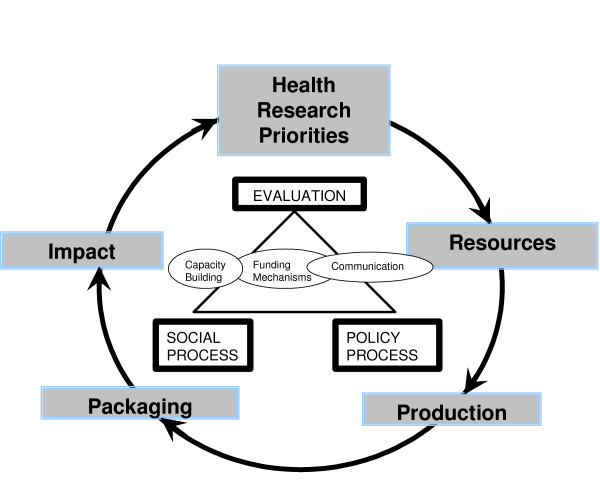
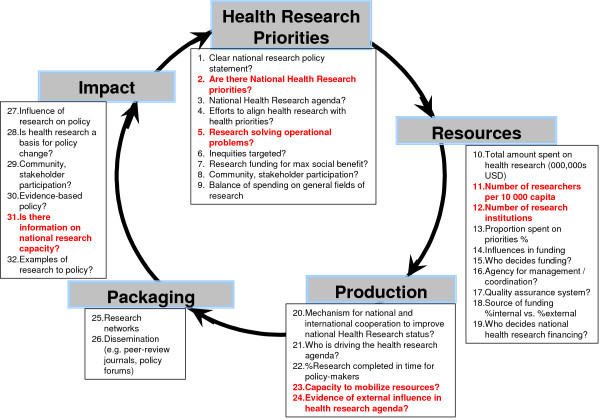
A multi-disciplinary team with coordinators from each of four regions (Asia, Latin America, Africa and Central and Eastern Europe) developed a questionnaire through consensus meetings using a mini-Delphi technique. Indicators were selected based on their quality, validity, comprehensiveness, feasibility and relevance to equity. Indicators represented five categories that form the Health Research Profile (HRP): 1) Research priorities; 2) Resources (amount spent on research); 3) Production of knowledge (capacity); 4) Packaging of knowledge and 5) Evidence of research impact on policy and equity. We surveyed three countries from each region.
Most countries reported explicit national health research priorities. Of these, half included specific research priorities to address inequities in health. Data on financing were lacking for most countries due to inadequate centralized collection of this information. The five main components of HRP showed a gradient where countries scoring lower on the Human Development Index (HDI) had a lower capacity to conduct research to meet local health research needs. Packaging such as peer-reviewed journals and policy forums were reported by two thirds of the countries. Seven out of 12 countries demonstrated impact of health research on policies and reported engagement of stakeholders in this process.
Only one out of 12 countries indicated there was research on all fronts of the equity debate. Knowledge sharing and management is needed to strengthen within-country capacity for research and implementation to reduce inequities in health. We recommend that all countries (and external agencies) should invest more in building a certain minimum level of national capacity for equity-oriented research.
健康研究促进发展委员会得出结论称,“对于最脆弱人群而言,研究带来的益处蕴含着变革潜力,但这一潜力在很大程度上尚未得到挖掘。”本项目旨在评估低收入和中等收入国家开展注重公平性研究的能力与投入。
一个多学科团队,其中来自四个地区(亚洲、拉丁美洲、非洲以及中东欧)的协调员通过使用小型德尔菲技术的共识会议制定了一份调查问卷。指标的选取基于其质量、有效性、全面性、可行性以及与公平性的相关性。指标涵盖构成健康研究概况(HRP)的五个类别:1)研究重点;2)资源(研究支出金额);3)知识产出(能力);4)知识传播;5)研究对政策和公平性影响的证据。我们对每个地区的三个国家进行了调查。
大多数国家报告了明确的国家卫生研究重点。其中,有一半国家纳入了针对解决健康不平等问题的特定研究重点。由于此类信息缺乏集中收集,大多数国家缺乏资金方面的数据。健康研究概况的五个主要组成部分呈现出一种梯度,即人类发展指数(HDI)得分较低的国家开展满足当地卫生研究需求的研究的能力也较低。三分之二的国家报告了诸如同行评审期刊和政策论坛等知识传播方式。12个国家中有7个展示了卫生研究对政策的影响,并报告了利益相关者在此过程中的参与情况。
12个国家中只有1个表示在公平性辩论的各个方面都有研究。需要进行知识共享和管理,以加强国内的研究和实施能力,从而减少健康方面的不平等。我们建议所有国家(以及外部机构)应加大投资,建立一定的国家公平性导向研究的最低能力水平。