Lee Jeong Min, Han Joon Koo, Lee Jae Young, Kim Se Hyung, Choi Jin Young, Lee Min Woo, Choi Seung Hong, Eo Hong, Choi Byung Ihn
Department of Radiology, and Institute of Radiation Medicine, Seoul National University College of Medicine, Clinical Research Institute, Seoul National University Hospital, Seoul, Korea.
Korean J Radiol. 2006 Apr-Jun;7(2):106-17. doi: 10.3348/kjr.2006.7.2.106.
We wanted to compare the efficiency of multipolar radiofrequency ablation (RFA) using three perfused-cooled electrodes with multiple overlapping and simultaneous monopolar techniques for creating an ablation zone in ex vivo bovine livers and in in vivo porcine livers.
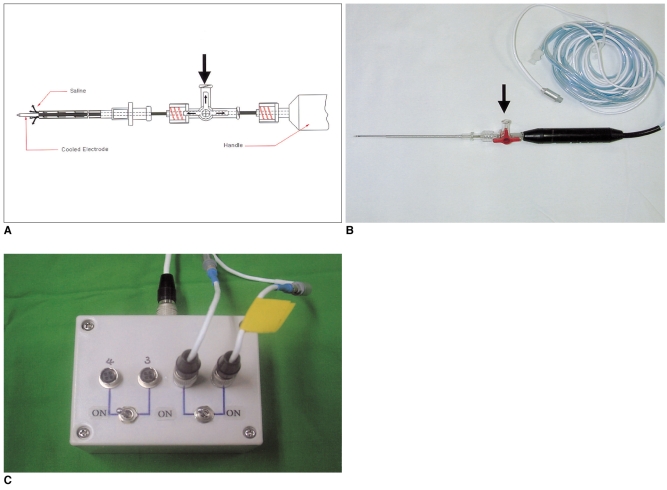
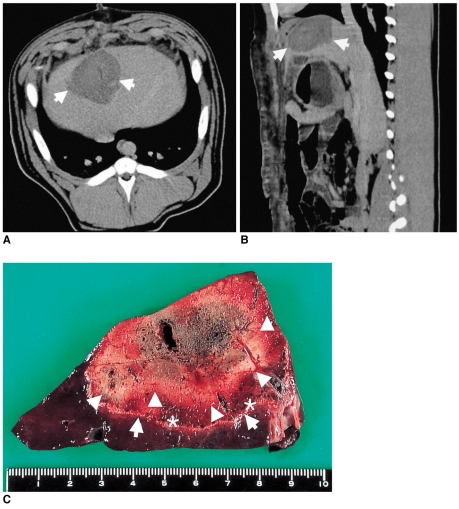
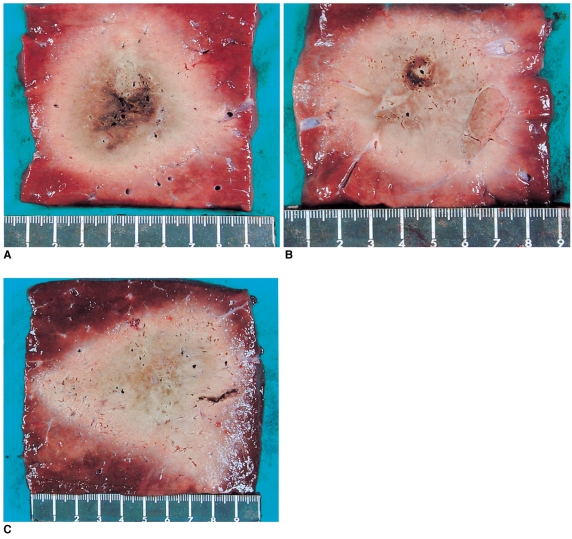
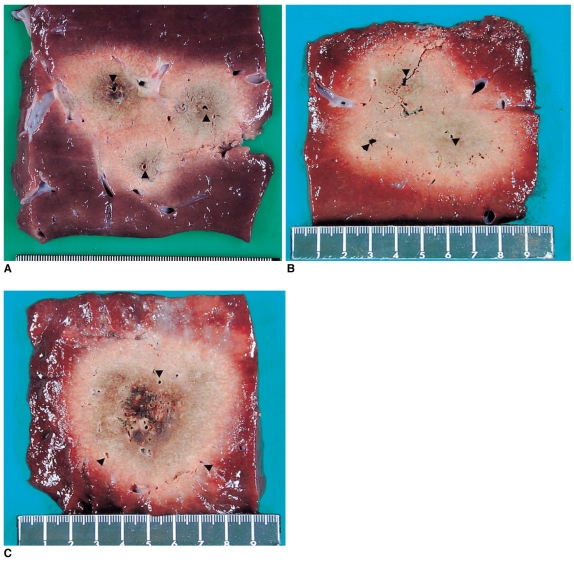
In the ex vivo experiments, we used a 200 W generator (Valleylab, CC-3 model) and three perfused-cooled electrodes or internally cooled electrodes to create 30 coagulation zones by performing consecutive monopolar RFA (group A, n = 10), simultaneous monopolar RFA (group B, n = 10) or multipolar RFA (group C, n = 10) in explanted bovine livers. In the consecutive mode, three ablation spheres were created by sequentially applying 150 watts radiofrequency (RF) energy to the internally cooled electrodes for 12 minutes each for a total of 36 minutes. In the simultaneous monopolar and multipolar modes, RF energy was concurrently applied to the three perfused-cooled electrodes for 20 minutes at 150 watt with instillation of 6% hypertonic saline at 2 mL/min. During RFA, we measured the temperatures of the treated area at its center. The changes in impedance, the current and liver temperature during RFA, as well as the dimensions of the thermal ablation zones, were compared among the three groups. In the in vivo experiments, three coagulations were created by performing multipolar RFA in a pig via laparotomy with using same parameter as the ex vivo study.
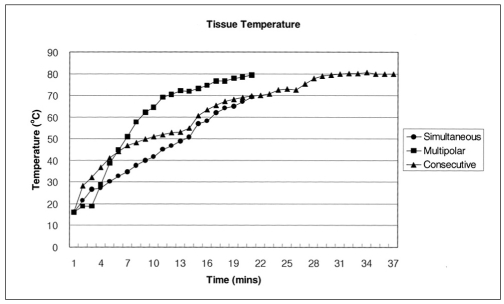
In the ex vivo experiments, the impedance was gradually decreased during the RFA in groups B and C, but in group A, the impedance was increased during RFA and this induced activation by the pulsed RF technique. In groups A, B and C, the mean final-temperature values were 80+/-10 degrees C, 69+/-18 degrees C and 79+/-12 degrees C, respectively (p < 0.05). The multipolar mode created a larger volume of ablation than did the other modes: 37.6+/-4.0 cm3 (group A); 44.9+/-12.7 cm3 (group B); and 78.9+/-6.9 cm3 (group C) (p < 0.05). In the in vivo experiment, the pig well tolerated the RFA procedure and no major complications occurred during the 4 days of the follow-up period. The mean volume of coagulations produced by multipolar RFA in the pig liver was 60.5+/-17.9 cm3.
For the multiple probe RFA, the multipolar mode with hypertonic saline instillation was more efficient in generating larger areas of thermal ablation than either the consecutive or simultaneous monopolar modes.
我们想要比较使用三个灌注冷却电极的多极射频消融(RFA)与多个重叠且同时进行的单极技术在离体牛肝和活体猪肝中创建消融区的效率。
在离体实验中,我们使用一台200W发生器(Valleylab,CC - 3型号)和三个灌注冷却电极或内部冷却电极,通过在离体牛肝中进行连续单极RFA(A组,n = 10)、同时单极RFA(B组,n = 10)或多极RFA(C组,n = 10)来创建30个凝固区。在连续模式下,通过依次向内部冷却电极施加150瓦射频(RF)能量,每次12分钟,共36分钟,创建三个消融球。在同时单极和多极模式下,以150瓦的功率同时向三个灌注冷却电极施加RF能量20分钟,并以2mL/min的速度滴注6%高渗盐水。在RFA过程中,我们测量治疗区域中心的温度。比较三组在RFA期间的阻抗、电流和肝脏温度变化,以及热消融区的尺寸。在体内实验中,通过剖腹术在猪身上使用与离体研究相同的参数进行多极RFA创建三个凝固区。
在离体实验中,B组和C组在RFA期间阻抗逐渐降低,但A组在RFA期间阻抗增加,这通过脉冲RF技术诱导激活。在A组、B组和C组中,平均最终温度值分别为80±10℃、69±18℃和79±12℃(p < 0.05)。多极模式创建的消融体积比其他模式更大:37.6±4.0cm³(A组);44.9±12.7cm³(B组);和78.9±6.9cm³(C组)(p < 0.05)。在体内实验中,猪对RFA手术耐受性良好,在随访的4天期间未发生重大并发症。猪肝脏中多极RFA产生的凝固平均体积为60.5±17.9cm³。
对于多探头RFA,与连续或同时单极模式相比,滴注高渗盐水的多极模式在产生更大面积的热消融方面更有效。