Misra Madhusmita, Tsai Patrika, Anderson Ellen J, Hubbard Jane L, Gallagher Katie, Soyka Leslie A, Miller Karen K, Herzog David B, Klibanski Anne
Neuroendocrine Unit, Massachusetts General Hospital and Harvard Medical School, Boston, MA 02114, USA.
Am J Clin Nutr. 2006 Oct;84(4):698-706. doi: 10.1093/ajcn/84.4.698.
Adolescence is a common time for the onset of anorexia nervosa (AN), a condition associated with long-term medical and hormonal consequences.
The objective was to compare the nutrient intakes of community-dwelling girls with AN with those of healthy adolescents and to describe the associations between specific nutrient intakes and nutritionally dependent hormones.
Nutrient intakes in 39 community-dwelling girls with AN and 39 healthy adolescents aged 12.1-18.7 y were determined by using 4-d food records. Fasting adiponectin, leptin, ghrelin, insulin, and insulin-like growth factor I (IGF-I) concentrations were measured. Indirect calorimetry was used to assess respiratory quotient and resting energy expenditure.
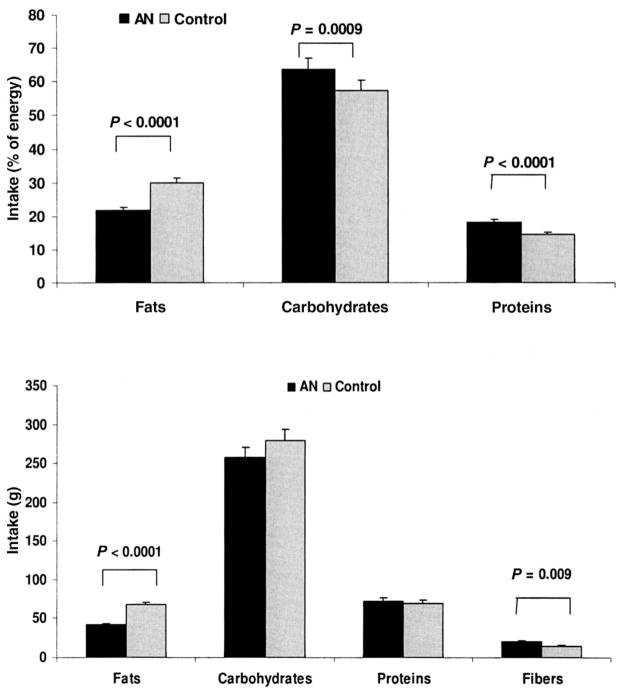
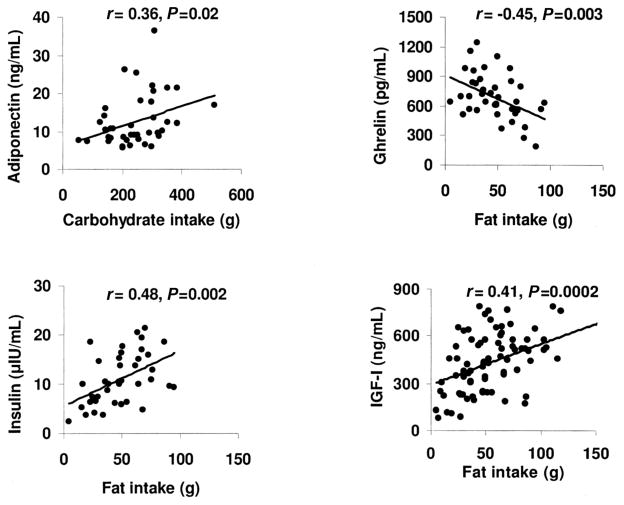
In contrast with the control group, the AN group consumed fewer calories from fats (P < 0.0001) and more from carbohydrates (P = 0.0009) and proteins (P < 0.0001). Intake of individual fat components was lower and of dietary fiber higher in the AN group. No significant between-group differences were observed in dietary intakes of calcium, zinc, and iron; however, total intake was greater in the AN group because of greater supplement use (P = 0.006, 0.02, and 0.01, respectively). The AN group had greater intakes of vitamins A, D, and K and of most of the B vitamins, and significantly more girls with AN met the Dietary Reference Intake for calcium (P = 0.01) and vitamin D (P = 0.02) from supplement use. Fat intake predicted ghrelin, insulin, and IGF-I concentrations; carbohydrate intake predicted adiponectin. Resting energy expenditure was lower (P < 0.0001) and leisure activity levels higher in the AN group.
Despite outpatient follow-up, community-dwelling girls with AN continue to have lower fat and higher fiber intakes than do healthy adolescents, which results in lower calorie intakes. Nutritionally related hormones are associated with specific nutrient intakes.
青春期是神经性厌食症(AN)发病的常见时期,这种疾病会带来长期的医学和激素方面的后果。
目的是比较社区居住的患有AN的女孩与健康青少年的营养摄入量,并描述特定营养摄入量与营养依赖性激素之间的关联。
通过4天的食物记录确定39名社区居住的患有AN的女孩和39名年龄在12.1 - 18.7岁的健康青少年的营养摄入量。测量空腹脂联素、瘦素、胃饥饿素、胰岛素和胰岛素样生长因子I(IGF - I)的浓度。采用间接测热法评估呼吸商和静息能量消耗。
与对照组相比,AN组从脂肪中摄入的热量较少(P < 0.0001),从碳水化合物(P = 0.0009)和蛋白质(P < 0.0001)中摄入的热量较多。AN组个体脂肪成分的摄入量较低,膳食纤维摄入量较高。在钙、锌和铁的膳食摄入量方面未观察到显著的组间差异;然而,由于补充剂使用较多,AN组的总摄入量更高(分别为P = 0.006、0.02和0.01)。AN组维生素A、D和K以及大多数B族维生素的摄入量更高,并且通过补充剂使用,更多患有AN的女孩达到了钙(P = 0.01)和维生素D(P = 0.02)的膳食参考摄入量。脂肪摄入量可预测胃饥饿素、胰岛素和IGF - I的浓度;碳水化合物摄入量可预测脂联素。AN组的静息能量消耗较低(P < 0.0001),休闲活动水平较高。
尽管进行了门诊随访,但社区居住的患有AN的女孩的脂肪摄入量仍然低于健康青少年,膳食纤维摄入量高于健康青少年,这导致热量摄入量较低。营养相关激素与特定营养摄入量有关。