Friedrich Claudia K, Eulitz Carsten, Lahiri Aditi
Department of Linguistics, University of Konstanz, Germany.
Behav Brain Funct. 2006 Oct 24;2:36. doi: 10.1186/1744-9081-2-36.
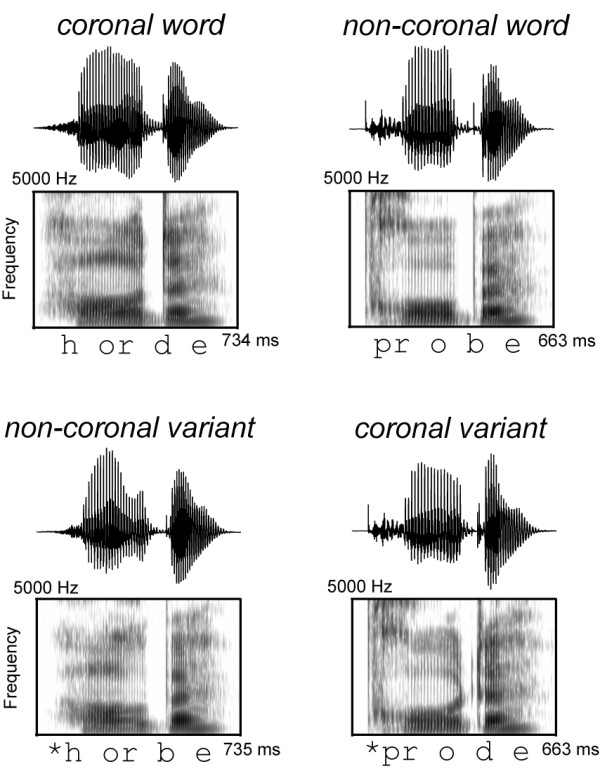
If all available acoustic phonetic information of words is used during lexical access and consequently stored in the mental lexicon, then all pseudowords that deviate in a single acoustic feature from a word should hamper word recognition. By contrast, models assuming underspecification of redundant phonological information in the mental lexicon predict a differential disruption of word recognition dependent on the phonological structure of the pseudoword. Using neurophysiological measures, the present study tested the predicted asymmetric disruption by assuming that coronal place of articulation for consonants is redundant.
Event-related potentials (ERPs) were recorded during a lexical decision task. The focus of interest was on word medial consonants. The crucial pseudowords were created by replacing the place of articulation of the medial consonant in German disyllabic words. We analyzed the differential temporal characteristics of the N400 pseudoword effect.
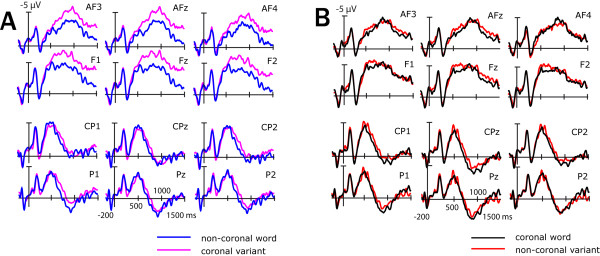
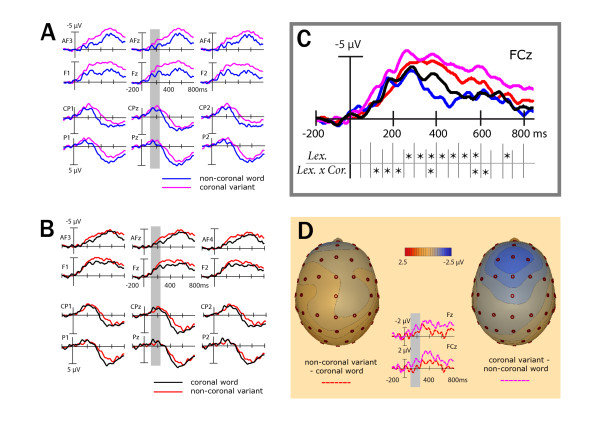
N400 amplitudes for pseudowords were enhanced compared to words. As the uniqueness and deviation points differ for coronal and non-coronal items, the ERPs had to be correspondingly adjusted. The adjusted ERPs revealed that the N400 pseudoword effect starts earlier for coronal than for non-coronal pseudoword variants. Thus, non-coronal variants are accepted as words longer than the coronal variants.
Our results indicate that lexical representations of words containing medial coronal consonants are initially activated by their corresponding non-coronal pseudowords. The most plausible explanation for the asymmetric neuronal processing of coronal and non-coronal pseudoword variants is an underspecified coronal place of articulation in the mental lexicon.
如果在词汇提取过程中使用了单词所有可用的声学语音信息,并因此存储在心理词库中,那么所有在单一声学特征上与单词不同的伪词都应该会妨碍单词识别。相比之下,假设心理词库中冗余语音信息未完全指定的模型预测,单词识别的差异破坏取决于伪词的语音结构。本研究采用神经生理学测量方法,通过假设辅音的冠状发音部位是冗余的,来测试预测的不对称破坏。
在词汇判断任务中记录事件相关电位(ERP)。关注的焦点是单词中间的辅音。关键伪词是通过替换德语双音节词中间辅音的发音部位而创建的。我们分析了N400伪词效应的不同时间特征。
与单词相比,伪词的N400波幅增强。由于冠状和非冠状项目的唯一性和偏差点不同,ERP必须相应调整。调整后的ERP显示,冠状伪词的N400伪词效应比非冠状伪词变体开始得更早。因此,非冠状变体被接受为单词的时间比冠状变体更长。
我们的结果表明,包含中间冠状辅音的单词的词汇表征最初会被其相应的非冠状伪词激活。对冠状和非冠状伪词变体不对称神经元处理的最合理解释是心理词库中冠状发音部位未完全指定。