Kaleli Ilknur, Demir Melek, Cevahir Nural, Yilmaz Mustafa, Demir Suleyman
Department of Microbiology, Pamukkale University Medical Faculty, Denizli, Turkey.
BMC Infect Dis. 2006 Oct 31;6:157. doi: 10.1186/1471-2334-6-157.
Infection by hepatitis B virus (HBV) causes complicated biochemical, immunological and histological changes in host immune response against the virus which can be specific or non-specific. Recent attention has focused on neopterin as a marker for the activation of cell mediated immunity. The aim of this study was to define the pattern of neopterin levels in replicative and nonreplicative HBV carriers.
Thirty HBV replicative carriers and 25 nonreplicative HBV carriers and 30 healthy adult patients were included this study. Hepatitis markers were determined by commercial kit based on chemilumminesans assay. HBV DNA was quantified by hybrid capture system. Serum neopterin levels were measured by the method of competitive enzyme-linked immunosorbent assay. Results were expressed as mean +/- SD and ranges.
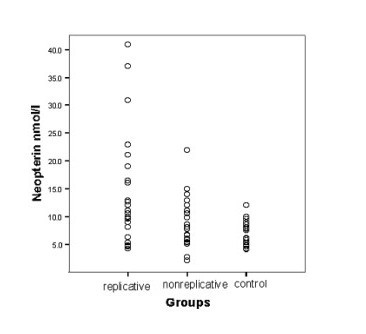
In the nonreplicative group, except for one patient, all the patients' HBeAg were negative and anti-HBe were positive. That particular patient was HBeAg positive and anti-HBe negative. In the replicative group, 23 out of 30 patients have positive HBeAg and negative anti-HBe; 7 out of 30 patients have negative HBeAg and positive anti-HBe. Serum neopterin concentrations were 14.5 +/- 10.0 (4.2-41) nmol/L in replicative HBV carriers, 8.9 +/- 4.3 (2.1-22) nmol/L in nonreplicative HBV carriers and 7.1 +/- 2.2 (4.0-12) nmol/L in the control group. Serum neopterin levels and the rates of abnormal serum neopterin levels in the replicative group were higher than the control group (P < 0.01 and P < 0.05). In the nonreplicative group, serum neopterin levels were not different from those of the control. There was a difference between replicative and nonreplicative groups in the respect of neopterin levels.
In the hepatitis B infected carriers, elevated neopterin levels may be an indicator of the presence of replication.
乙型肝炎病毒(HBV)感染会在宿主针对该病毒的免疫反应中引发复杂的生化、免疫和组织学变化,这些变化可能是特异性的,也可能是非特异性的。最近,新蝶呤作为细胞介导免疫激活的标志物受到了关注。本研究的目的是确定复制型和非复制型HBV携带者中新蝶呤水平的模式。
本研究纳入了30例HBV复制型携带者、25例非复制型HBV携带者和30例健康成年患者。采用基于化学发光分析的商业试剂盒测定肝炎标志物。通过杂交捕获系统对HBV DNA进行定量。采用竞争性酶联免疫吸附测定法测量血清新蝶呤水平。结果以平均值±标准差和范围表示。
在非复制型组中,除1例患者外,所有患者的HBeAg均为阴性,抗-HBe为阳性。该特殊患者HBeAg阳性,抗-HBe阴性。在复制型组中,30例患者中有23例HBeAg阳性,抗-HBe阴性;30例患者中有7例HBeAg阴性,抗-HBe阳性。复制型HBV携带者的血清新蝶呤浓度为14.5±10.0(4.2 - 41)nmol/L,非复制型HBV携带者为8.9±4.3(2.1 - 22)nmol/L,对照组为7.1±2.2(4.0 - 12)nmol/L。复制型组的血清新蝶呤水平及血清新蝶呤水平异常率均高于对照组(P < 0.01和P < 0.05)。在非复制型组中,血清新蝶呤水平与对照组无差异。复制型组和非复制型组在新蝶呤水平方面存在差异。
在乙型肝炎感染携带者中,新蝶呤水平升高可能是病毒复制存在的一个指标。