Henker Jobst, Laass Martin, Blokhin Boris M, Bolbot Yuriy K, Maydannik Vitaliy G, Elze Martina, Wolff Corinna, Schulze Jürgen
Department of Paediatrics, University Hospital Carl-Gustav-Carus, Fetscherstrasse 74, 01307, Dresden, Germany.
Eur J Pediatr. 2007 Apr;166(4):311-8. doi: 10.1007/s00431-007-0419-x. Epub 2007 Feb 8.
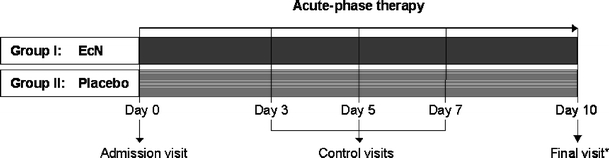
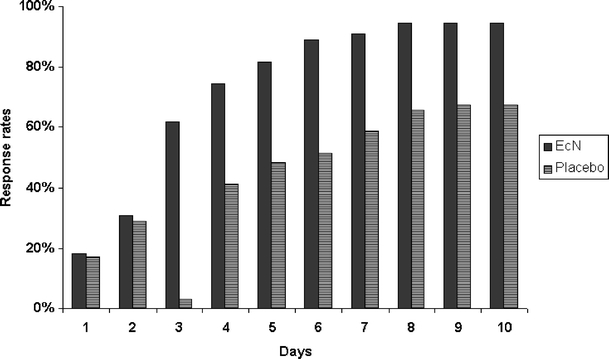
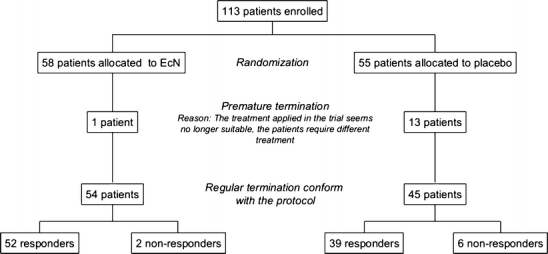
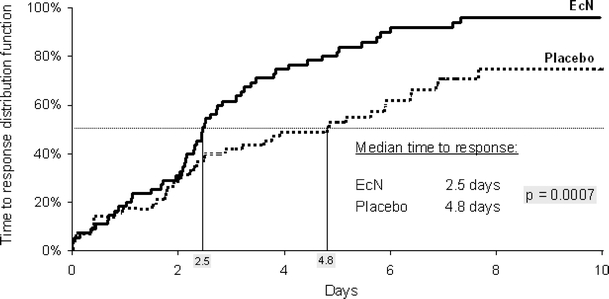
In most cases, acute diarrhoea will become self-limiting during the first few days after onset. For young children, however, health risks may develop when the disease lasts longer than 3 days. The purpose of the present trial was to determine whether the stool frequency of infants and toddlers suffering from acute diarrhoea could be normalised more quickly by administering the probiotic Escherichia coli Nissle 1917 (EcN) solution than by administering a placebo. The safety of EcN were also assessed. A total of 113 children (aged 2-47 months) with acute diarrhoea (> three watery or loose stools in 24 h) were randomised to either a group receiving the probiotic EcN suspension (n = 55) or a group receiving the placebo suspension (n = 58) in a confirmative, double-blind clinical trial. Depending on the age of patients, 1-3 ml per day of verum suspension (10(8) viable EcN cells per millilitre) or placebo were administered orally. The causes of the diarrhoea were viral rather than bacterial, but they were mainly unspecific infections. The median onset of treatment response (reduction of daily stool frequency to </= three watery or loose stools over at least 2 consecutive days) occurred more rapidly in the children receiving the EcN solution (2.5 days) than in those receiving the placebo (4.8 days), a significant difference (2.3 days; p = 0.0007). The number of patients showing a response was clearly higher (p < 0.0001) in the EcN group (52/55; 94.5%) than in the placebo group (39/58; 67.2%). EcN was found to be safe and well-tolerated, and it showed a significant superiority compared to the placebo in the treatment of acute diarrhoea in infants and toddlers.
在大多数情况下,急性腹泻在发病后的头几天会自行缓解。然而,对于幼儿来说,如果疾病持续超过3天,可能会出现健康风险。本试验的目的是确定,与服用安慰剂相比,给患有急性腹泻的婴幼儿服用益生菌大肠杆菌Nissle 1917(EcN)溶液是否能更快地使大便频率恢复正常。同时还评估了EcN的安全性。在一项确证性双盲临床试验中,共有113名患有急性腹泻(24小时内有超过三次水样便或稀便)的儿童(年龄在2 - 47个月)被随机分为两组,一组接受益生菌EcN悬浮液(n = 55),另一组接受安慰剂悬浮液(n = 58)。根据患者年龄,每天口服1 - 3毫升的试验组悬浮液(每毫升含10⁸个活的EcN细胞)或安慰剂。腹泻的原因是病毒性而非细菌性的,但主要是非特异性感染。接受EcN溶液的儿童(2.5天)出现治疗反应(连续至少2天每日大便频率降至≤三次水样便或稀便)的中位时间比接受安慰剂的儿童(4.8天)更快,差异显著(2.3天;p = 0.0007)。EcN组出现反应的患者数量明显高于安慰剂组(52/55;94.5%对比39/58;67.2%,p < 0.0001)。结果发现EcN安全且耐受性良好,在治疗婴幼儿急性腹泻方面,与安慰剂相比具有显著优势。