de Mos Marieke, Koevoet Wendy J L M, Jahr Holger, Verstegen Monique M A, Heijboer Marinus P, Kops Nicole, van Leeuwen Johannes P T M, Weinans Harrie, Verhaar Jan A N, van Osch Gerjo J V M
Department of Orthopaedics, Erasmus MC, University Medical Centre Rotterdam, CA, The Netherlands.
BMC Musculoskelet Disord. 2007 Feb 23;8:16. doi: 10.1186/1471-2474-8-16.
Tendinosis lesions show an increase of glycosaminoglycan amount, calcifications, and lipid accumulation. Therefore, altered cellular differentiation might play a role in the etiology of tendinosis. This study investigates whether adolescent human tendon tissue contains a population of cells with intrinsic differentiation potential.
Cells derived from adolescent non-degenerative hamstring tendons were characterized by immunohistochemistry and FACS-analysis. Cells were cultured for 21 days in osteogenic, adipogenic, and chondrogenic medium and phenotypical evaluation was carried out by immunohistochemical and qPCR analysis. The results were compared with the results of similar experiments on adult bone marrow-derived stromal cells (BMSCs).
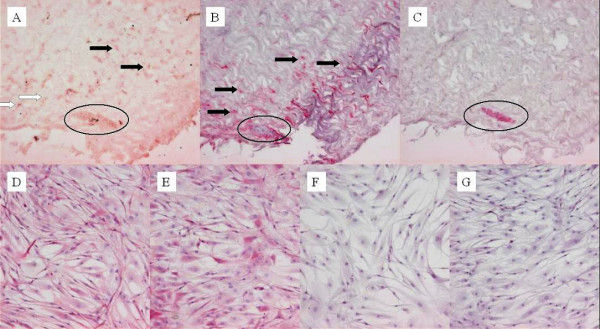
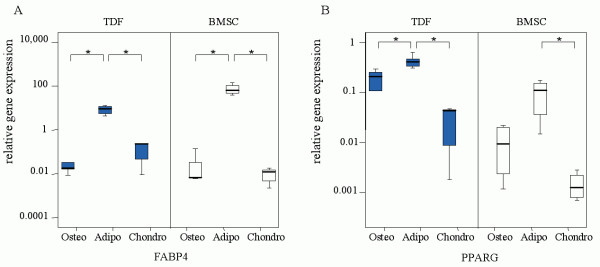
Tendon-derived cells stained D7-FIB (fibroblast-marker) positive, but alpha-SMA (marker for smooth muscle cells and pericytes) negative. Tendon-derived cells were 99% negative for CD34 (endothelial cell marker), and 73% positive for CD105 (mesenchymal progenitor-cell marker). In adipogenic medium, intracellular lipid vacuoles were visible and tendon-derived fibroblasts showed upregulation of adipogenic markers FABP4 (fatty-acid binding protein 4) and PPARG (peroxisome proliferative activated receptor gamma). In chondrogenic medium, some cells stained positive for collagen 2 and tendon-derived fibroblasts showed upregulation of collagen 2 and collagen 10. In osteogenic medium Von Kossa staining showed calcium deposition although osteogenic markers remained unaltered. Tendon-derived cells and BMCSs behaved largely comparable, although some distinct differences were present between the two cell populations.
This study suggests that our population of explanted human tendon cells has an intrinsic differentiation potential. These results support the hypothesis that there might be a role for altered tendon-cell differentiation in the pathophysiology of tendinosis.
肌腱病损表现为糖胺聚糖量增加、钙化和脂质蓄积。因此,细胞分化改变可能在肌腱病的病因中起作用。本研究调查青少年人肌腱组织是否含有具有内在分化潜能的细胞群体。
通过免疫组织化学和流式细胞术分析对来自青少年非退行性绳肌腱的细胞进行表征。将细胞在成骨、成脂和成软骨培养基中培养21天,并通过免疫组织化学和定量聚合酶链反应分析进行表型评估。将结果与成人骨髓来源的基质细胞(BMSCs)的类似实验结果进行比较。
肌腱来源的细胞D7-FIB(成纤维细胞标志物)染色呈阳性,但α-SMA(平滑肌细胞和周细胞标志物)染色呈阴性。肌腱来源的细胞CD34(内皮细胞标志物)呈99%阴性,CD105(间充质祖细胞标志物)呈73%阳性。在成脂培养基中,可见细胞内脂质空泡,且肌腱来源的成纤维细胞显示成脂标志物FABP4(脂肪酸结合蛋白4)和PPARG(过氧化物酶体增殖物激活受体γ)上调。在成软骨培养基中,一些细胞胶原2染色呈阳性,且肌腱来源的成纤维细胞显示胶原2和胶原10上调。在成骨培养基中,冯·科萨染色显示有钙沉积,尽管成骨标志物未改变。肌腱来源的细胞和骨髓间充质干细胞的行为在很大程度上具有可比性,尽管这两个细胞群体之间存在一些明显差异。
本研究表明,我们所培养的人肌腱细胞群体具有内在分化潜能。这些结果支持了这样一种假说,即肌腱细胞分化改变可能在肌腱病的病理生理学中起作用。