Lee Todd A, Weaver Frances M, Weiss Kevin B
Midwest Center for Health Services and Policy Research, Hines VA Hospital, Hines, IL 60141, USA.
J Gen Intern Med. 2007 Jan;22(1):62-7. doi: 10.1007/s11606-007-0118-3.
Patients with chronic obstructive pulmonary disease (COPD) are included in several national pneumococcal vaccination recommendations whereas asthma patients are not. The objective of this study was to evaluate pneumonia-related hospitalization risk in patients with COPD or asthma and vaccination impact.
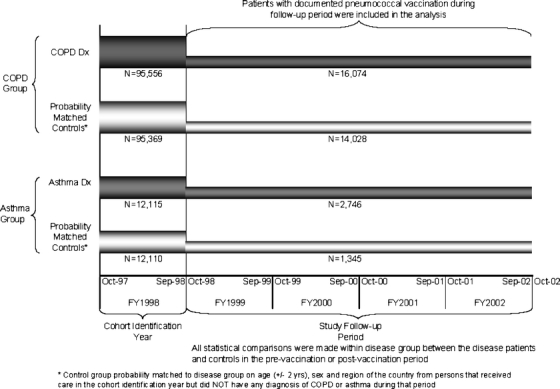
We identified patients with documented pneumococcal vaccination from a cohort of veterans with either a diagnosis of asthma or COPD and their matched controls. Patients were identified between October 1, 1997 and September 30, 1998 and followed for 5 years. For each group we identified pneumococcal pneumonia hospitalizations and all pneumonia-related hospitalizations in the periods before and after vaccination. We estimated hospitalization rates and compared rates in the asthma and COPD groups to controls using negative binomial regression models.
We identified 16,074 COPD patients (average age 65.8 years), 14,028 controls for the COPD patients (average age 67.5 years), 2,746 asthma patients (average age 53.0 years), and 1,345 controls for the asthma patients (average age 59.2 years). Compared to controls, the adjusted risk of pneumococcal pneumonia hospitalizations before pneumococcal vaccination was COPD = 8.02 (95% CI, 4.44-14.48) and asthma = 0.76 (0.17-3.53). For any pneumonia-related hospitalization, the adjusted risk was COPD = 3.91 (3.40-4.50) and asthma = 1.45 (0.85-2.46). After vaccination, events decreased in all groups. The adjusted risk for pneumococcal pneumonia hospitalizations postvaccination was COPD = 3.87 (2.55-5.88) and asthma = 0.30 (0.04-1.99). For any pneumonia-related hospitalization the adjusted risk was COPD = 3.71 (3.33-4.13) and asthma = 0.79 (0.50-1.25).
This study supports the value of vaccinating COPD patients; however, the value of vaccination for asthma patients is less certain.
慢性阻塞性肺疾病(COPD)患者被纳入多项国家肺炎球菌疫苗接种建议中,而哮喘患者则未被纳入。本研究的目的是评估COPD或哮喘患者与肺炎相关的住院风险以及疫苗接种的影响。
我们从一组患有哮喘或COPD诊断的退伍军人及其匹配对照中识别出有肺炎球菌疫苗接种记录的患者。患者于1997年10月1日至1998年9月30日期间被识别,并随访5年。对于每组患者,我们确定了疫苗接种前后期间的肺炎球菌肺炎住院病例和所有与肺炎相关的住院病例。我们估计了住院率,并使用负二项回归模型将哮喘和COPD组的住院率与对照组进行比较。
我们识别出16,074例COPD患者(平均年龄65.8岁),14,028例COPD患者的对照(平均年龄67.5岁),2,746例哮喘患者(平均年龄53.0岁),以及1,345例哮喘患者的对照(平均年龄59.2岁)。与对照组相比,肺炎球菌疫苗接种前肺炎球菌肺炎住院的校正风险为:COPD = 8.02(95%CI,4.44 - 14.48),哮喘 = 0.76(0.17 - 3.53)。对于任何与肺炎相关的住院,校正风险为:COPD = 3.91(3.40 - 4.50),哮喘 = 1.45(0.85 - 2.46)。疫苗接种后,所有组的事件均有所减少。疫苗接种后肺炎球菌肺炎住院的校正风险为:COPD = 3.87(2.55 - 5.88),哮喘 = 0.30(0.04 - 1.99)。对于任何与肺炎相关的住院,校正风险为:COPD = 3.71(3.33 - 4.13),哮喘 = 0.79(0.5