Schnackenberg Laura K, Sun Jinchun, Espandiari Parvaneh, Holland Ricky D, Hanig Joseph, Beger Richard D
National Center for Toxicological Research (NCTR), Jefferson, AR 72079, USA.
BMC Bioinformatics. 2007 Nov 1;8 Suppl 7(Suppl 7):S3. doi: 10.1186/1471-2105-8-S7-S3.
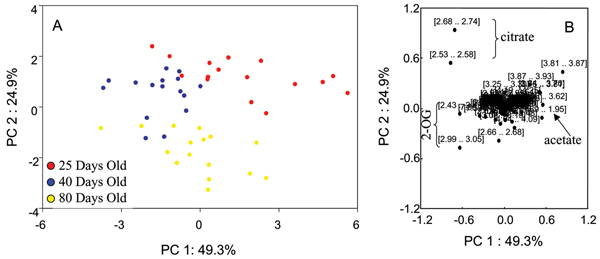
Urine from male Sprague-Dawley rats 25, 40, and 80 days old was analyzed by NMR and UPLC/MS. The effects of data normalization procedures on principal component analysis (PCA) and quantitative analysis of NMR-based metabonomics data were investigated. Additionally, the effects of age on the metabolic profiles were examined by both NMR and UPLC/MS analyses.
The data normalization factor was shown to have a great impact on the statistical and quantitative results indicating the need to carefully consider how to best normalize the data within a particular study and when comparing different studies. PCA applied to the data obtained from both NMR and UPLC/MS platforms reveals similar age-related differences. NMR indicated many metabolites associated with the Krebs cycle decrease while citrate and 2-oxoglutarate, also associated with the Krebs cycle, increase in older rats.
This study compared four different normalization methods for the NMR-based metabonomics spectra from an age-related study. It was shown that each method of normalization has a great effect on both the statistical and quantitative analyses. Each normalization method resulted in altered relative positions of significant PCA loadings for each sample spectra but it did not alter which chemical shifts had the highest loadings. The greater the normalization factor was related to age, the greater the separation between age groups was observed in subsequent PCA analyses. The normalization factor that showed the least age dependence was total NMR intensity, which was consistent with UPLC/MS data. Normalization by total intensity attempts to make corrections due to dietary and water intake of the individual animal, which is especially useful in metabonomics evaluations of urine. Additionally, metabonomics evaluations of age-related effects showed decreased concentrations of many Krebs cycle intermediates along with increased levels of oxidized antioxidants in urine of older rats, which is consistent with current theories on aging and its association with diminishing mitochondrial function and increasing levels of reactive oxygen species. Analysis of urine by both NMR and UPLC/MS provides a comprehensive and complementary means of examining metabolic events in aging rats.
对25日龄、40日龄和80日龄雄性Sprague-Dawley大鼠的尿液进行了核磁共振(NMR)和超高效液相色谱/质谱联用(UPLC/MS)分析。研究了数据归一化程序对主成分分析(PCA)和基于NMR的代谢组学数据定量分析的影响。此外,通过NMR和UPLC/MS分析研究了年龄对代谢谱的影响。
数据归一化因子对统计和定量结果有很大影响,这表明在特定研究中以及比较不同研究时,需要仔细考虑如何最好地对数据进行归一化。应用于从NMR和UPLC/MS平台获得的数据的PCA揭示了类似的与年龄相关的差异。NMR表明,与三羧酸循环相关的许多代谢物在老年大鼠中减少,而同样与三羧酸循环相关的柠檬酸和2-氧代戊二酸增加。
本研究比较了基于年龄相关研究的NMR代谢组学光谱的四种不同归一化方法。结果表明,每种归一化方法对统计和定量分析都有很大影响。每种归一化方法导致每个样品光谱的显著PCA载荷的相对位置发生变化,但没有改变具有最高载荷的化学位移。归一化因子与年龄的相关性越大,在随后的PCA分析中观察到的年龄组之间的分离就越大。与年龄依赖性最小的归一化因子是总NMR强度,这与UPLC/MS数据一致。通过总强度进行归一化试图对个体动物的饮食和水分摄入进行校正,这在尿液的代谢组学评估中特别有用。此外,对年龄相关效应的代谢组学评估表明,老年大鼠尿液中许多三羧酸循环中间体的浓度降低,同时氧化抗氧化剂水平升高,这与当前关于衰老及其与线粒体功能下降和活性氧水平升高相关的理论一致。通过NMR和UPLC/MS对尿液进行分析提供了一种全面且互补的手段来研究衰老大鼠的代谢事件。