Lipkovich Ilya, Adams David H, Mallinckrodt Craig, Faries Doug, Baron David, Houston John P
Lilly Research Laboratories, Eli Lilly and Company, Indianapolis Indiana, USA.
BMC Psychiatry. 2008 Jan 7;8:3. doi: 10.1186/1471-244X-8-3.
The true dose effect in flexible-dose clinical trials may be obscured and even reversed because dose and outcome are related.
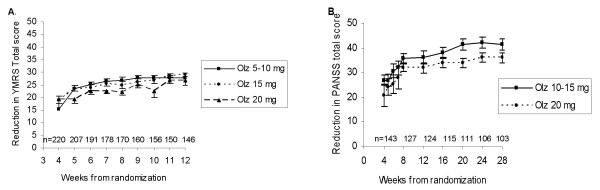
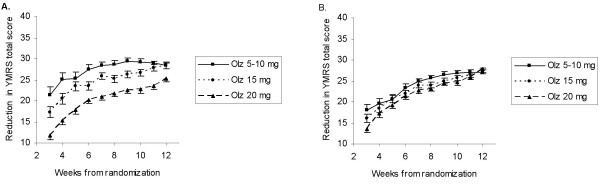
To evaluate dose effect in response on primary efficacy scales from 2 randomized, double-blind, flexible-dose trials of patients with bipolar mania who received olanzapine (N = 234, 5-20 mg/day), or patients with schizophrenia who received olanzapine (N = 172, 10-20 mg/day), we used marginal structural models, inverse probability of treatment weighting (MSM, IPTW) methodology. Dose profiles for mean changes from baseline were evaluated using weighted MSM with a repeated measures model. To adjust for selection bias due to non-random dose assignment and dropouts, patient-specific time-dependent weights were determined as products of (i) stable weights based on inverse probability of receiving the sequence of dose assignments that was actually received by a patient up to given time multiplied by (ii) stable weights based on inverse probability of patient remaining on treatment by that time. Results were compared with those by unweighted analyses.
While the observed difference in efficacy scores for dose groups for the unweighted analysis strongly favored lower doses, the weighted analyses showed no strong dose effects and, in some cases, reversed the apparent "negative dose effect."
While naïve comparison of groups by last or modal dose in a flexible-dose trial may result in severely biased efficacy analyses, the MSM with IPTW estimators approach may be a valuable method of removing these biases and evaluating potential dose effect, which may prove useful for planning confirmatory trials.
在灵活剂量的临床试验中,由于剂量与结果相关,真实的剂量效应可能会被掩盖甚至逆转。
为了评估来自两项随机、双盲、灵活剂量试验的原发性疗效量表反应中的剂量效应,这两项试验分别针对接受奥氮平治疗的双相躁狂症患者(N = 234,5 - 20毫克/天)或接受奥氮平治疗的精神分裂症患者(N = 172,10 - 20毫克/天),我们使用了边际结构模型、治疗权重逆概率(MSM,IPTW)方法。使用带有重复测量模型的加权MSM评估从基线开始的平均变化的剂量曲线。为了调整由于非随机剂量分配和脱落导致的选择偏倚,将患者特定的时间依赖性权重确定为以下两者的乘积:(i)基于患者在给定时间之前实际接受的剂量分配序列的逆概率的稳定权重,乘以(ii)基于患者在该时间仍接受治疗的逆概率的稳定权重。将结果与未加权分析的结果进行比较。
虽然未加权分析中剂量组疗效评分的观察差异强烈支持较低剂量,但加权分析显示没有强烈的剂量效应,并且在某些情况下,逆转了明显的“负剂量效应”。
在灵活剂量试验中,按末次或模态剂量对组进行简单比较可能会导致疗效分析出现严重偏差,而采用IPTW估计器的MSM方法可能是消除这些偏差并评估潜在剂量效应的一种有价值的方法,这可能对规划确证性试验有用。