Jäger M, Zilkens C, Zanger K, Krauspe R
Department of Orthopaedics, Heinrich-Heine University Medical School, Moorenstrasse 5, 40225 Duesseldorf , Germany.
J Biomed Biotechnol. 2007;2007(8):69036. doi: 10.1155/2007/69036.
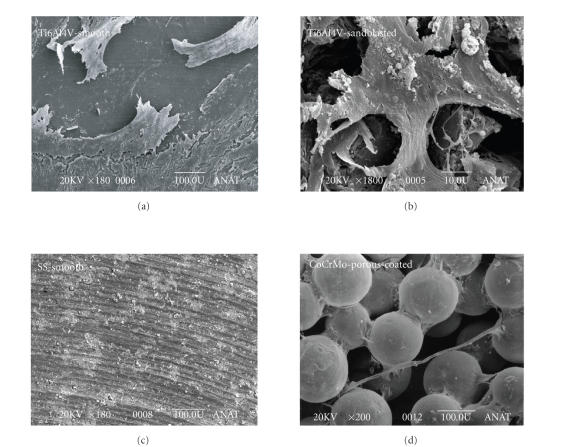
Cell-surface interactions play a crucial role for biomaterial application in orthopaedics. It is evident that not only the chemical composition of solid substances influence cellular adherence, migration, proliferation and differentiation but also the surface topography of a biomaterial. The progressive application of nanostructured surfaces in medicine has gained increasing interest to improve the cytocompatibility and osteointegration of orthopaedic implants. Therefore, the understanding of cell-surface interactions is of major interest for these substances. In this review, we elucidate the principle mechanisms of nano- and microscale cell-surface interactions in vitro for different cell types onto typical orthopaedic biomaterials such as titanium (Ti), cobalt-chrome-molybdenum (CoCrMo) alloys, stainless steel (SS), as well as synthetic polymers (UHMWPE, XLPE, PEEK, PLLA). In addition, effects of nano- and microscaled particles and their significance in orthopaedics were reviewed. The significance for the cytocompatibility of nanobiomaterials is discussed critically.
细胞表面相互作用在骨科生物材料应用中起着至关重要的作用。显然,不仅固体物质的化学成分会影响细胞的黏附、迁移、增殖和分化,生物材料的表面形貌也会产生影响。纳米结构表面在医学上的逐步应用越来越受到关注,以改善骨科植入物的细胞相容性和骨整合。因此,了解细胞 - 表面相互作用对于这些物质至关重要。在本综述中,我们阐明了不同细胞类型在体外与典型骨科生物材料(如钛(Ti)、钴铬钼(CoCrMo)合金、不锈钢(SS)以及合成聚合物(超高分子量聚乙烯(UHMWPE)、交联聚乙烯(XLPE)、聚醚醚酮(PEEK)、聚左旋乳酸(PLLA))之间纳米和微米尺度细胞 - 表面相互作用的主要机制。此外,还综述了纳米和微米级颗粒的影响及其在骨科中的意义。对纳米生物材料细胞相容性的重要性进行了批判性讨论。