Johnson William E B, Stephan Simon, Roberts Sally
Centre for Spinal Studies, Robert Jones and Agnes Hunt Orthopaedic Hospital, Oswestry, Shropshire, SY10 7AG, UK.
Arthritis Res Ther. 2008;10(2):R46. doi: 10.1186/ar2405. Epub 2008 Apr 23.
The avascular nature of the human intervertebral disc (IVD) is thought to play a major role in disc pathophysiology by limiting nutrient supply to resident IVD cells. In the human IVD, the central IVD cells at maturity are normally chondrocytic in phenotype. However, abnormal cell phenotypes have been associated with degenerative disc diseases, including cell proliferation and cluster formation, cell death, stellate morphologies, and cell senescence. Therefore, we have examined the relative influence of possible blood-borne factors on the growth characteristics of IVD cells in vitro.
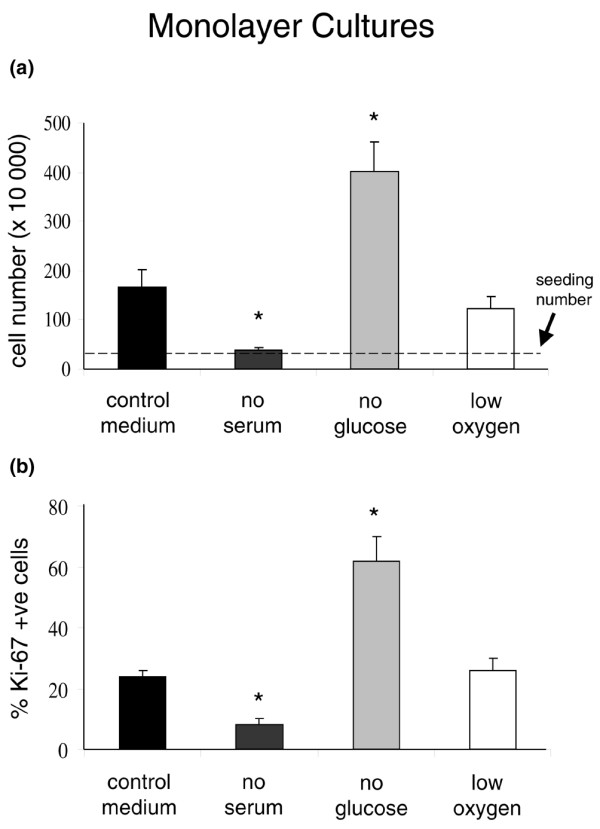
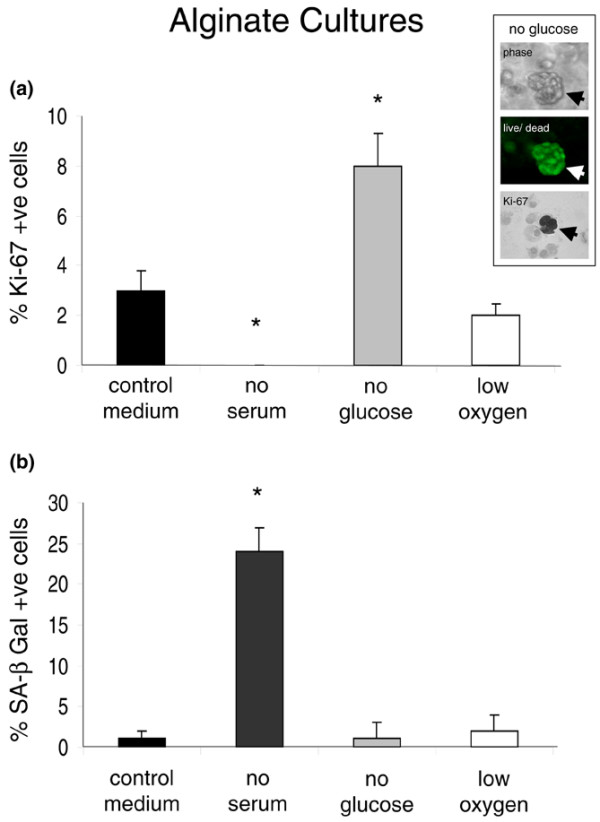
Bovine IVD cells were cultured either in monolayer to encourage cell proliferation or in alginate to induce chondrocytic differentiation. In both culture systems, cells were maintained with or without 20% serum, with or without 320 mg/dL glucose, and in atmospheric levels (~21%) of oxygen or 1% oxygen. Cell proliferation and viability, cell senescence, and collagen immunopositivity were assessed after 7 days. Statistical differences in these growth characteristics were tested using nonparametric analyses (n = 4 samples).
In both culture systems, serum deprivation significantly inhibited IVD cell proliferation and increased cell positivity for senescence-associated beta-galactosidase (SA-beta-gal), a marker of cell senescence. Conversely, IVD cells cultured in the presence of serum, but deprived of glucose, proliferated significantly more rapidly. In alginate cultures, this enhanced cell proliferation (through glucose deprivation) led to the formation of IVD cell clusters. Serum-deprived cells in monolayer, but not in alginate, adopted a stellate appearance. Oxygen deprivation alone had little effect on IVD cell proliferation or survival. Oxygen and glucose deprivation also had no significant effect on SA-beta-gal positivity. IVD cell viability was markedly and significantly decreased in serum-deprived alginate cultures, but in all other conditions remained at or greater than approximately 95%. Glucose deprivation, but not serum or oxygen deprivation, inhibited synthesis of type I and type II collagen, both in monolayer and alginate cultures.
This study demonstrates that factors present in serum interact with other nutrients, notably glucose, to play a major role in regulating the behaviour of IVD cells. These findings suggest that IVD cell phenotypes seen in degenerative disc disease may arise through the cells' response to altered vascularisation and nutrient supply.
人类椎间盘(IVD)的无血管特性被认为通过限制对椎间盘内驻留细胞的营养供应,在椎间盘病理生理学中起主要作用。在人类椎间盘中,成熟的椎间盘中央细胞通常具有软骨细胞表型。然而,异常的细胞表型与椎间盘退变疾病相关,包括细胞增殖和聚集形成、细胞死亡、星状形态以及细胞衰老。因此,我们研究了可能的血源性因子对体外椎间盘细胞生长特性的相对影响。
牛椎间盘细胞在单层培养中以促进细胞增殖,或在藻酸盐中培养以诱导软骨细胞分化。在这两种培养系统中,细胞分别在有或无20%血清、有或无320mg/dL葡萄糖以及大气氧水平(约21%)或1%氧的条件下培养。7天后评估细胞增殖和活力、细胞衰老以及胶原蛋白免疫阳性。使用非参数分析(n = 4个样本)测试这些生长特性的统计学差异。
在两种培养系统中,血清剥夺均显著抑制椎间盘细胞增殖,并增加衰老相关β-半乳糖苷酶(SA-β-gal)的细胞阳性,SA-β-gal是细胞衰老的标志物。相反,在有血清但缺乏葡萄糖的条件下培养的椎间盘细胞增殖明显更快。在藻酸盐培养中,这种通过葡萄糖剥夺增强的细胞增殖导致了椎间盘细胞簇的形成。单层培养中血清剥夺的细胞呈现星状外观,但藻酸盐培养中的细胞没有。单独的氧剥夺对椎间盘细胞增殖或存活几乎没有影响。氧和葡萄糖剥夺对SA-β-gal阳性也没有显著影响。在血清剥夺的藻酸盐培养中,椎间盘细胞活力显著降低,但在所有其他条件下仍保持在或高于约95%。葡萄糖剥夺而非血清或氧剥夺,在单层培养和藻酸盐培养中均抑制I型和II型胶原蛋白的合成。
本研究表明血清中的因子与其他营养物质(特别是葡萄糖)相互作用,在调节椎间盘细胞行为中起主要作用。这些发现表明,在椎间盘退变疾病中看到的椎间盘细胞表型可能是细胞对血管化和营养供应改变的反应所致。