Sennhenn-Kirchner Sabine, Schwarz Peter, Schliephake Henning, Konietschke Frank, Brunner Edgar, Borg-von Zepelin Margarete
Department of Oral and Maxillofacial Surgery, Georg-August University of Goettingen, Göttingen, Germany.
Lasers Med Sci. 2009 May;24(3):313-20. doi: 10.1007/s10103-008-0561-3. Epub 2008 May 6.
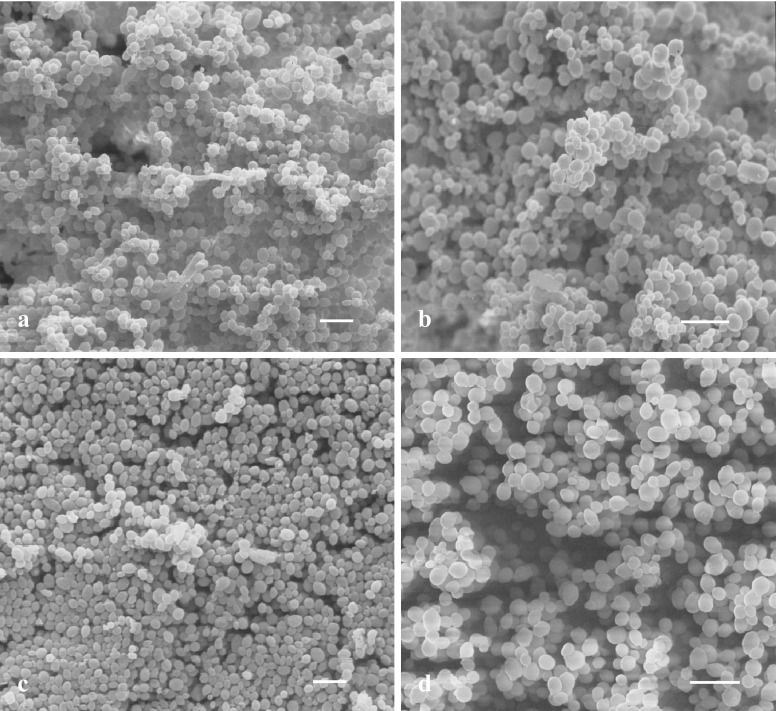
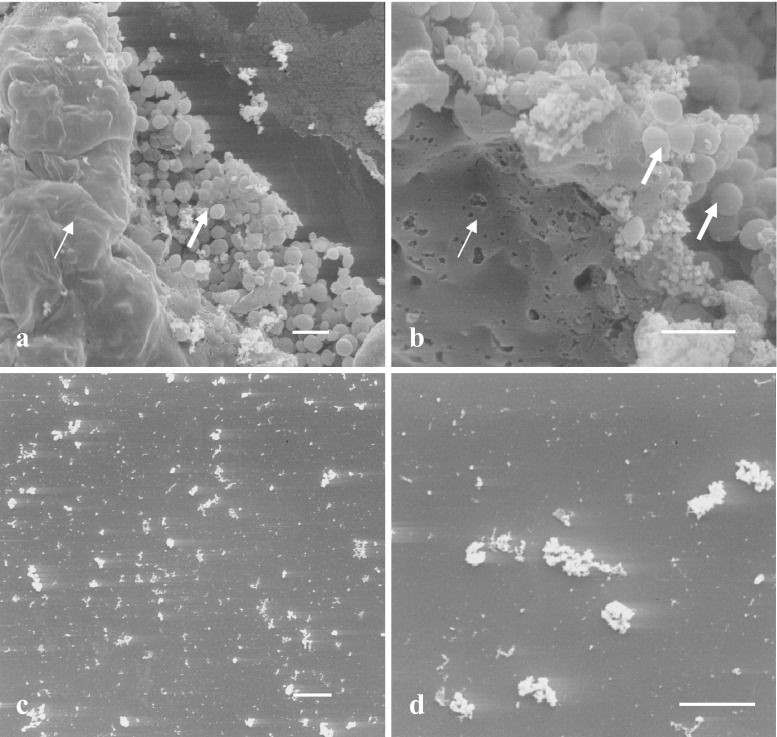
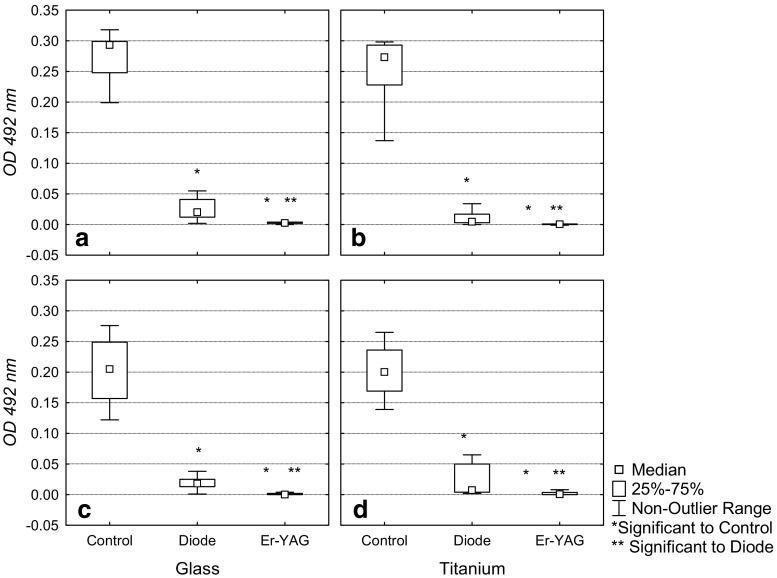
The different forms of superficial and systemic candidiasis are often associated with biofilm formation on surfaces of host tissues or medical devices. The biofilm formation of Candida spp., in general, necessitates significantly increased amounts of antifungal agents for therapy. Often the therapeutic effect is doubtful. A 5-day biofilm model with oral Candida isolates was established according to Chandra et al. (J Dent Res 80:903-908, 2001) on glass and titanium surfaces and was modified by Sennhenn-Kirchner et al. (Z Zahnärztl Implantol 3:45-51, 2007) to investigate different aspects unanswered in the field of dentistry. In this model, the efficacy of erbium:yttrium-aluminium-garnet (Er:YAG) light (2940 nm, 100 mJ, 10 Hz, 300 micros pulsed mode applied for 80 s) and diode laser light (810 nm, 1 W, continuous wave mode applied for 20 s with four repetitions after 30 s pauses each) was evaluated and compared to untreated controls. The photometric evaluation of the samples was completed by observations on morphological changes of yeast cells grown in the biofilm. Compared to the untreated controls Candida cells grown in mature in vitro biofilms were significantly reduced by both wavelengths investigated. Comparison between the different methods of laser treatment additionally revealed a significantly greater effect of the Er:YAG over the diode laser. Scanning electron microscopy findings proved that the diode laser light was effective in direct contact mode. In contrast, in the areas without direct contact, the fungal cells were left almost unchanged. The Er:YAG laser damaged the fungal cells to a great extent wherever it was applied.
浅表性和全身性念珠菌病的不同形式通常与宿主组织或医疗设备表面的生物膜形成有关。一般来说,念珠菌属的生物膜形成需要大量增加抗真菌药物用于治疗。通常治疗效果存疑。根据钱德拉等人(《牙科研究杂志》80:903 - 908, 2001年)的方法,在玻璃和钛表面建立了一个为期5天的口腔念珠菌分离株生物膜模型,并由森亨 - 基尔希纳等人(《口腔种植学杂志》3:45 - 51, 2007年)进行了改进,以研究牙科领域中未得到解答的不同方面。在该模型中,评估了铒:钇铝石榴石(Er:YAG)激光(2940纳米,100毫焦,10赫兹,300微秒脉冲模式,照射80秒)和二极管激光(810纳米,1瓦,连续波模式,每次照射20秒,每次间隔30秒后重复4次)的疗效,并与未处理的对照组进行比较。通过观察生物膜中生长的酵母细胞的形态变化完成对样本的光度评估。与未处理的对照组相比,在体外成熟生物膜中生长的念珠菌细胞在两种研究波长下均显著减少。不同激光治疗方法之间的比较还显示,Er:YAG激光的效果明显优于二极管激光。扫描电子显微镜结果证明,二极管激光在直接接触模式下有效。相比之下,在没有直接接触的区域,真菌细胞几乎没有变化。无论在何处应用,Er:YAG激光都对真菌细胞造成了很大程度的损伤。