Miyashita Yumi, Nishimura Rimei, Nemoto Masami, Matsudaira Toru, Kurata Hideaki, Yokota Tamotsu, Yokota Kuninobu, Tojo Katsuyoshi, Utsunomiya Kazunori, Tajima Naoko
Division of diabetes, Metabolism and Endocrinology, Department of Internal Medicine, Jikei University School of Medicine, Tokyo, Japan.
Cardiovasc Diabetol. 2008 May 29;7:16. doi: 10.1186/1475-2840-7-16.
The large clinical trials proved that Basal-Bolus (BB) insulin therapy was effective in the prevention of diabetic complications and their progression. However, BB therapy needs multiple insulin injections per a day. In this regard, a biphasic insulin analogue needs only twice-daily injections, and is able to correct postprandial hyperglycemia. Therefore it may achieve the blood glucose control as same as that of BB therapy and prevent the diabetic complications including macroangiopathy.
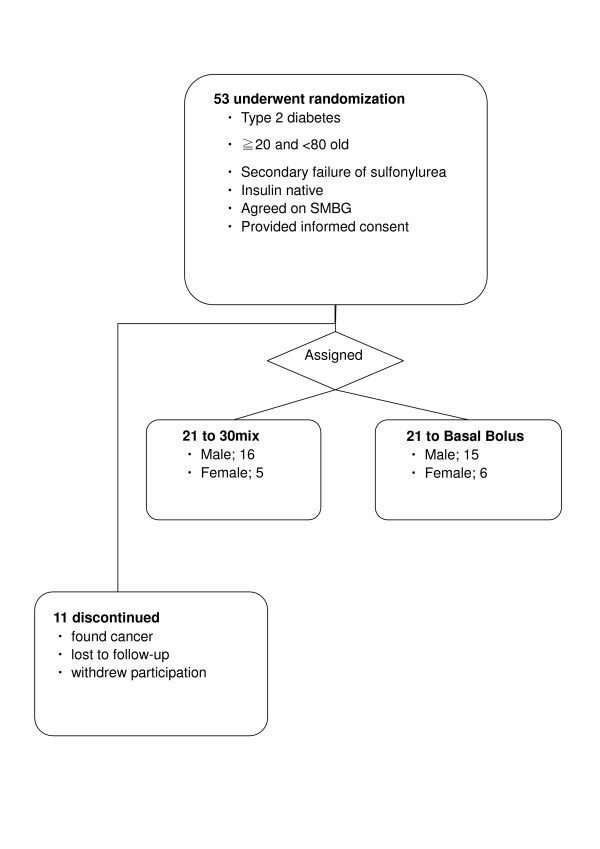
In PROBE (Prospective, Randomized, Open, Blinded-Endpoint) design, forty-two type 2 diabetic patients (male: 73.8%, median(inter quartile range) age: 64.5(56.8-71.0)years) with secondary failure of sulfonylurea (SU) were randomly assigned to BB therapy with a thrice-daily insulin aspart and once-daily basal insulin (BB group) or to conventional therapy with a twice-daily biphasic insulin analogue (30 Mix group), and were followed up for 6 months to compare changes in HbA1c, daily glycemic profile, intima-media thickness (IMT) of carotid artery, adiponectin levels, amounts of insulin used, and QOL between the two groups.
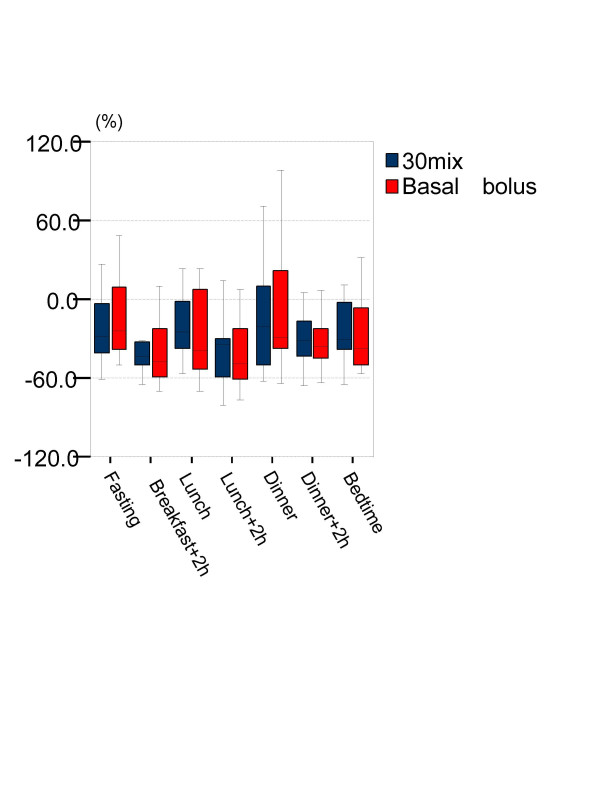
After 6 months, HbA1c was significantly reduced in both groups compared to baseline (30 Mix; 9.3(8.1-11.3) --> 7.4(6.9-8.7)%, p < 0.01, vs BB;8.9(7.7-10.0) --> 6.9(6.2-7.3)%, p < 0.01), with no significant difference between the groups in percentage change in HbA1c (30 Mix; -14.7(-32.5- (-)7.5)% vs BB -17.8(-30.1- (-)11.1)%, p = 0.32). There was a significant decrease in daily glycemic profile at all points except dinner time in both groups compared to baseline. There was a significant increase in the amount of insulin used in the 30 Mix group after treatment compared to baseline (30 Mix;0.30(0.17-0.44) --> 0.39(0.31-0.42) IU/kg, p = 0.01). There was no significant difference in IMT, BMI, QOL or adiponectin levels in either group compared to baseline.
Both BB and 30 mix group produced comparable reductions in HbA1c in type 2 diabetic patients with secondary failure. There was no significant change in IMT as an indicator of early atherosclerotic changes between the two groups. The basal-bolus insulin therapy may not be necessarily needed if the type 2 diabetic patients have become secondary failure.
Current Controlled Trials number, NCT00348231.
大型临床试验证明,基础-餐时(BB)胰岛素治疗在预防糖尿病并发症及其进展方面是有效的。然而,BB疗法需要每天多次注射胰岛素。在这方面,双相胰岛素类似物仅需每日注射两次,并且能够纠正餐后高血糖。因此,它可能实现与BB疗法相同的血糖控制,并预防包括大血管病变在内的糖尿病并发症。
采用前瞻性、随机、开放、盲终点(PROBE)设计,将42例磺脲类药物(SU)继发失效的2型糖尿病患者(男性占73.8%,年龄中位数(四分位间距):64.5(56.8 - 71.0)岁)随机分为每日三次门冬胰岛素和每日一次基础胰岛素的BB治疗组(BB组)或每日两次双相胰岛素类似物的传统治疗组(30混合组),随访6个月,比较两组糖化血红蛋白(HbA1c)、每日血糖谱、颈动脉内膜中层厚度(IMT)、脂联素水平、胰岛素使用量及生活质量(QOL)的变化。
6个月后,两组HbA1c均较基线显著降低(30混合组:9.3(8.1 - 11.3)% → 7.4(6.9 - 8.7)%,p < 0.01;BB组:8.9(7.7 - 10.0)% → 6.9(6.2 - 7.3)%,p < 0.01),两组HbA1c变化百分比无显著差异(30混合组:-14.7(-32.5 - (-)7.5)%,BB组:-17.8(-30.1 - (-)11.1)%,p = 0.32)。与基线相比,两组除晚餐时间外各时间点的每日血糖谱均显著降低。治疗后,30混合组胰岛素使用量较基线显著增加(30混合组:0.30(0.17 - 0.44)→ 0.39(0.31 - 0.42)IU/kg,p = 0.01)。两组IMT、体重指数(BMI)、QOL或脂联素水平与基线相比均无显著差异。
在SU继发失效的2型糖尿病患者中,BB组和30混合组在降低HbA1c方面效果相当。两组间作为早期动脉粥样硬化改变指标的IMT无显著变化。2型糖尿病患者出现SU继发失效时,不一定需要基础-餐时胰岛素治疗。
当前受控试验编号,NCT00348231。