Sletten Ellen M, Bertozzi Carolyn R
Department of Chemistry and Molecular and Cell Biology and Howard Hughes Medical Institute, University of California, California, USA.
Org Lett. 2008 Jul 17;10(14):3097-9. doi: 10.1021/ol801141k. Epub 2008 Jun 13.
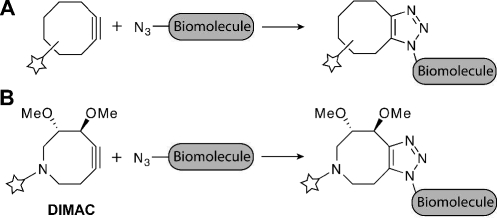
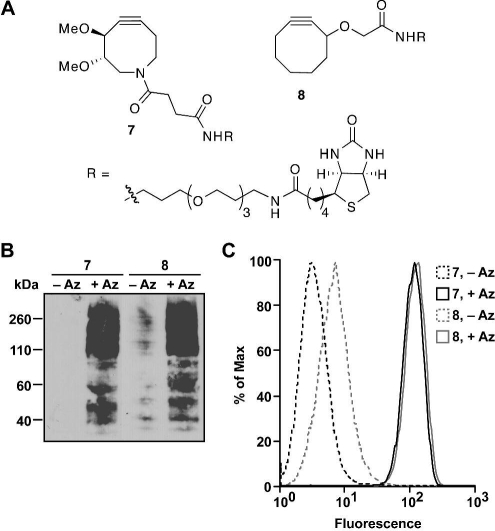
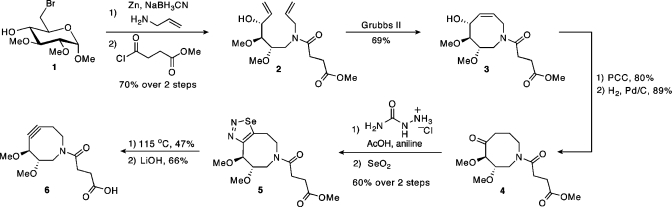
Biomolecules labeled with azides can be detected through Cu-free click chemistry with cyclooctyne probes, but their intrinsic hydrophobicity can compromise bioavailability. Here, we report the synthesis and evaluation of a novel azacyclooctyne, 6,7-dimethoxyazacyclooct-4-yne (DIMAC). Generated in nine steps from a glucose analogue, DIMAC reacted with azide-labeled proteins and cells similarly to cyclooctynes. However, its superior polarity and water solubility reduced nonspecific binding, thereby improving the sensitivity of azide detection.
叠氮化物标记的生物分子可通过与环辛炔探针的无铜点击化学进行检测,但其固有的疏水性会影响生物利用度。在此,我们报告了一种新型氮杂环辛炔6,7-二甲氧基氮杂环辛-4-炔(DIMAC)的合成与评估。DIMAC由葡萄糖类似物经九步反应生成,与叠氮化物标记的蛋白质和细胞的反应类似于环辛炔。然而,其优异的极性和水溶性降低了非特异性结合,从而提高了叠氮化物检测的灵敏度。