Xia Xuhua
Department of Biology and Center for Advanced Research in Environmental Genomics, University of Ottawa 30 Marie Curie, Ottawa, K1N 6N5, Canada.
BMC Evol Biol. 2008 Jul 19;8:211. doi: 10.1186/1471-2148-8-211.
Fungal and animal mitochondrial genomes typically have one tRNA for each synonymous codon family. The codon-anticodon adaptation hypothesis predicts that the wobble nucleotide of a tRNA anticodon should evolve towards maximizing Watson-Crick base pairing with the most frequently used codon within each synonymous codon family, whereas the wobble versatility hypothesis argues that the nucleotide at the wobble site should be occupied by a nucleotide most versatile in wobble pairing, i.e., the tRNA wobble nucleotide should be G for NNY codon families, and U for NNR and NNN codon families (where Y stands for C or U, R for A or G and N for any nucleotide).
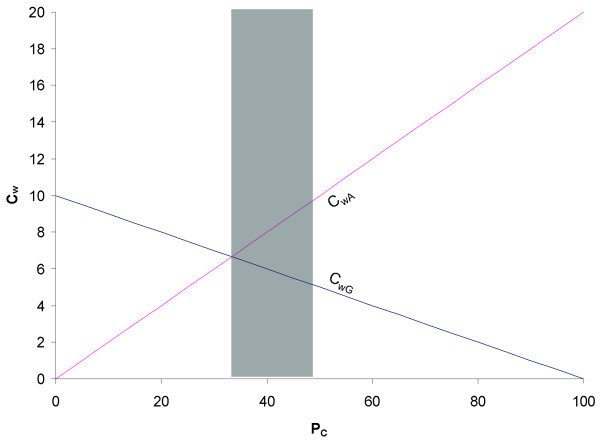
We here integrate these two traditional hypotheses on tRNA anticodons into a unified model based on an analysis of the wobble costs associated with different wobble base pairs. This novel approach allows the relative cost of wobble pairing to be qualitatively evaluated. A comprehensive study of 36 fungal genomes suggests very different costs between two kinds of U:G wobble pairs, i.e., (1) between a G at the wobble site of a tRNA anticodon and a U at the third codon position (designated MU3:G) and (2) between a U at the wobble site of a tRNA anticodon and a G at the third codon position (designated MG3:U).
In general, MU3:G is much smaller than MG3:U, suggesting no selection against U-ending codons in NNY codon families with a wobble G in the tRNA anticodon but strong selection against G-ending codons in NNR codon families with a wobble U at the tRNA anticodon. This finding resolves several puzzling observations in fungal genomics and corroborates previous studies showing that U3:G wobble is energetically more favorable than G3:U wobble.
真菌和动物的线粒体基因组通常每个同义密码子家族有一个tRNA。密码子-反密码子适配假说预测,tRNA反密码子的摆动核苷酸应朝着与每个同义密码子家族中最常用密码子的沃森-克里克碱基配对最大化的方向进化,而摆动通用性假说认为,摆动位点的核苷酸应由摆动配对中最通用的核苷酸占据,即tRNA摆动核苷酸在NNY密码子家族中应为G,在NNR和NNN密码子家族中应为U(其中Y代表C或U,R代表A或G,N代表任何核苷酸)。
我们在此基于对不同摆动碱基对相关摆动成本的分析,将这两种关于tRNA反密码子的传统假说整合为一个统一模型。这种新方法能够定性评估摆动配对的相对成本。对36个真菌基因组的全面研究表明,两种U:G摆动对之间的成本差异很大,即(1)tRNA反密码子摆动位点的G与密码子第三位的U之间(称为MU3:G),以及(2)tRNA反密码子摆动位点的U与密码子第三位的G之间(称为MG3:U)。
一般来说,MU3:G远小于MG3:U,这表明在tRNA反密码子中有摆动G的NNY密码子家族中,对以U结尾的密码子没有选择压力,但在tRNA反密码子中有摆动U的NNR密码子家族中,对以G结尾的密码子有强烈的选择压力。这一发现解决了真菌基因组学中的几个令人困惑的观察结果,并证实了先前的研究表明U3:G摆动在能量上比G3:U摆动更有利。