Victoria Berta, Ahmed Ahmed, Zuerner Richard L, Ahmed Niyaz, Bulach Dieter M, Quinteiro Javier, Hartskeerl Rudy A
Department of Biochemistry and Molecular Biology, Faculty of Biology, University of Santiago de Compostela, Galicia, Spain.
PLoS One. 2008 Jul 16;3(7):e2752. doi: 10.1371/journal.pone.0002752.
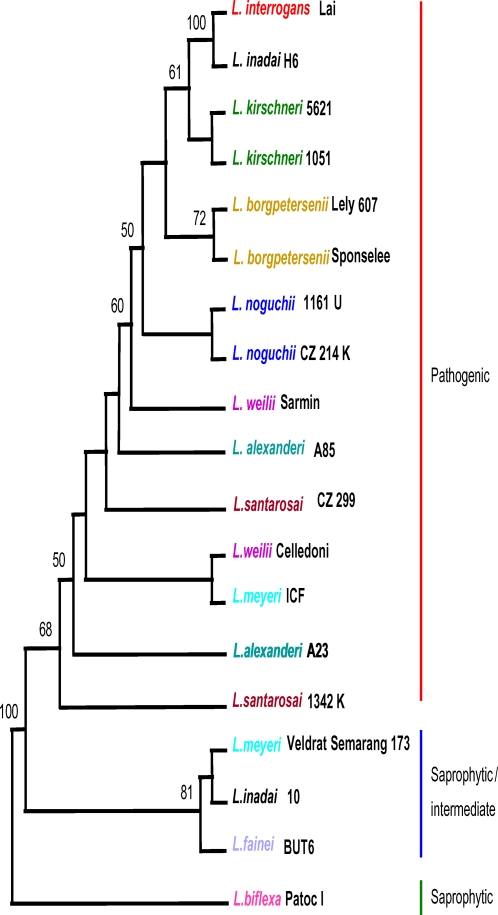
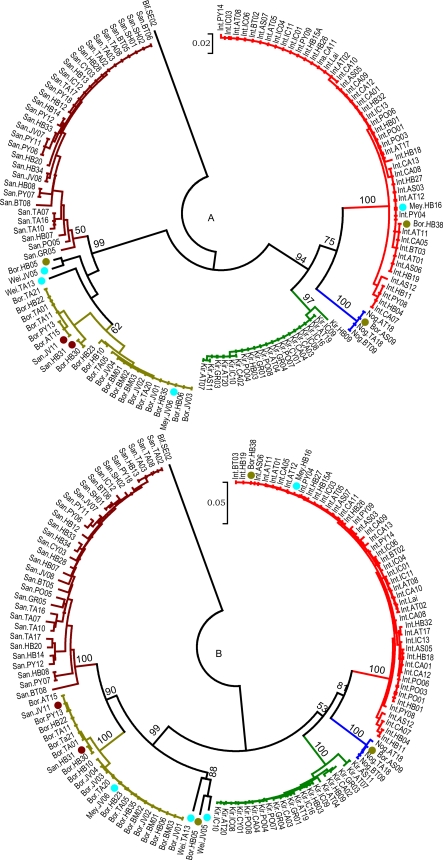
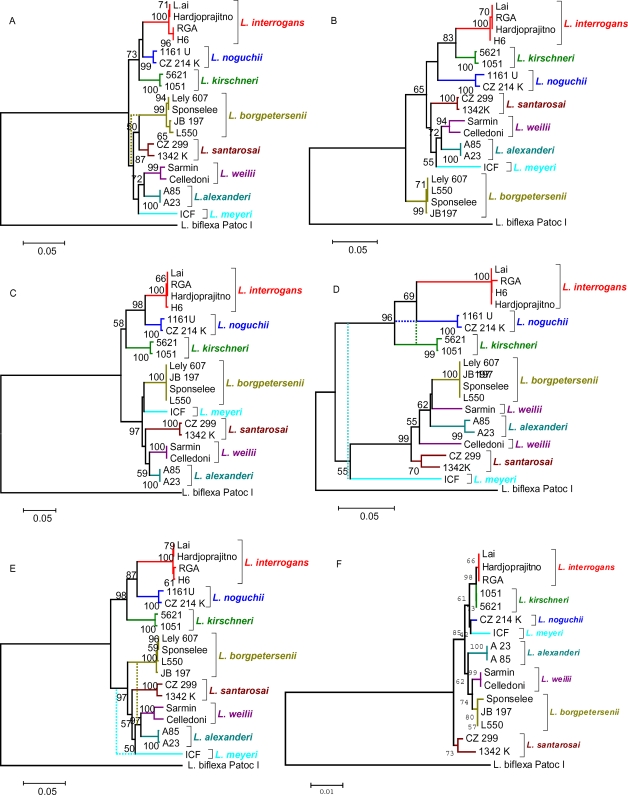
S10-spc-alpha is a 17.5 kb cluster of 32 genes encoding ribosomal proteins. This locus has an unusual composition and organization in Leptospira interrogans. We demonstrate the highly conserved nature of this region among diverse Leptospira and show its utility as a phylogenetically informative region. Comparative analyses were performed by PCR using primer sets covering the whole locus. Correctly sized fragments were obtained by PCR from all L. interrogans strains tested for each primer set indicating that this locus is well conserved in this species. Few differences were detected in amplification profiles between different pathogenic species, indicating that the S10-spc-alpha locus is conserved among pathogenic Leptospira. In contrast, PCR analysis of this locus using DNA from saprophytic Leptospira species and species with an intermediate pathogenic capacity generated varied results. Sequence alignment of the S10-spc-alpha locus from two pathogenic species, L. interrogans and L. borgpetersenii, with the corresponding locus from the saprophyte L. biflexa serovar Patoc showed that genetic organization of this locus is well conserved within Leptospira. Multilocus sequence typing (MLST) of four conserved regions resulted in the construction of well-defined phylogenetic trees that help resolve questions about the interrelationships of pathogenic Leptospira. Based on the results of secY sequence analysis, we found that reliable species identification of pathogenic Leptospira is possible by comparative analysis of a 245 bp region commonly used as a target for diagnostic PCR for leptospirosis. Comparative analysis of Leptospira strains revealed that strain H6 previously classified as L. inadai actually belongs to the pathogenic species L. interrogans and that L. meyeri strain ICF phylogenetically co-localized with the pathogenic clusters. These findings demonstrate that the S10-spc-alpha locus is highly conserved throughout the genus and may be more useful in comparing evolution of the genus than loci studied previously.
S10-spc-alpha是一个由32个编码核糖体蛋白的基因组成的17.5 kb基因簇。该基因座在问号钩端螺旋体中具有不寻常的组成和组织。我们证明了该区域在不同钩端螺旋体中的高度保守性,并展示了其作为系统发育信息区域的实用性。使用覆盖整个基因座的引物对通过PCR进行比较分析。对于每个引物对,从所有测试的问号钩端螺旋体菌株中通过PCR获得了正确大小的片段,表明该基因座在该物种中高度保守。在不同致病物种之间的扩增图谱中检测到的差异很少,表明S10-spc-alpha基因座在致病性钩端螺旋体中是保守的。相比之下,使用腐生钩端螺旋体物种和具有中等致病能力物种的DNA对该基因座进行PCR分析产生了不同的结果。来自两个致病物种问号钩端螺旋体和伯氏钩端螺旋体的S10-spc-alpha基因座与腐生双曲钩端螺旋体血清型Patoc的相应基因座的序列比对表明,该基因座的遗传组织在钩端螺旋体属内高度保守。对四个保守区域进行多位点序列分型(MLST),构建了明确的系统发育树,有助于解决致病性钩端螺旋体之间相互关系的问题。基于secY序列分析的结果,我们发现通过对通常用作钩端螺旋体病诊断PCR靶标的245 bp区域进行比较分析,可以对致病性钩端螺旋体进行可靠的物种鉴定。钩端螺旋体菌株的比较分析表明,先前分类为Inadai钩端螺旋体的H6菌株实际上属于致病物种问号钩端螺旋体,并且迈耶氏钩端螺旋体菌株ICF在系统发育上与致病簇共定位。这些发现表明,S10-spc-alpha基因座在整个属中高度保守,在比较该属的进化方面可能比以前研究的基因座更有用。