Brown James S, Bateson Thomas F, McDonnell William F
National Center for Environmental Assessment, US Environmental Protection Agency, Research Triangle Park, North Carolina 27711, USA.
Environ Health Perspect. 2008 Aug;116(8):1023-6. doi: 10.1289/ehp.11396.
Ozone is a potent photochemical oxidant that produces transient, reversible decrements in the lung function of acutely exposed individuals. A recent study provided previously unavailable clinical data for 30 healthy young adults exposed to O(3) at 0.06 ppm. That study showed significant effects of 0.08 ppm on lung function, confirming the findings of others. However, exposure to 0.06 ppm O(3) was not reported to significantly affect lung function.
We conducted this analysis to reevaluate the existing lung function data of the volunteers previously exposed to 0.06 ppm O(3).
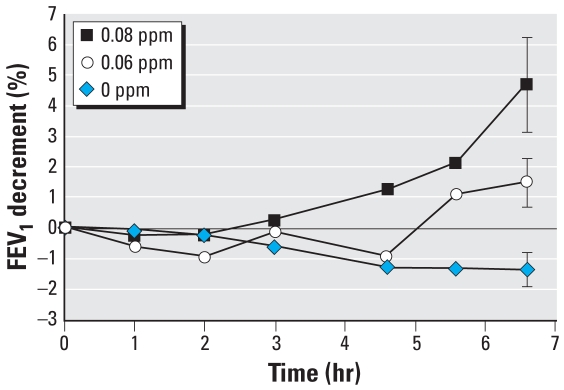
We obtained pre- and postexposure data on forced expiratory volume in 1 sec (FEV(1)) for all subjects who were previously exposed for 6.6 hr to filtered air or to 0.06 ppm or 0.08 ppm O(3). We used standard statistical methods appropriate for paired comparisons to reanalyze FEV(1) responses after exposure to 0.06 ppm O(3) relative to filtered air.
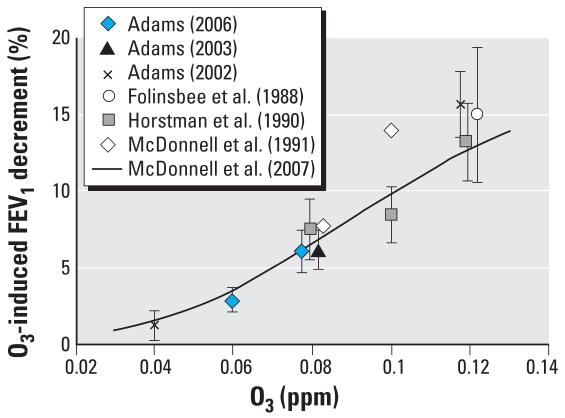
Controlling for filtered air responses, 24 of the 30 subjects experienced an O(3)-induced decrement in FEV(1). On average, 0.06 ppm O(3) exposure caused a 2.85% reduction in FEV(1) (p < 0.002), which was consistent with the predicted FEV(1) response from existing models. Although the average response was small, two subjects had > 10% FEV(1) decrements.
Exposure to 0.06 ppm O(3) causes a biologically small but highly statistically significant decrease in mean FEV(1) responses of young healthy adults.
臭氧是一种强效光化学氧化剂,会使急性暴露个体的肺功能产生短暂、可逆的下降。最近一项研究提供了30名健康年轻成年人暴露于0.06 ppm臭氧环境下的临床数据,这些数据此前未曾有过。该研究表明,0.08 ppm的臭氧对肺功能有显著影响,证实了其他研究结果。然而,据报道,暴露于0.06 ppm臭氧环境下对肺功能并无显著影响。
我们进行此项分析,以重新评估此前暴露于0.06 ppm臭氧环境下的志愿者现有的肺功能数据。
我们获取了所有曾暴露于过滤空气、0.06 ppm或0.08 ppm臭氧环境6.6小时的受试者的一秒用力呼气量(FEV₁)的暴露前和暴露后数据。我们使用适合配对比较的标准统计方法,重新分析暴露于0.06 ppm臭氧环境相对于过滤空气后的FEV₁反应。
在控制过滤空气反应的情况下,30名受试者中有24名出现了臭氧诱导的FEV₁下降。平均而言,暴露于0.06 ppm臭氧导致FEV₁下降2.85%(p < 0.002),这与现有模型预测的FEV₁反应一致。尽管平均反应较小,但有两名受试者的FEV₁下降超过10%。
暴露于0.06 ppm臭氧会使年轻健康成年人的平均FEV₁反应出现生物学上虽小但在统计学上高度显著的下降。