Elliott Paul, Savitz David A
Small Area Health Statistics Unit, Department of Epidemiology and Public Health, Imperial College London, London, UK.
Environ Health Perspect. 2008 Aug;116(8):1098-104. doi: 10.1289/ehp.10817.
Small-area studies are part of the tradition of spatial epidemiology, which is concerned with the analysis of geographic patterns of disease with respect to environmental, demographic, socioeconomic, and other factors. We focus on etiologic research, where the aim is to make inferences about spatially varying environmental factors influencing the risk of disease.
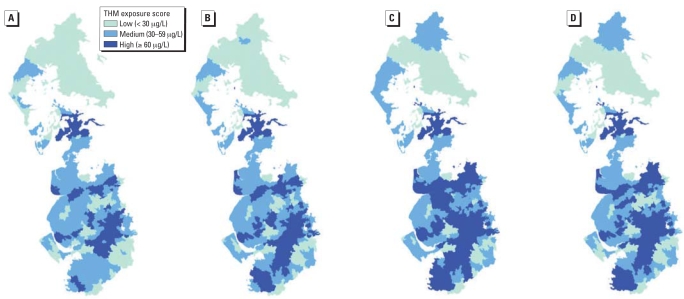
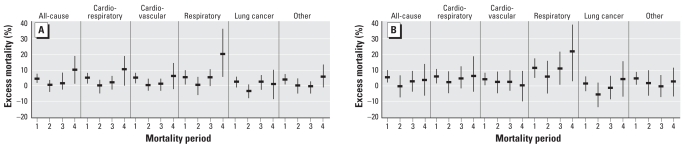
We illustrate the approach through three exemplars: a) magnetic fields from overhead electric power lines and the occurrence of childhood leukemia, which illustrates the use of geographic information systems to focus on areas with high exposure prevalence; b) drinking-water disinfection by-products and reproductive outcomes, taking advantage of large between- to within-area variability in exposures from the water supply; and c) chronic exposure to air pollutants and cardiorespiratory health, where issues of socioeconomic confounding are particularly important.
The small-area epidemiologic approach assigns exposure estimates to individuals based on location of residence or other geographic variables such as workplace or school. In this way, large populations can be studied, increasing the ability to investigate rare exposures or rare diseases. The approach is most effective when there is well-defined exposure variation across geographic units, limited within-area variation, and good control for potential confounding across areas.
In conjunction with traditional individual-based approaches, small-area studies offer a valuable addition to the armamentarium of the environmental epidemiologist. Modeling of exposure patterns coupled with collection of individual-level data on subsamples of the population should lead to improved risk estimates (i.e., less potential for bias) and help strengthen etiologic inference.
小区域研究是空间流行病学传统的一部分,空间流行病学关注疾病地理模式与环境、人口、社会经济及其他因素之间的分析。我们专注于病因学研究,其目的是推断影响疾病风险的空间变化环境因素。
我们通过三个示例阐述该方法:a)来自架空电力线的磁场与儿童白血病的发生,这说明了利用地理信息系统聚焦高暴露患病率区域;b)饮用水消毒副产物与生殖结局,利用供水暴露在区域间和区域内的巨大变异性;c)长期暴露于空气污染物与心肺健康,其中社会经济混杂问题尤为重要。
小区域流行病学方法根据居住地点或其他地理变量(如工作场所或学校)为个体分配暴露估计值。通过这种方式,可以研究大量人群,提高调查罕见暴露或罕见疾病的能力。当地理单元间存在明确的暴露变异、区域内变异有限且对区域间潜在混杂因素有良好控制时,该方法最为有效。
与传统的基于个体的方法相结合,小区域研究为环境流行病学家的工具库增添了有价值的内容。暴露模式建模与人群子样本个体水平数据的收集应能改进风险估计(即减少偏差可能性)并有助于加强病因推断。