Sheth Bhavin R, Janvelyan Davit, Khan Murtuza
University of Houston, Houston, Texas, United States of America.
PLoS One. 2008 Sep 12;3(9):e3190. doi: 10.1371/journal.pone.0003190.
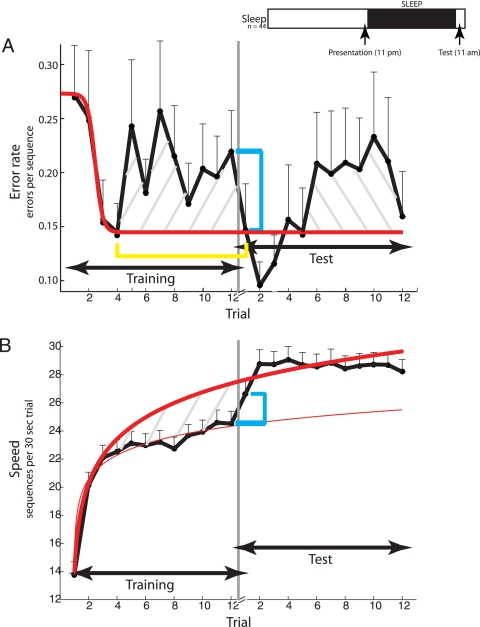
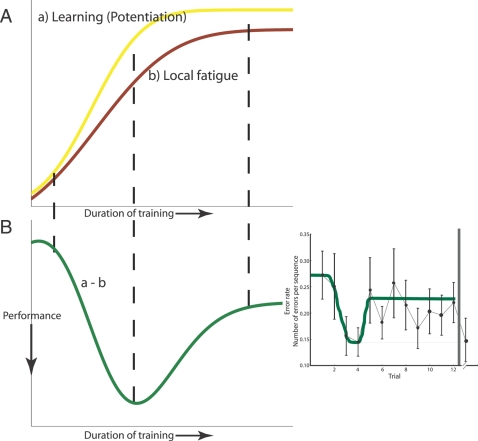
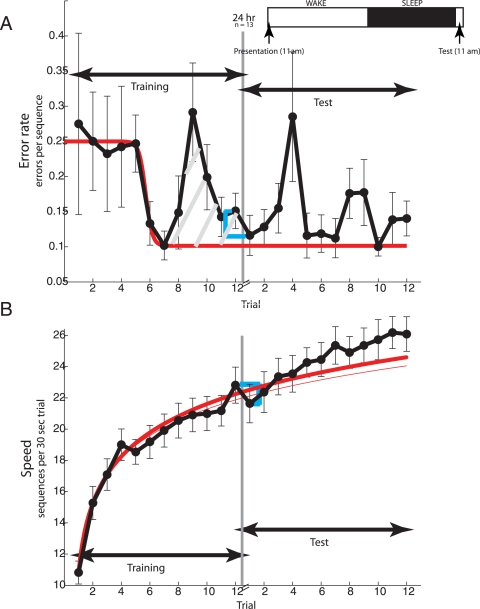
Emerging evidence suggests that sleep plays a key role in procedural learning, particularly in the continued development of motor skill learning following initial acquisition. We argue that a detailed examination of the time course of performance across sleep on the finger-tapping task, established as the paradigm for studying the effect of sleep on motor learning, will help distinguish a restorative role of sleep in motor skill learning from a proactive one. Healthy subjects rehearsed for 12 trials and, following a night of sleep, were tested. Early training rapidly improved speed as well as accuracy on pre-sleep training. Additional rehearsal caused a marked slow-down in further improvement or partial reversal in performance to observed levels below theoretical upper limits derived on the basis of early pre-sleep rehearsal. This decrement in learning efficacy does not occur always, but if and only if it does, overnight sleep has an effect in fully or partly restoring the efficacy and actual performance to the optimal theoretically achieveable level. Our findings re-interpret the sleep-dependent memory enhancement in motor learning reported in the literature as a restoration of fatigued circuitry specialized for the skill. In providing restitution to the fatigued brain, sleep eliminates the rehearsal-induced synaptic fatigue of the circuitry specialized for the task and restores the benefit of early pre-sleep rehearsal. The present findings lend support to the notion that latent sleep-dependent enhancement of performance is a behavioral expression of the brain's restitution in sleep.
新出现的证据表明,睡眠在程序性学习中起着关键作用,尤其是在初始习得后运动技能学习的持续发展方面。我们认为,对手指敲击任务中睡眠期间表现的时间进程进行详细研究,该任务已被确立为研究睡眠对运动学习影响的范式,将有助于区分睡眠在运动技能学习中的恢复作用和主动作用。健康受试者进行了12次试验,经过一夜睡眠后进行测试。早期训练迅速提高了睡眠前训练的速度和准确性。额外的练习导致进一步提高的速度明显减慢,或者表现部分逆转至低于基于睡眠前早期练习得出的理论上限的观察水平。学习效能的这种下降并非总是发生,但如果发生,且仅在发生时,夜间睡眠会对将效能和实际表现完全或部分恢复到理论上可达到的最佳水平产生影响。我们的研究结果将文献中报道的运动学习中依赖睡眠的记忆增强重新解释为专门用于该技能的疲劳神经回路的恢复。通过为疲劳的大脑提供恢复,睡眠消除了专门用于该任务的神经回路中由练习引起的突触疲劳,并恢复了睡眠前早期练习的益处。目前的研究结果支持了这样一种观点,即睡眠依赖的潜在表现增强是大脑在睡眠中恢复的行为表现。