Pazos Florencio, Valencia Alfonso
Structure of Macromolecules, Computational Systems Biology Group, National Centre for Biotechnology (CNB-CSIC), Madrid, Spain.
EMBO J. 2008 Oct 22;27(20):2648-55. doi: 10.1038/emboj.2008.189. Epub 2008 Sep 25.
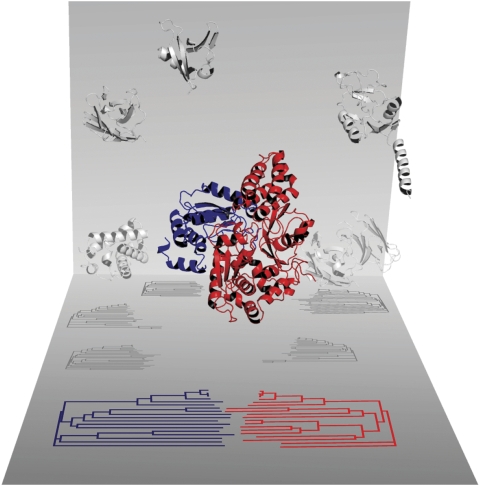
Co-evolution has an important function in the evolution of species and it is clearly manifested in certain scenarios such as host-parasite and predator-prey interactions, symbiosis and mutualism. The extrapolation of the concepts and methodologies developed for the study of species co-evolution at the molecular level has prompted the development of a variety of computational methods able to predict protein interactions through the characteristics of co-evolution. Particularly successful have been those methods that predict interactions at the genomic level based on the detection of pairs of protein families with similar evolutionary histories (similarity of phylogenetic trees: mirrortree). Future advances in this field will require a better understanding of the molecular basis of the co-evolution of protein families. Thus, it will be important to decipher the molecular mechanisms underlying the similarity observed in phylogenetic trees of interacting proteins, distinguishing direct specific molecular interactions from other general functional constraints. In particular, it will be important to separate the effects of physical interactions within protein complexes ('co-adaptation') from other forces that, in a less specific way, can also create general patterns of co-evolution.
协同进化在物种进化中具有重要作用,并且在某些情形中表现得很明显,比如宿主 - 寄生虫和捕食者 - 猎物的相互作用、共生和互利共生。对在分子水平上研究物种协同进化所开发的概念和方法的外推,促使了各种能够通过协同进化特征预测蛋白质相互作用的计算方法的发展。基于检测具有相似进化历史的蛋白质家族对(系统发育树的相似性:镜像树)来预测基因组水平上相互作用的那些方法尤其成功。该领域未来的进展将需要更好地理解蛋白质家族协同进化的分子基础。因此,解读相互作用蛋白质系统发育树中观察到的相似性背后的分子机制,区分直接的特异性分子相互作用与其他一般功能限制,将非常重要。特别是,将蛋白质复合物内物理相互作用的影响(“共同适应”)与其他以较不特异方式也能产生协同进化一般模式的力量区分开来将很重要。