Orlowski M
Department of Microbiology, Louisiana State University, Baton Rouge 70803.
Microbiol Rev. 1991 Jun;55(2):234-58. doi: 10.1128/mr.55.2.234-258.1991.
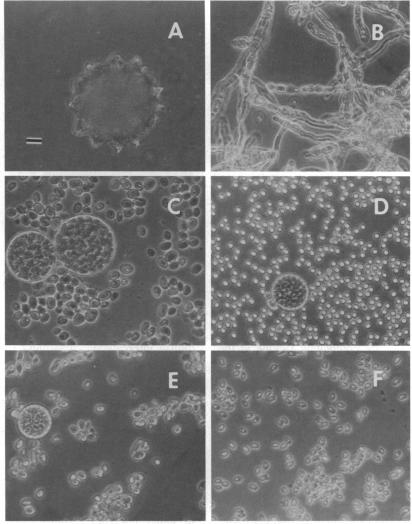
Mucor dimorphism has interested microbiologists since the time of Pasteur. When deprived of oxygen, these fungi grow as spherical, multipolar budding yeasts. In the presence of oxygen, they propagate as branching coenocytic hyphae. The ease with which these morphologies can be manipulated in the laboratory, the diverse array of morphopoietic agents available, and the alternative developmental fates that can be elicited from a single cell type (the sporangiospore) make Mucor spp. a highly propitious system in which to study eukaryotic cellular morphogenesis. The composition and organization of the cell wall differ greatly in Mucor yeasts and hyphae. The deposition of new wall polymers is isodiametric in yeasts and apically polarized in hyphae. Current research has focused on the identity and control of enzymes participating in wall synthesis. An understanding of how the chitosome interacts with appropriate effectors, specific enzymes, and the plasma membrane to assemble chitin-chitosan microfibrils and to deposit them at the proper sites on the cell exterior will be critical to elucidating dimorphism. Several biochemical and physiological parameters have been reported to fluctuate in a manner that correlates with Mucor morphogenesis. The literature describing these has been reviewed critically with the intent of distinguishing between causal and casual connections. The advancement of molecular genetics has afforded powerful new tools that researchers have begun to exploit in the study of Mucor dimorphism. Several genes, some encoding products known to correlate with development in Mucor spp. or other fungi, have been cloned, sequenced, and examined for transcriptional activity during morphogenesis. Most have appeared in multiple copies displaying independent transcriptional control. Selective translation of stored mRNA molecules occurs during sporangiospore germination. Many other correlates of Mucor morphogenesis, presently described but not yet explained, should prove amenable to analysis by the emerging molecular technology.
自巴斯德时代以来,毛霉的双态性就引起了微生物学家的兴趣。在缺氧条件下,这些真菌以球形、多极出芽酵母的形式生长。在有氧环境中,它们则以分支的多核菌丝体形式繁殖。这些形态在实验室中易于操控,有多种形态发生因子可供使用,并且从单一细胞类型(孢子囊孢子)可引发不同的发育命运,这使得毛霉属成为研究真核细胞形态发生的极为有利的系统。毛霉酵母和菌丝的细胞壁组成与结构差异很大。新壁聚合物的沉积在酵母中是等径的,而在菌丝中是顶端极化的。目前的研究集中在参与细胞壁合成的酶的特性和调控上。了解几丁质体如何与合适的效应物、特定酶以及质膜相互作用,以组装几丁质 - 壳聚糖微纤维并将它们沉积在细胞外的适当位置,对于阐明双态性至关重要。据报道,一些生化和生理参数会以与毛霉形态发生相关的方式波动。对描述这些内容的文献进行了批判性综述,目的是区分因果关系和偶然关系。分子遗传学的进展提供了强大的新工具,研究人员已开始在毛霉双态性研究中加以利用。几个基因,其中一些编码已知与毛霉属或其他真菌发育相关的产物,已被克隆、测序,并在形态发生过程中检测其转录活性。大多数基因以多拷贝形式出现,显示出独立的转录控制。在孢子囊孢子萌发过程中发生储存mRNA分子的选择性翻译。目前已描述但尚未解释的毛霉形态发生的许多其他相关因素,应该可以通过新兴的分子技术进行分析。