Canolty Ryan T, Soltani Maryam, Dalal Sarang S, Edwards Erik, Dronkers Nina F, Nagarajan Srikantan S, Kirsch Heidi E, Barbaro Nicholas M, Knight Robert T
Helen Wills Neuroscience Institute, University of California, Berkeley, CA 94720-3190, USA.
Front Neurosci. 2007 Oct 15;1(1):185-96. doi: 10.3389/neuro.01.1.1.014.2007. eCollection 2007 Nov.
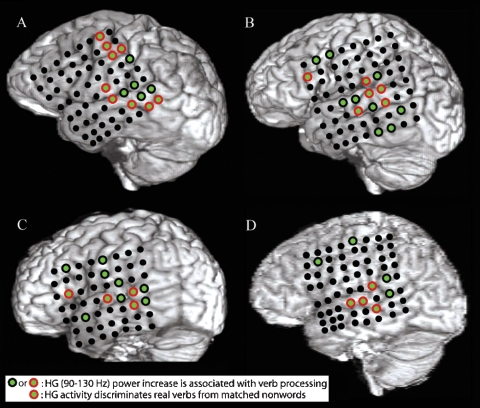
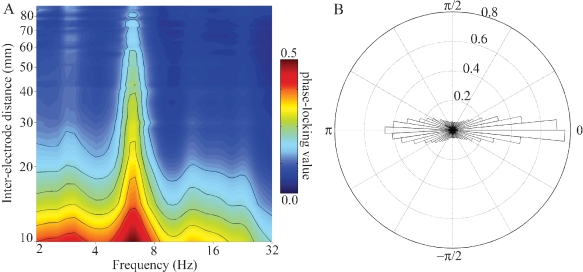
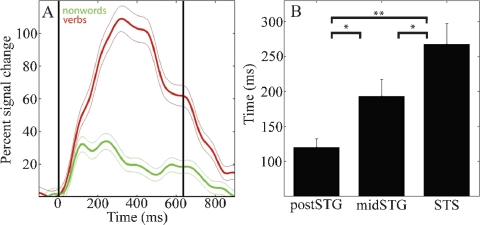
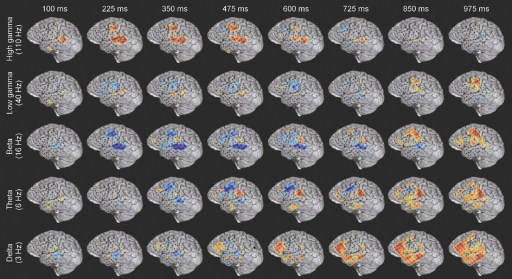
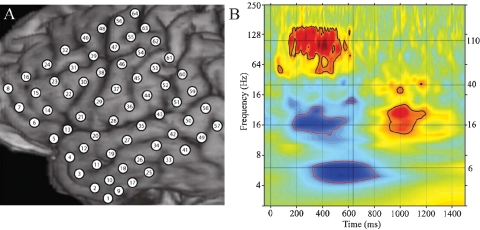
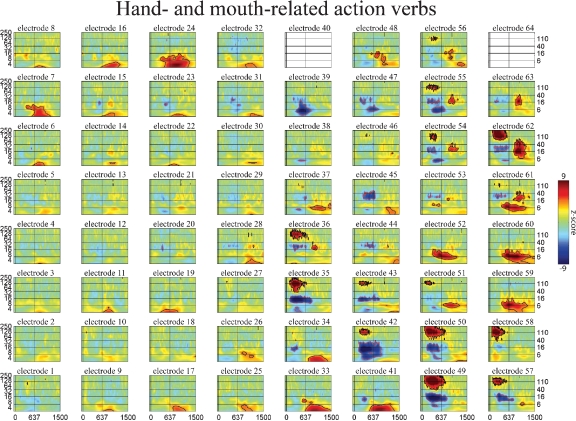
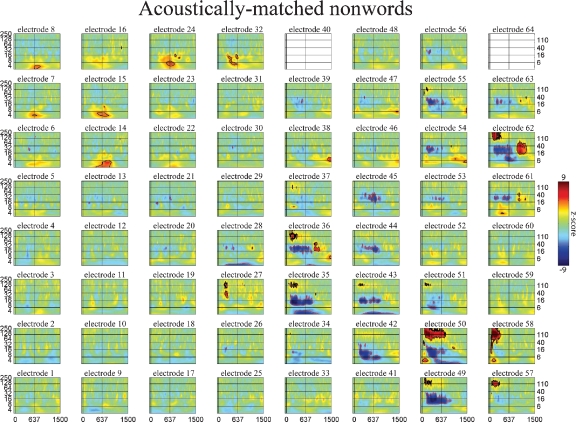
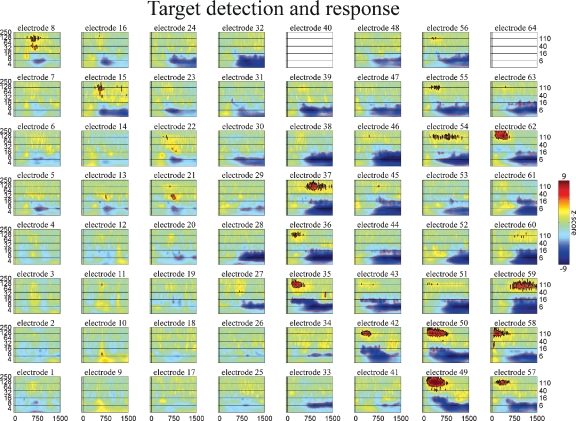
We examined the spatiotemporal dynamics of word processing by recording the electrocorticogram (ECoG) from the lateral frontotemporal cortex of neurosurgical patients chronically implanted with subdural electrode grids. Subjects engaged in a target detection task where proper names served as infrequent targets embedded in a stream of task-irrelevant verbs and nonwords. Verbs described actions related to the hand (e.g, throw) or mouth (e.g., blow), while unintelligible nonwords were sounds which matched the verbs in duration, intensity, temporal modulation, and power spectrum. Complex oscillatory dynamics were observed in the delta, theta, alpha, beta, low, and high gamma (HG) bands in response to presentation of all stimulus types. HG activity (80-200 Hz) in the ECoG tracked the spatiotemporal dynamics of word processing and identified a network of cortical structures involved in early word processing. HG was used to determine the relative onset, peak, and offset times of local cortical activation during word processing. Listening to verbs compared to nonwords sequentially activates first the posterior superior temporal gyrus (post-STG), then the middle superior temporal gyrus (mid-STG), followed by the superior temporal sulcus (STS). We also observed strong phase-locking between pairs of electrodes in the theta band, with weaker phase-locking occurring in the delta, alpha, and beta frequency ranges. These results provide details on the first few hundred milliseconds of the spatiotemporal evolution of cortical activity during word processing and provide evidence consistent with the hypothesis that an oscillatory hierarchy coordinates the flow of information between distinct cortical regions during goal-directed behavior.
我们通过记录长期植入硬膜下电极网格的神经外科患者外侧额颞叶皮质的皮质电图(ECoG),研究了词汇加工的时空动态。受试者参与了一项目标检测任务,其中专有名词作为不常见目标,嵌入在一系列与任务无关的动词和非词流中。动词描述与手(如扔)或嘴(如吹)相关的动作,而无法理解的非词是在持续时间、强度、时间调制和功率谱方面与动词匹配的声音。在呈现所有刺激类型时,在δ、θ、α、β、低频和高频γ(HG)频段观察到了复杂的振荡动态。ECoG中的HG活动(80 - 200 Hz)追踪了词汇加工的时空动态,并确定了参与早期词汇加工的皮质结构网络。HG被用于确定词汇加工过程中局部皮质激活的相对起始、峰值和结束时间。与依次听非词相比,听动词首先激活后颞上回(post - STG),然后激活颞中回(mid - STG),接着激活颞上沟(STS)。我们还观察到θ频段电极对之间有强烈的锁相,而在δ、α和β频率范围内锁相较弱。这些结果提供了词汇加工过程中皮质活动时空演变最初几百毫秒的详细信息,并提供了与以下假设一致的证据:在目标导向行为中,振荡层次结构协调不同皮质区域之间的信息流。