Division of General Internal Medicine, Mayo Clinic, Rochester, MN, USA.
Evid Based Complement Alternat Med. 2011;2011:350697. doi: 10.1093/ecam/nen069. Epub 2011 Jun 23.
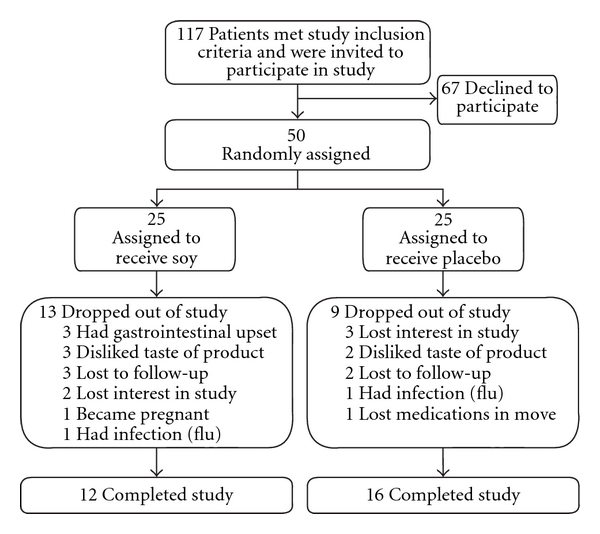
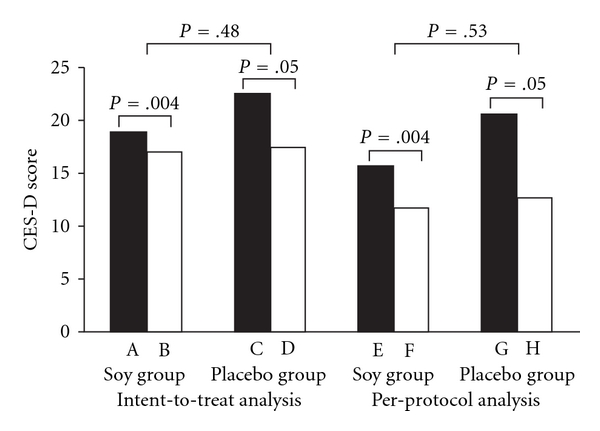
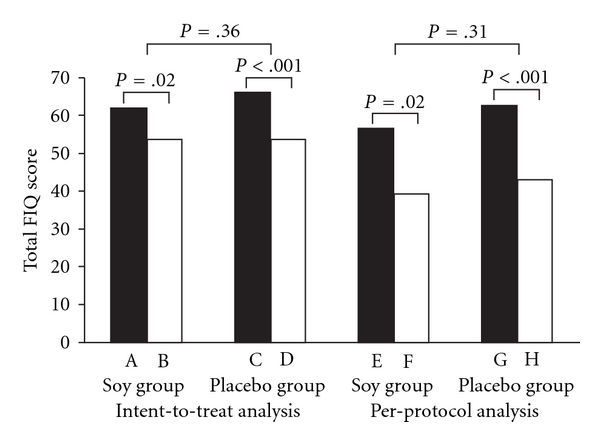
Most patients with fibromyalgia use complementary and alternative medicine (CAM). Properly designed controlled trials are necessary to assess the effectiveness of these practices. This study was a randomized, double-blind, placebo-controlled, early phase trial. Fifty patients seen at a fibromyalgia outpatient treatment program were randomly assigned to a daily soy or placebo (casein) shake. Outcome measures were scores of the Fibromyalgia Impact Questionnaire (FIQ) and the Center for Epidemiologic Studies Depression Scale (CES-D) at baseline and after 6 weeks of intervention. Analysis was with standard statistics based on the null hypothesis, and separation test for early phase CAM comparative trials. Twenty-eight patients completed the study. Use of standard statistics with intent-to-treat analysis showed that total FIQ scores decreased by 14% in the soy group (P = .02) and by 18% in the placebo group (P < .001). The difference in change in scores between the groups was not significant (P = .16). With the same analysis, CES-D scores decreased in the soy group by 16% (P = .004) and in the placebo group by 15% (P = .05). The change in scores was similar in the groups (P = .83). Results of statistical analysis using the separation test and intent-to-treat analysis revealed no benefit of soy compared with placebo. Shakes that contain soy and shakes that contain casein, when combined with a multidisciplinary fibromyalgia treatment program, provide a decrease in fibromyalgia symptoms. Separation between the effects of soy and casein (control) shakes did not favor the intervention. Therefore, large-sample studies using soy for patients with fibromyalgia are probably not indicated.
大多数纤维肌痛患者使用补充和替代医学(CAM)。有必要设计适当的对照试验来评估这些实践的有效性。本研究是一项随机、双盲、安慰剂对照的早期试验。50 名在纤维肌痛门诊治疗计划中就诊的患者被随机分配到每天服用大豆或安慰剂(酪蛋白)奶昔。主要结局指标是基线和干预 6 周后的纤维肌痛影响问卷(FIQ)和流行病学研究中心抑郁量表(CES-D)评分。分析采用基于零假设的标准统计学方法和早期阶段 CAM 比较试验的分离检验。28 名患者完成了研究。采用意向治疗分析的标准统计学方法显示,大豆组的总 FIQ 评分下降了 14%(P =.02),安慰剂组下降了 18%(P <.001)。两组间评分变化的差异无统计学意义(P =.16)。同样的分析显示,大豆组的 CES-D 评分下降了 16%(P =.004),安慰剂组下降了 15%(P =.05)。两组评分变化相似(P =.83)。使用分离检验和意向治疗分析的统计分析结果表明,大豆与安慰剂相比没有益处。含有大豆的奶昔和含有酪蛋白的奶昔与多学科纤维肌痛治疗方案相结合,可减轻纤维肌痛症状。大豆和酪蛋白(对照)奶昔的作用分离并未支持干预措施。因此,对于纤维肌痛患者使用大豆的大样本研究可能并不合适。