Alecu Iulian, Bousquet Cedric, Jaulent Marie-Christine
Université Paris Descartes, Faculté de Médecine, Inserm, U729, SPIM, Paris, 75006 France.
BMC Med Inform Decis Mak. 2008 Oct 27;8 Suppl 1(Suppl 1):S4. doi: 10.1186/1472-6947-8-S1-S4.
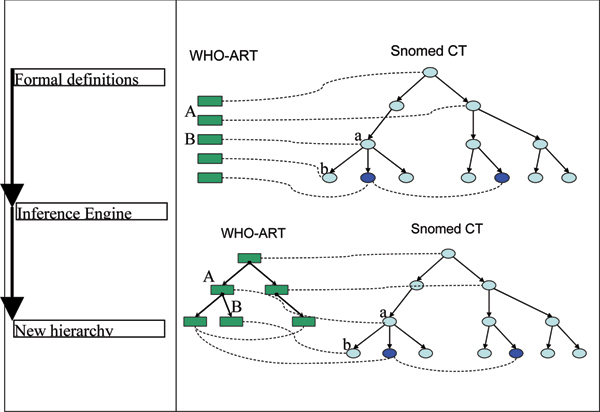
WHO-ART and MedDRA are medical terminologies used for the coding of adverse drug reactions in pharmacovigilance databases. MedDRA proposes 13 Special Search Categories (SSC) grouping terms associated to specific medical conditions. For instance, the SSC "Haemorrhage" includes 346 MedDRA terms among which 55 are also WHO-ART terms. WHO-ART itself does not provide such groupings. Our main contention is the possibility of classifying WHO-ART terms in semantic categories by using knowledge extracted from SNOMED CT. A previous paper presents the way WHO-ART term definitions have been automatically generated in a description logics formalism by using their corresponding SNOMED CT synonyms. Based on synonymy and relative position of WHO-ART terms in SNOMED CT, specialization or generalization relationships could be inferred. This strategy is successful for grouping the WHO-ART terms present in most MedDRA SSCs. However the strategy failed when SSC were organized on other basis than taxonomy.
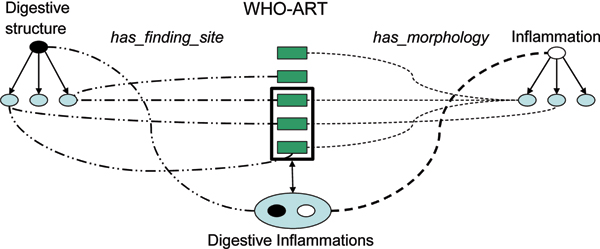
We propose a new method that improves the previous WHO-ART structure by integrating the associative relationships included in SNOMED CT.
The new method improves the groupings. For example, none of the 55 WHO-ART terms in the Haemorrhage SSC were matched using the previous method. With the new method, we improve the groupings and obtain 87% coverage of the Haemorrhage SSC.
SNOMED CT's terminological structure can be used to perform automated groupings in WHO-ART. This work proves that groupings already present in the MedDRA SSCs (e.g. the haemorrhage SSC) may be retrieved using classification in SNOMED CT.
WHO-ART和MedDRA是用于药物警戒数据库中药物不良反应编码的医学术语。MedDRA提出了13个特殊搜索类别(SSC),将与特定医疗状况相关的术语进行分组。例如,“出血”这一特殊搜索类别包含346个MedDRA术语,其中55个也是WHO-ART术语。而WHO-ART本身并未提供此类分组。我们的主要观点是利用从SNOMED CT中提取的知识将WHO-ART术语分类到语义类别中的可能性。之前的一篇论文介绍了通过使用相应的SNOMED CT同义词以描述逻辑形式自动生成WHO-ART术语定义的方法。基于WHO-ART术语在SNOMED CT中的同义关系和相对位置,可以推断出专门化或泛化关系。该策略成功地对大多数MedDRA特殊搜索类别中的WHO-ART术语进行了分组。然而,当特殊搜索类别不是基于分类法组织时,该策略就会失败。
我们提出了一种新方法,通过整合SNOMED CT中包含的关联关系来改进先前的WHO-ART结构。
新方法改进了分组。例如,使用先前的方法,出血特殊搜索类别中的55个WHO-ART术语均未匹配成功。采用新方法,我们改进了分组,并实现了对出血特殊搜索类别87%的覆盖。
SNOMED CT的术语结构可用于在WHO-ART中进行自动分组。这项工作证明,MedDRA特殊搜索类别中已有的分组(如出血特殊搜索类别)可以通过在SNOMED CT中进行分类来检索。