• 文献检索
  • 文档翻译
  • 深度研究
  • 学术资讯
  • Suppr Zotero 插件Zotero 插件
  • 邀请有礼
  • 套餐&价格
  • 历史记录
应用&插件
Suppr Zotero 插件Zotero 插件浏览器插件Mac 客户端Windows 客户端微信小程序
定价
高级版会员购买积分包购买API积分包
服务
文献检索文档翻译深度研究API 文档MCP 服务
关于我们
关于 Suppr公司介绍联系我们用户协议隐私条款
关注我们

Suppr 超能文献

核心技术专利:CN118964589B侵权必究
粤ICP备2023148730 号-1Suppr @ 2026

文献检索

告别复杂PubMed语法,用中文像聊天一样搜索,搜遍4000万医学文献。AI智能推荐,让科研检索更轻松。

立即免费搜索

文件翻译

保留排版,准确专业,支持PDF/Word/PPT等文件格式,支持 12+语言互译。

免费翻译文档

深度研究

AI帮你快速写综述,25分钟生成高质量综述,智能提取关键信息,辅助科研写作。

立即免费体验

比较两个基于网络的戒烟项目:随机对照试验。

Comparing two web-based smoking cessation programs: randomized controlled trial.

作者信息

McKay H Garth, Danaher Brian G, Seeley John R, Lichtenstein Edward, Gau Jeff M

机构信息

Oregon Research Institute, 1715 Franklin Boulevard, Eugene, OR 97403, USA.

出版信息

J Med Internet Res. 2008 Nov 18;10(5):e40. doi: 10.2196/jmir.993.

DOI:10.2196/jmir.993
PMID:19017582
原文链接:https://pmc.ncbi.nlm.nih.gov/articles/PMC2630830/
Abstract

BACKGROUND

Smoking cessation remains a significant public health problem. Innovative interventions that use the Internet have begun to emerge that offer great promise in reaching large numbers of participants and encouraging widespread behavior change. To date, the relatively few controlled trials of Web-based smoking cessation programs have been limited by short follow-up intervals.

OBJECTIVE

We describe the 6-month follow-up results of a randomized controlled trial in which participants recruited online were randomly assigned to either a Web-based smoking cessation program (Quit Smoking Network; QSN) or a Web-based exercise enhancement program (Active Lives) adapted somewhat to encourage smoking cessation.

METHODS

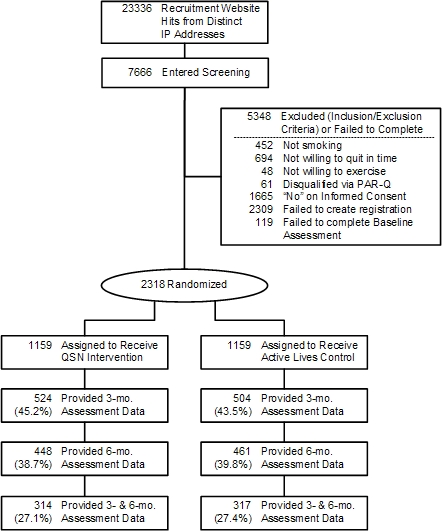
The study was a two-arm randomized controlled trial that compared two Web-based smoking cessation programs: (1) the QSN intervention condition presented cognitive-behavioral strategies, and (2) the Active Lives control condition provided participants with guidance in developing a physical activity program to assist them with quitting. The QSN condition provided smoking cessation information and behavior change strategies while the Active Lives condition provided participants with physical activity recommendations and goal setting. The QSN condition was designed to be more engaging (eg, it included multimedia components) and to present much greater content than is typically found in smoking cessation programs.

RESULTS

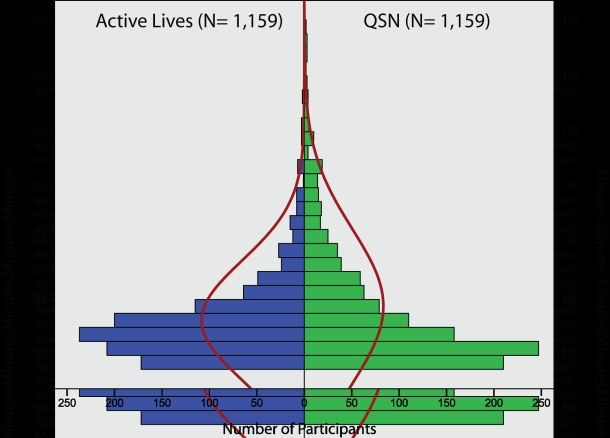
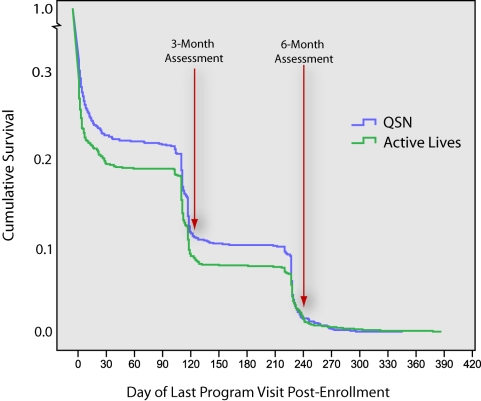
Contrary to our hypotheses, no between-condition differences in smoking abstinence were found at 3- and 6-month follow-up assessments. While participants in the QSN intervention condition spent more time than controls visiting the online program, the median number of 1.0 visit in each condition and the substantial attrition (60.8% at the 6-month follow-up) indicate that participants were not as engaged as we had expected.

CONCLUSIONS

Contrary to our hypothesis, our test of two Web-based smoking cessation conditions, an intervention and an attention placebo control, failed to show differences at 3- and 6-month assessments. We explored possible reasons for this finding, including limited engagement of participants and simplifying program content and architecture. Future research needs to address methods to improve participant engagement in online smoking cessation programs. Possible approaches in this regard can include new informed consent procedures that better explain the roles and responsibilities of being a research participant, new program designs that add more vitality (changing content from visit to visit), and new types of reminders pushed out to participants to encourage return visits. Simplifying program content through a combination of enhanced tailoring and information architecture also merits further research attention.
https://cdn.ncbi.nlm.nih.gov/pmc/blobs/dd37/2630830/c09bf09282b5/jmir_v10i5e40_fig3.jpg
https://cdn.ncbi.nlm.nih.gov/pmc/blobs/dd37/2630830/e8d23dd0c557/jmir_v10i5e40_fig1.jpg
https://cdn.ncbi.nlm.nih.gov/pmc/blobs/dd37/2630830/8bd78465d61f/jmir_v10i5e40_fig2.jpg
https://cdn.ncbi.nlm.nih.gov/pmc/blobs/dd37/2630830/c09bf09282b5/jmir_v10i5e40_fig3.jpg
https://cdn.ncbi.nlm.nih.gov/pmc/blobs/dd37/2630830/e8d23dd0c557/jmir_v10i5e40_fig1.jpg
https://cdn.ncbi.nlm.nih.gov/pmc/blobs/dd37/2630830/8bd78465d61f/jmir_v10i5e40_fig2.jpg
https://cdn.ncbi.nlm.nih.gov/pmc/blobs/dd37/2630830/c09bf09282b5/jmir_v10i5e40_fig3.jpg
摘要

背景

戒烟仍然是一个重大的公共卫生问题。利用互联网的创新干预措施已开始出现,有望覆盖大量参与者并促进广泛的行为改变。迄今为止,相对较少的基于网络的戒烟项目对照试验受到随访间隔时间短的限制。

目的

我们描述了一项随机对照试验的6个月随访结果,该试验中在线招募的参与者被随机分配到一个基于网络的戒烟项目(戒烟网络;QSN)或一个为鼓励戒烟而稍作调整的基于网络的运动增强项目(积极生活)。

方法

该研究是一项双臂随机对照试验,比较了两个基于网络的戒烟项目:(1)QSN干预组呈现认知行为策略,(2)积极生活对照组为参与者提供制定体育活动计划的指导以帮助他们戒烟。QSN组提供戒烟信息和行为改变策略,而积极生活组为参与者提供体育活动建议和目标设定。QSN组的设计更具吸引力(例如,它包括多媒体组件),并且提供的内容比典型的戒烟项目要多得多。

结果

与我们的假设相反,在3个月和6个月的随访评估中,未发现戒烟情况在组间存在差异。虽然QSN干预组的参与者访问在线项目的时间比对照组多,但每组的访问中位数为1.0次,且流失率较高(6个月随访时为60.8%),这表明参与者的参与度不如我们预期的高。

结论

与我们的假设相反,我们对两个基于网络的戒烟条件(一个干预组和一个注意力安慰剂对照组)的测试在3个月和6个月的评估中未显示出差异。我们探讨了这一结果的可能原因,包括参与者参与度有限以及简化项目内容和架构。未来的研究需要解决提高参与者参与在线戒烟项目的方法。这方面可能的方法包括新的知情同意程序,更好地解释作为研究参与者的角色和责任;新的项目设计,增加更多活力(每次访问改变内容);以及向参与者推送新型提醒以鼓励回访。通过增强个性化定制和信息架构相结合来简化项目内容也值得进一步的研究关注。

相似文献

1
Comparing two web-based smoking cessation programs: randomized controlled trial.比较两个基于网络的戒烟项目:随机对照试验。
J Med Internet Res. 2008 Nov 18;10(5):e40. doi: 10.2196/jmir.993.
2
Use of non-assigned smoking cessation programs among participants of a Web-based randomized controlled trial.在一项基于网络的随机对照试验参与者中使用非指定的戒烟计划。
J Med Internet Res. 2009 Jun 25;11(2):e26. doi: 10.2196/jmir.1172.
3
A digital smoking cessation program delivered through internet and cell phone without nicotine replacement (happy ending): randomized controlled trial.一项通过互联网和手机提供的无尼古丁替代的数字戒烟计划(皆大欢喜结局):随机对照试验
J Med Internet Res. 2008 Nov 28;10(5):e51. doi: 10.2196/jmir.1005.
4
The role of engagement in a tailored web-based smoking cessation program: randomized controlled trial.参与定制的基于网络的戒烟计划的作用:随机对照试验。
J Med Internet Res. 2008 Nov 4;10(5):e36. doi: 10.2196/jmir.1002.
5
Internet-based interventions for smoking cessation.基于互联网的戒烟干预措施。
Cochrane Database Syst Rev. 2010 Sep 8(9):CD007078. doi: 10.1002/14651858.CD007078.pub3.
6
Improving adherence to web-based cessation programs: a randomized controlled trial study protocol.提高基于网络的戒烟计划的依从性:一项随机对照试验研究方案。
Trials. 2013 Feb 17;14:48. doi: 10.1186/1745-6215-14-48.
7
Preventing smoking relapse via Web-based computer-tailored feedback: a randomized controlled trial.通过基于网络的计算机定制反馈预防吸烟复发:一项随机对照试验。
J Med Internet Res. 2012 Aug 20;14(4):e109. doi: 10.2196/jmir.2057.
8
Effect of adding a virtual community (bulletin board) to smokefree.gov: randomized controlled trial.在无烟.gov网站添加虚拟社区(公告栏)的效果:随机对照试验。
J Med Internet Res. 2008 Dec 19;10(5):e53. doi: 10.2196/jmir.1124.
9
Effect of tailoring in an internet-based intervention for smoking cessation: randomized controlled trial.量身定制的基于互联网的戒烟干预措施的效果:随机对照试验。
J Med Internet Res. 2011 Dec 15;13(4):e121. doi: 10.2196/jmir.1605.
10
Phone and web-based tobacco cessation treatment: real-world utilization patterns and outcomes for 11,000 tobacco users.基于电话和网络的戒烟治疗:11000名烟草使用者的实际使用模式和结果
J Med Internet Res. 2008 Nov 14;10(5):e41. doi: 10.2196/jmir.999.

引用本文的文献

1
Differences in the effectiveness of individual-level smoking cessation interventions by socioeconomic status.个体层面戒烟干预措施的有效性在社会经济地位方面的差异。
Cochrane Database Syst Rev. 2025 Jan 27;1(1):CD015120. doi: 10.1002/14651858.CD015120.pub2.
2
Effectiveness of pedometer-based walking programmes in improving some modifiable risk factors of stroke among community-dwelling older adults: a systematic review, theoretical synthesis and meta-analysis.基于计步器的步行计划对改善社区居住老年人中风可改变风险因素的有效性:系统评价、理论综合和荟萃分析。
BMC Geriatr. 2024 Jun 13;24(1):516. doi: 10.1186/s12877-024-05069-z.
3

本文引用的文献

1
Phone and web-based tobacco cessation treatment: real-world utilization patterns and outcomes for 11,000 tobacco users.基于电话和网络的戒烟治疗:11000名烟草使用者的实际使用模式和结果
J Med Internet Res. 2008 Nov 14;10(5):e41. doi: 10.2196/jmir.999.
2
Web-based smoking-cessation programs: results of a randomized trial.基于网络的戒烟项目:一项随机试验的结果
Am J Prev Med. 2008 May;34(5):373-81. doi: 10.1016/j.amepre.2007.12.024.
3
ChewFree.com: evaluation of a Web-based cessation program for smokeless tobacco users.ChewFree.com:针对无烟烟草使用者的基于网络的戒烟项目评估。
Digital health interventions for all? Examining inclusivity across all stages of the digital health intervention research process.
数字健康干预面向所有人?审视数字健康干预研究过程各个阶段的包容性。
Trials. 2024 Jan 30;25(1):98. doi: 10.1186/s13063-024-07937-w.
4
Secure Asynchronous Communication Between Smokers and Tobacco Treatment Specialists: Secondary Analysis of a Web-Assisted Tobacco Intervention in the QUIT-PRIMO and National Dental PBRN Networks.吸烟者与烟草治疗专家之间的安全异步通信:QUIT-PRIMO和国家牙科PBRN网络中网络辅助烟草干预的二次分析。
J Med Internet Res. 2020 May 6;22(5):e13289. doi: 10.2196/13289.
5
Exercise interventions for smoking cessation.用于戒烟的运动干预措施。
Cochrane Database Syst Rev. 2019 Oct 30;2019(10):CD002295. doi: 10.1002/14651858.CD002295.pub6.
6
Outcomes and Device Usage for Fully Automated Internet Interventions Designed for a Smartphone or Personal Computer: The MobileQuit Smoking Cessation Randomized Controlled Trial.专为智能手机或个人电脑设计的全自动互联网干预措施的效果及设备使用情况:戒烟移动随机对照试验。
J Med Internet Res. 2019 Jun 6;21(6):e13290. doi: 10.2196/13290.
7
Conversation Within a Facebook Smoking Cessation Intervention Trial For Young Adults (Tobacco Status Project): Qualitative Analysis.脸书针对年轻人的戒烟干预试验(烟草状况项目)中的对话:定性分析
JMIR Form Res. 2018 Sep 4;2(2):e11138. doi: 10.2196/11138.
8
Which eHealth interventions are most effective for smoking cessation? A systematic review.哪些电子健康干预措施对戒烟最有效?一项系统综述。
Patient Prefer Adherence. 2018 Oct 8;12:2065-2084. doi: 10.2147/PPA.S169397. eCollection 2018.
9
Exploring Online Asynchronous Counseling With Tobacco Treatment Specialists in the QUIT-PRIMO and National Dental PBRN HI-QUIT Studies: Who Uses It and What Do They Say?在QUIT-PRIMO和国家牙科实践-based研究网络HI-QUIT研究中与烟草治疗专家探索在线异步咨询:谁在使用它以及他们说了什么?
Am J Health Promot. 2018 Jun;32(5):1170-1177. doi: 10.1177/0890117116670972. Epub 2016 Oct 10.
10
A randomized controlled evaluation of the tobacco status project, a Facebook intervention for young adults.一项针对年轻人的Facebook干预措施——烟草状况项目的随机对照评估。
Addiction. 2018 May 24. doi: 10.1111/add.14245.
Nicotine Tob Res. 2008 Feb;10(2):381-91. doi: 10.1080/14622200701824984.
4
Analysis of binary outcomes with missing data: missing = smoking, last observation carried forward, and a little multiple imputation.对存在缺失数据的二元结局进行分析:缺失值 = 吸烟情况,采用末次观察值结转法,并进行少量多重填补。
Addiction. 2007 Oct;102(10):1564-73. doi: 10.1111/j.1360-0443.2007.01946.x.
5
Measuring participant rurality in Web-based interventions.衡量基于网络干预措施中的参与者的农村地区属性。
BMC Public Health. 2007 Aug 31;7:228. doi: 10.1186/1471-2458-7-228.
6
Smoking cessation via the internet: a randomized clinical trial of an internet intervention as adjuvant treatment in a smoking cessation intervention.通过互联网戒烟:一项关于互联网干预作为戒烟干预辅助治疗的随机临床试验。
Nicotine Tob Res. 2006 Dec;8 Suppl 1:S59-67. doi: 10.1080/14622200601047900.
7
American Cancer Society's QuitLink: randomized trial of Internet assistance.美国癌症协会的戒烟热线:互联网辅助的随机试验。
Nicotine Tob Res. 2007 Mar;9(3):415-20. doi: 10.1080/14622200701188877.
8
Self-help cessation programs for smokeless tobacco users: long-term follow-up of a randomized trial.无烟烟草使用者的自助戒烟计划:一项随机试验的长期随访
Nicotine Tob Res. 2007 Feb;9(2):281-9. doi: 10.1080/14622200601080281.
9
The law of attrition revisited.再探磨损定律。
J Med Internet Res. 2006 Sep 29;8(3):e20; author reply e21. doi: 10.2196/jmir.8.3.e20.
10
Defining participant exposure measures in Web-based health behavior change programs.定义基于网络的健康行为改变项目中的参与者暴露测量指标。
J Med Internet Res. 2006 Aug 30;8(3):e15. doi: 10.2196/jmir.8.3.e15.