Stoddard Jacqueline L, Augustson Erik M, Moser Richard P
SAIC-Frederick Inc, NCI-Frederick, Frederick, MD 21702, USA.
J Med Internet Res. 2008 Dec 19;10(5):e53. doi: 10.2196/jmir.1124.
Demand for online information and help exceeds most other forms of self-help. Web-assisted tobacco interventions (WATIs) offer a potentially low-cost way to reach millions of smokers who wish to quit smoking and to test various forms of online assistance for use/utilization and user satisfaction.
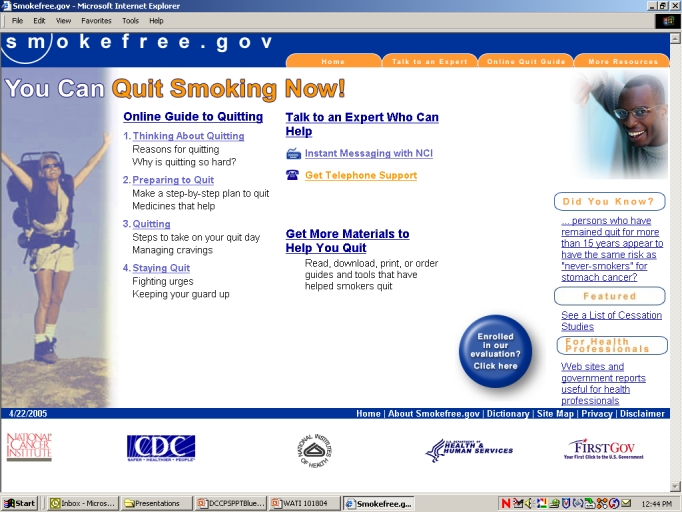
Our primary aim was to determine the utilization of and satisfaction with 2 versions of a smoking cessation website (smokefree.gov), one of which included an asynchronous bulletin board (BB condition). A secondary goal was to measure changes in smoking behavior 3 months after enrollment in the study.
All participants were adult federal employees or contractors to the federal government who responded to an email and indicated a willingness to quit smoking in 30 days. We randomly assigned participants to either the BB condition or the publicly available version--usual care (UC)--and then assessed the number of minutes of website use and satisfaction with each condition as well as changes in smoking behavior.
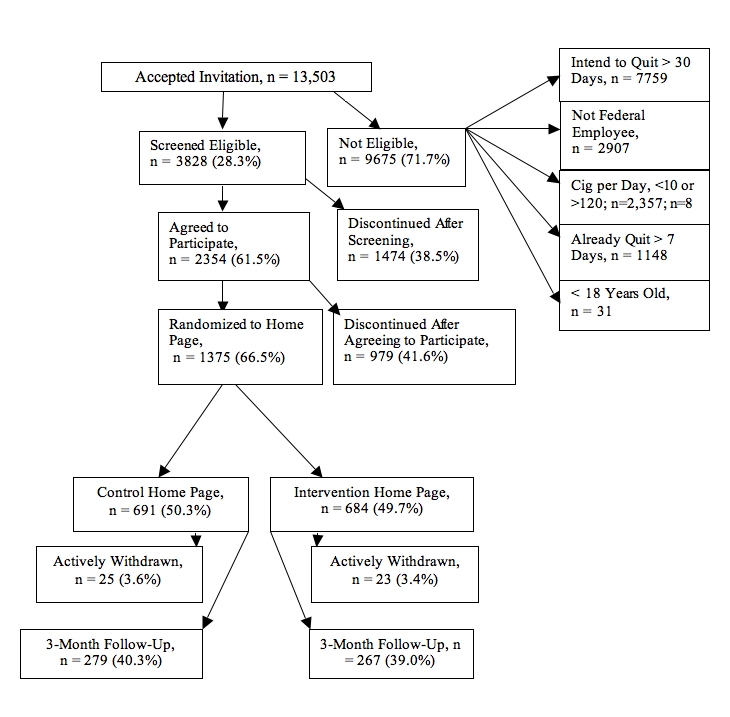
Among the 1375 participants, 684 were randomized to the BB intervention, and 691 to the control UC condition. A total of 39.7% returned a follow-up questionnaire after 3 months, with similar rates across the two groups (UC: n=279, 40.3%; BB: n=267, 39.0%). Among those respondents assigned to the BB condition, only 81 participants (11.8%) elected to view the bulletin board or post a message, limiting our ability to analyze the impact of bulletin board use on cessation. Satisfaction with the website was high and did not differ significantly between conditions (UC: 90.2%, BB: 84.9%, P= .08). Utilization, or minutes spent on the website, was significantly longer for the BB than the UC condition (18.0 vs 11.1, P = .01) and was nearly double for those who remained in the study (21.2) than for those lost to follow-up (9.6, P< .001). Similar differences were observed between those who made a serious quit attempt versus those who did not (22.4 vs 10.4, P= .02) and between those with a quit date on or a few days prior to the enrollment date versus those with a later quit date (29.4 vs 12.5, P = .001). There were no statistically significant differences in quit rates between the BB and UC group, both in intent-to-treat analysis (ITT) and in analyzing the adherence subgroup (respondents) only. Combined across the UC and BB groups, 7-day abstinence was 6.8% with ITT and 17.6% using only participants in the follow-up (adherence). For participants who attempted to quit within a few days of study entry (vs 30 days), quit rates were 29.6% (ITT) and 44.4% (adherence).
Quit rates for participants were similar to other WATIs, with the most favorable outcomes demonstrated by smokers ready to quit at the time of enrolling in the trial and smokers using pharmacotherapy. Utilization of the asynchronous bulletin board was lower than expected, and did not have an impact on outcomes (quit rates). Given the demand for credible online resources for smoking cessation, future studies should continue to evaluate use of and satisfaction with Web features and to clarify results in terms of time since last cigarette as well as use of pharmacotherapy.
对在线信息和帮助的需求超过了大多数其他形式的自助方式。网络辅助烟草干预措施(WATI)提供了一种潜在的低成本途径,可覆盖数百万希望戒烟的吸烟者,并测试各种形式的在线援助的使用情况及用户满意度。
我们的主要目的是确定一个戒烟网站(smokefree.gov)的两个版本的使用情况和满意度,其中一个版本包含一个异步公告栏(BB组)。次要目标是在研究入组3个月后测量吸烟行为的变化。
所有参与者均为成年联邦雇员或联邦政府承包商,他们回复了一封电子邮件,并表示愿意在30天内戒烟。我们将参与者随机分配到BB组或公开可用版本——常规护理(UC组),然后评估网站使用的分钟数、对每种情况的满意度以及吸烟行为的变化。
在1375名参与者中,684人被随机分配到BB干预组,691人被分配到对照UC组。3个月后共有39.7%的人返回了随访问卷,两组的回复率相似(UC组:n = 279,40.3%;BB组:n = 267,39.0%)。在分配到BB组的受访者中,只有81名参与者(11.8%)选择查看公告栏或发布消息,这限制了我们分析公告栏使用对戒烟影响的能力。对网站的满意度较高,两组之间无显著差异(UC组:90.2%,BB组:84.9%,P = 0.08)。BB组在网站上的使用时间,即花费的分钟数,显著长于UC组(18.0对11.1,P = 0.01),并且留在研究中的参与者的使用时间(21.2)几乎是失访者(9.6,P < 0.001)的两倍。在进行认真戒烟尝试的人与未进行尝试的人之间(22.4对10.4,P = 0.02)以及在入组日期或入组日期前几天有戒烟日期的人与有较晚戒烟日期的人之间(29.4对12.5,P = 0.001)也观察到了类似差异。在意向性分析(ITT)以及仅分析依从性子组(受访者)时,BB组和UC组之间的戒烟率无统计学显著差异。综合UC组和BB组,ITT分析的7天戒断率为6.8%,仅使用随访中的参与者(依从性)时为17.6%。对于在研究入组后几天内(与30天相比)尝试戒烟的参与者,戒烟率为29.6%(ITT)和44.4%(依从性)。
参与者的戒烟率与其他WATI相似,在试验入组时准备戒烟的吸烟者和使用药物治疗的吸烟者显示出最有利的结果。异步公告栏的使用率低于预期,并且对结果(戒烟率)没有影响。鉴于对可靠的在线戒烟资源的需求,未来的研究应继续评估网络功能的使用情况和满意度,并根据距上次吸烟的时间以及药物治疗的使用情况来阐明结果。