Wang Chong-Zhi, Aung Han H, Zhang Bin, Sun Shi, Li Xiao-Li, He Hui, Xie Jing-Tian, He Tong-Chuan, Du Wei, Yuan Chun-Su
Tang Center for Herbal Medicine Research, The Pritzker School of Medicine, University of Chicago, Chicago, IL 60637, USA.
Anticancer Res. 2008 Sep-Oct;28(5A):2545-51.
Former studies have shown that extract from American ginseng (Panax quinquefolius) may possess certain antiproliferative effects on cancer cells. In this study, the chemical constituents of both untreated and heat-processed American ginseng and their antiproliferative activities on human breast cancer cells were evaluated.
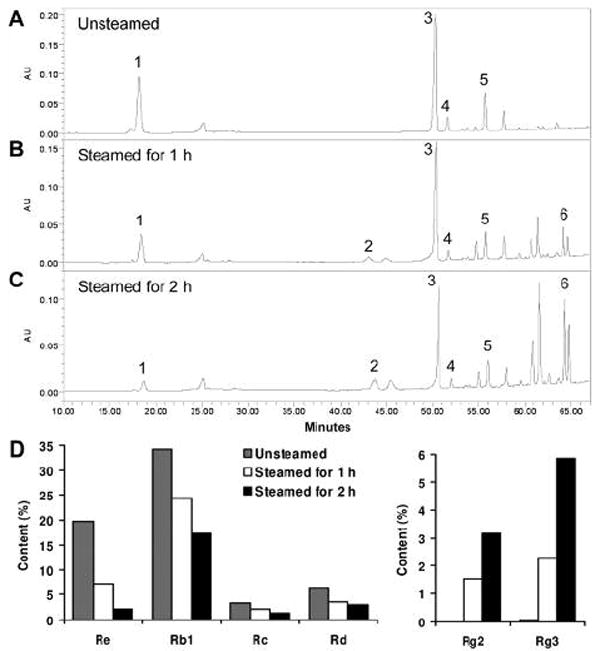
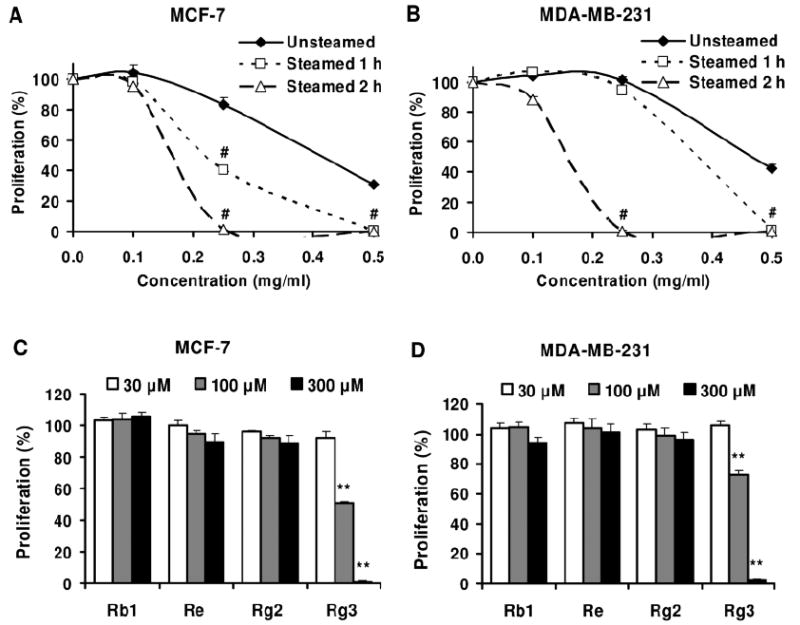
American ginseng roots were steamed at 120 degrees C for 1 h or 2 h. The major ginsenosides in the two steamed and in the unsteamed extracts were quantitatively determined using high performance liquid chromatography (HPLC). The antiproliferative activities of these extracts and individual ginsenosides on MCF-7 and MDA-MB-231 breast cancer cells were assayed using the MTS method. The effects of the extracts and the ginsenosides on the induction of cell apoptosis, the expression of cyclins A and D1, and cell cycle arrest were evaluated.
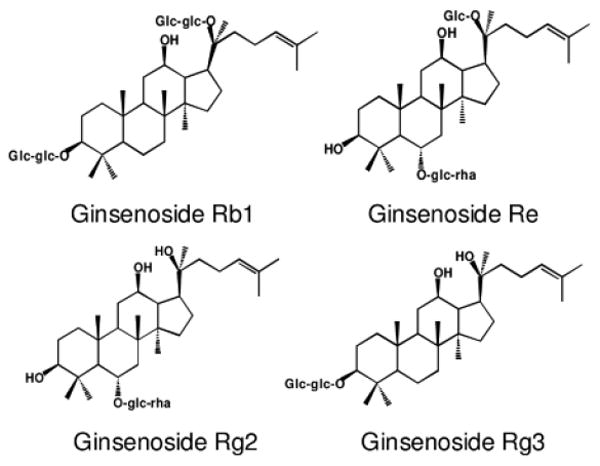
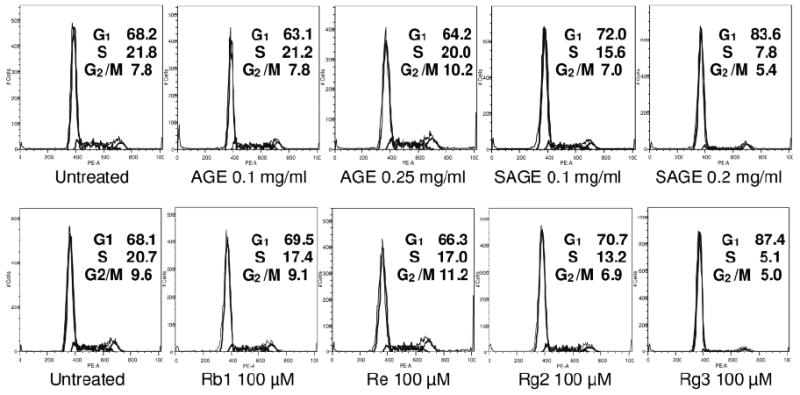
Compared to the untreated extract, heat-processing reduced the content of ginsenosides Rb1, Re, Rc and Rd, and increased the content of Rg2 and Rg3. After 2 h steaming, the percent content of ginsenoside Rg3 was increased from 0.06% to 5.9%. Compared to the unsteamed extract, the 2 h steamed extract significantly increased the antiproliferative activity and significantly reduced the number of viable cells. The steamed extract also significantly reduced the expression of cyclin A and cyclin D1. The cell cycle assay showed that the steamed extract and ginsenoside Rg3 arrested cancer cells in G1-phase.
Heat-processing of American ginseng root significantly increases antiproliferative activity and influences the cell cycle profile.
先前的研究表明,西洋参(Panax quinquefolius)提取物可能对癌细胞具有一定的抗增殖作用。在本研究中,对未处理和热处理西洋参的化学成分及其对人乳腺癌细胞的抗增殖活性进行了评估。
西洋参根在120℃下蒸1小时或2小时。使用高效液相色谱法(HPLC)对两种蒸制提取物和未蒸制提取物中的主要人参皂苷进行定量测定。采用MTS法测定这些提取物和单个人参皂苷对MCF-7和MDA-MB-231乳腺癌细胞的抗增殖活性。评估提取物和人参皂苷对细胞凋亡诱导、细胞周期蛋白A和D1表达以及细胞周期阻滞的影响。
与未处理的提取物相比,热处理降低了人参皂苷Rb1、Re、Rc和Rd的含量,并增加了Rg2和Rg3的含量。蒸制2小时后,人参皂苷Rg3的百分含量从0.06%增加到5.9%。与未蒸制的提取物相比,蒸制2小时的提取物显著提高了抗增殖活性,并显著减少了活细胞数量。蒸制提取物还显著降低了细胞周期蛋白A和细胞周期蛋白D1的表达。细胞周期分析表明,蒸制提取物和人参皂苷Rg3使癌细胞停滞在G1期。
西洋参根的热处理显著提高了抗增殖活性并影响细胞周期分布。