Schnyder M, Kohler L, Hemphill A, Deplazes P
Institute of Parasitology, University of Zurich, Winterthurerstrasse 266a, CH-8057 Zurich, Switzerland.
Vet Parasitol. 2009 Mar 9;160(1-2):149-54. doi: 10.1016/j.vetpar.2008.10.094. Epub 2008 Nov 5.
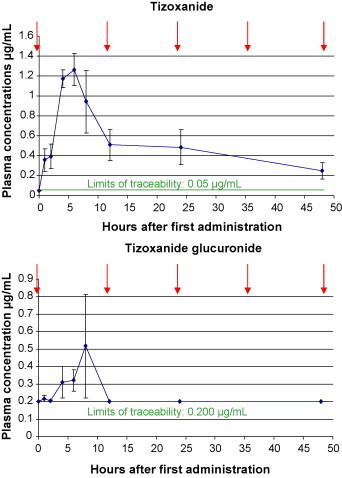
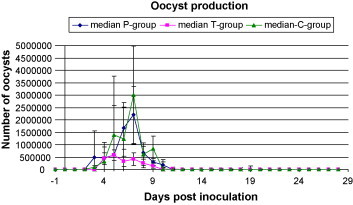
Diarrhoea caused by Cryptosporidium parvum is a major problem in calves younger than 4 weeks of age. To date only a few compounds have been approved for prophylactic and none for therapeutic use. Nitazoxanide (NTZ) has proven its efficacy in vitro against C. parvum and is approved by FDA for the treatment of human cryptosporidiosis. In a first experimental study, 3 uninfected calves were treated with NTZ and pharmacokinetics was followed through blood samples. Serum samples of uninfected treated calves contained both NTZ metabolites (tizoxanide and tizoxanide glucuronide) and oral administration at 12 h intervals was considered as optimal. Three groups of three calves (1-3 days old) were then each inoculated with 1x10(7) oocysts of C. parvum (cattle genotype): the prophylactic group received 15 mg/kg body weight NTZ twice daily orally in milk from 1 day before to 8 days postinoculation (dpi). The therapeutic group received the same dosage of NTZ for 10 days from the appearance of diarrhoea (between 1 and 5 dpi). The control group was left untreated. All calves were monitored daily from day -1 to 28 dpi and faecal samples were collected for evaluation of consistency and for determination of oocyst numbers per gram (OPG) of faeces. Diarrhoea was observed in all calves within the first week. Neither prophylactic nor therapeutic use of NTZ improved the clinical appearance and calves of the therapeutic showed a longer diarrheic episode (p<0.05) with strong altered faecal consistency compared to the untreated control group. The number of days with oocyst excretion did not differ significantly between the groups. In 5 out of 6 infected and treated calves oocyst excretion stopped only after discontinuation of treatment. In the prophylactic and in the control group mean values of the sum of the daily OPG per calf (8.5x10(6) and 8.0x10(6), respectively) and of the mean daily number of OPG (0.3x10(6) and 0.3x10(6), respectively) were similar, while the therapeutic group showed significantly lower values (1.9x10(6) and 0.06x10(6), respectively, p<0.05). However oocyst determinations in this group may have been altered by the severe diarrhoea, diluting oocyst densities in the analysed faecal samples. In conclusion, these preliminary results about the first prophylactic and therapeutic use of NTZ in calves did not show the expected positive effect on the course of the Cryptosporidium-infection, neither on reducing the clinical severity, nor on oocyst excretion.
由微小隐孢子虫引起的腹泻是4周龄以下犊牛的一个主要问题。迄今为止,只有少数化合物被批准用于预防,没有一种被批准用于治疗。硝唑尼特(NTZ)已在体外证明对微小隐孢子虫有效,并且已被美国食品药品监督管理局批准用于治疗人类隐孢子虫病。在第一项实验研究中,对3头未感染的犊牛用硝唑尼特进行治疗,并通过采集血样跟踪其药代动力学。未感染且接受治疗的犊牛血清样本中同时含有硝唑尼特的代谢产物(替唑尼特和替唑尼特葡萄糖醛酸苷),并且每隔12小时口服给药被认为是最佳的。然后将三组,每组三头犊牛(1 - 3日龄)分别接种1×10⁷个微小隐孢子虫(牛基因型)卵囊:预防组从接种前1天至接种后8天(dpi)每天两次口服给予15mg/kg体重的硝唑尼特,混于牛奶中。治疗组从出现腹泻(1至5 dpi之间)开始接受相同剂量的硝唑尼特治疗10天。对照组不进行治疗。从第 -1天至28 dpi每天对所有犊牛进行监测,并收集粪便样本以评估粪便稠度以及测定每克粪便中的卵囊数(OPG)。在第一周内所有犊牛均出现腹泻。硝唑尼特的预防和治疗使用均未改善临床症状,并且治疗组的犊牛腹泻持续时间更长(p<0.05),与未治疗的对照组相比,粪便稠度有明显改变。各组之间卵囊排泄天数没有显著差异。在6头感染并接受治疗的犊牛中,有5头仅在停止治疗后卵囊排泄才停止。在预防组和对照组中,每头犊牛每日OPG总和的平均值(分别为8.5×10⁶和8.0×10⁶)以及每日平均OPG数(分别为0.3×10⁶和0.3×10⁶)相似,而治疗组的值显著较低(分别为1.9×10⁶和0.06×10⁶,p<0.05)。然而,该组中的卵囊测定可能因严重腹泻而受到影响,从而稀释了所分析粪便样本中的卵囊密度。总之,这些关于硝唑尼特在犊牛中首次预防和治疗使用的初步结果并未显示出对隐孢子虫感染病程有预期的积极影响,既未减轻临床严重程度,也未减少卵囊排泄。