Anand Amit, Li Yu, Wang Yang, Lowe Mark J, Dzemidzic Mario
Department of Psychiatry, Indiana University School of Medicine, Indianapolis, IN, USA.
Psychiatry Res. 2009 Mar 31;171(3):189-98. doi: 10.1016/j.pscychresns.2008.03.012. Epub 2009 Feb 20.
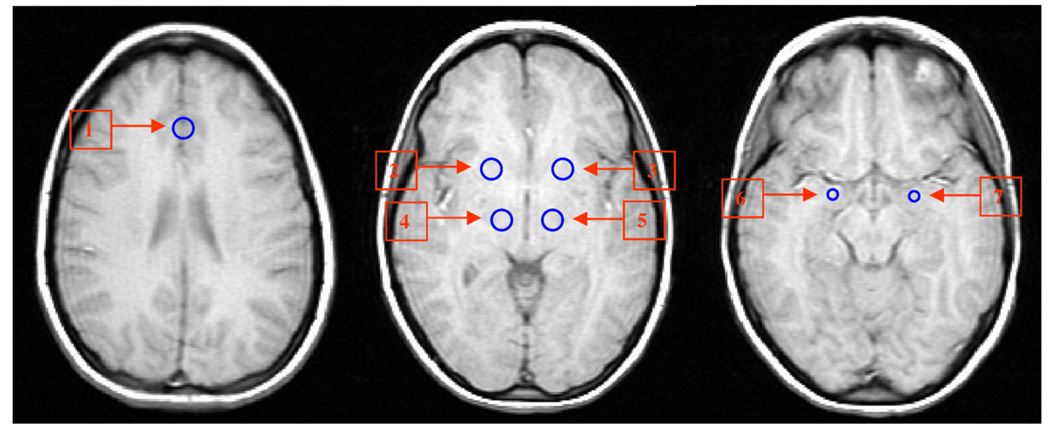
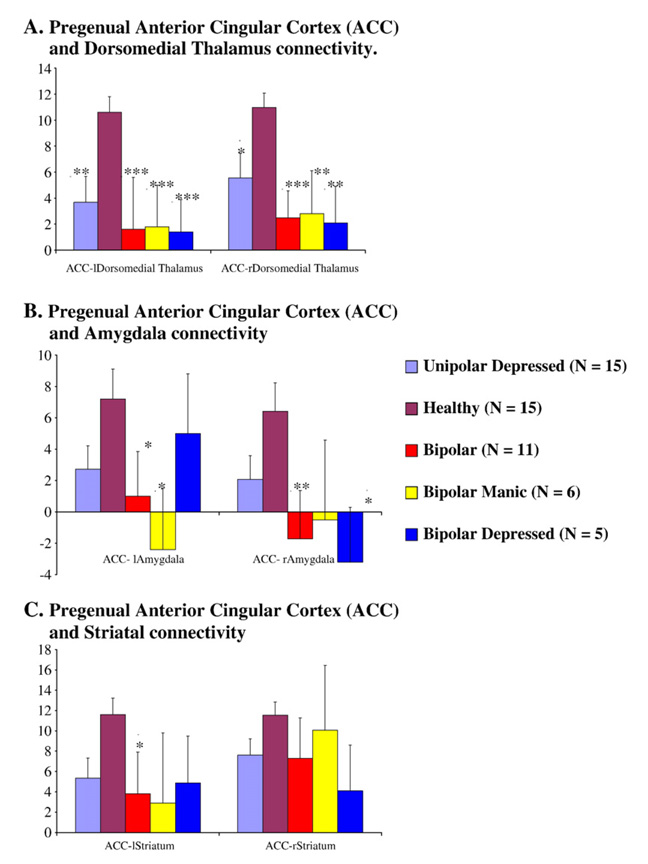
This study for the first time investigated resting state corticolimbic connectivity abnormalities in unmedicated bipolar disorder (BD) and compared them with findings in healthy controls and unipolar major depressive disorder (MDD) patient groups. Resting state correlations of low frequency BOLD fluctuations (LFBF) in echoplanar functional magnetic resonance (fMRI) data were acquired from a priori defined regions of interests (ROIs) in the pregenual anterior cingulate cortex (pgACC), dorsomedial thalamus (DMTHAL), pallidostriatum (PST) and amygdala (AMYG), to investigate corticolimbic functional connectivity in unmedicated BD patients in comparison to healthy subjects and MDD patients. Data were acquired from 11 unmedicated BD patients [six manic (BDM) and five depressed (BDD)], and compared with data available from 15 unmedicated MDD and 15 healthy subjects. BD patients had significantly decreased pgACC connectivity to the left and right DMTHAL, similar to findings seen in MDD. Additionally, BD patients had decreased pgACC connectivity with the left and right AMYG as well as the left PST. An exploratory analysis revealed that both BDD and BDM patients had decreased connectivity between the pgACC and DMTHAL. The results of the study indicate a common finding of decreased corticolimbic functional connectivity in different types of mood disorders.
本研究首次调查了未用药的双相情感障碍(BD)患者静息态皮质-边缘系统连接异常情况,并将其与健康对照者及单相重度抑郁症(MDD)患者组的研究结果进行比较。采用回波平面功能磁共振成像(fMRI)数据中低频血氧水平依赖波动(LFBF)的静息态相关性,从膝前扣带回皮质(pgACC)、背内侧丘脑(DMTHAL)、苍白球纹状体(PST)和杏仁核(AMYG)的先验定义感兴趣区域(ROIs)获取数据,以研究未用药的BD患者与健康受试者及MDD患者相比的皮质-边缘系统功能连接情况。数据来自11例未用药的BD患者[6例躁狂发作(BDM)和5例抑郁发作(BDD)],并与15例未用药的MDD患者和15例健康受试者的可用数据进行比较。BD患者与左右DMTHAL的pgACC连接显著降低,与MDD患者的研究结果相似。此外,BD患者与左右AMYG以及左侧PST的pgACC连接也降低。一项探索性分析显示,BDD和BDM患者的pgACC与DMTHAL之间的连接均降低。该研究结果表明,在不同类型的情绪障碍中,皮质-边缘系统功能连接降低是一个常见发现。