Sunagawa Shinichi, DeSalvo Michael K, Voolstra Christian R, Reyes-Bermudez Alejandro, Medina Mónica
School of Natural Sciences, University of California Merced, Merced, California, United States of America.
PLoS One. 2009;4(3):e4865. doi: 10.1371/journal.pone.0004865. Epub 2009 Mar 13.
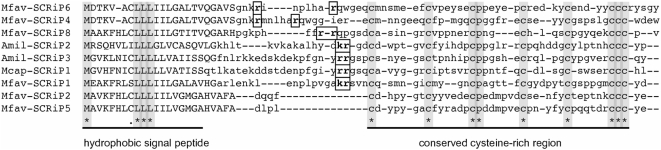
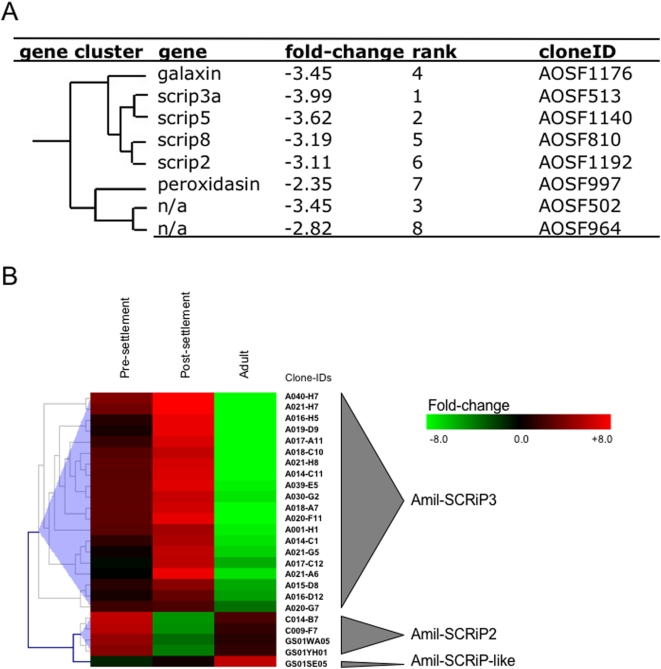
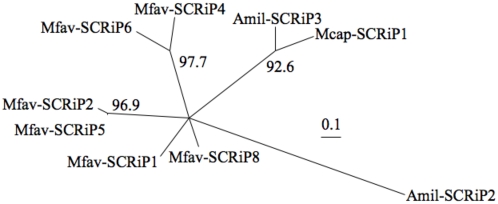
The amount of genomic sequence information continues to grow at an exponential rate, while the identification and characterization of genes without known homologs remains a major challenge. For non-model organisms with limited resources for manipulative studies, high-throughput transcriptomic data combined with bioinformatics methods provide a powerful approach to obtain initial insights into the function of unknown genes. In this study, we report the identification and characterization of a novel family of putatively secreted, small, cysteine-rich proteins herein named Small Cysteine-Rich Proteins (SCRiPs). Their discovery in expressed sequence tag (EST) libraries from the coral Montastraea faveolata required the performance of an iterative search strategy based on BLAST and Hidden-Markov-Model algorithms. While a discernible homolog could neither be identified in the genome of the sea anemone Nematostella vectensis, nor in a large EST dataset from the symbiotic sea anemone Aiptasia pallida, we identified SCRiP sequences in multiple scleractinian coral species. Therefore, we postulate that this gene family is an example of lineage-specific gene expansion in reef-building corals. Previously published gene expression microarray data suggest that a sub-group of SCRiPs is highly responsive to thermal stress. Furthermore, data from microarray experiments investigating developmental gene expression in the coral Acropora millepora suggest that different SCRiPs may play distinct roles in the development of corals. The function of these proteins remains to be elucidated, but our results from in silico, transcriptomic, and phylogenetic analyses provide initial insights into the evolution of SCRiPs, a novel, taxonomically restricted gene family that may be responsible for a lineage-specific trait in scleractinian corals.
基因组序列信息的数量持续呈指数级增长,而鉴定和表征没有已知同源物的基因仍然是一项重大挑战。对于用于操纵性研究的资源有限的非模式生物,高通量转录组数据与生物信息学方法相结合,为初步了解未知基因的功能提供了一种强大的方法。在本研究中,我们报告了一个新的推测为分泌型、小的、富含半胱氨酸的蛋白质家族的鉴定和表征,在此将其命名为小富含半胱氨酸蛋白(SCRiPs)。在来自珊瑚蒙氏鹿角珊瑚(Montastraea faveolata)的表达序列标签(EST)文库中发现它们,需要基于BLAST和隐马尔可夫模型算法执行迭代搜索策略。虽然在海葵星状海葵(Nematostella vectensis)的基因组中,以及在共生海葵苍白艾氏海葵(Aiptasia pallida)的大型EST数据集中,均未鉴定出可识别的同源物,但我们在多个石珊瑚物种中鉴定出了SCRiP序列。因此,我们推测这个基因家族是造礁珊瑚中谱系特异性基因扩增的一个例子。先前发表的基因表达微阵列数据表明,一组SCRiPs对热应激高度敏感。此外,来自研究珊瑚多孔鹿角珊瑚(Acropora millepora)发育基因表达的微阵列实验的数据表明,不同的SCRiPs可能在珊瑚发育中发挥不同的作用。这些蛋白质的功能仍有待阐明,但我们通过计算机模拟、转录组学和系统发育分析得到的结果,为SCRiPs的进化提供了初步见解,SCRiPs是一个新的、分类学上受限的基因家族,可能与石珊瑚的谱系特异性特征有关。