Yamaguchi Yuji, Hearing Vincent J
Department of Geriatric and Environmental Dermatology, Nagoya City University Graduate School of Medical Sciences, Nagoya, Japan.
Biofactors. 2009 Mar-Apr;35(2):193-9. doi: 10.1002/biof.29.
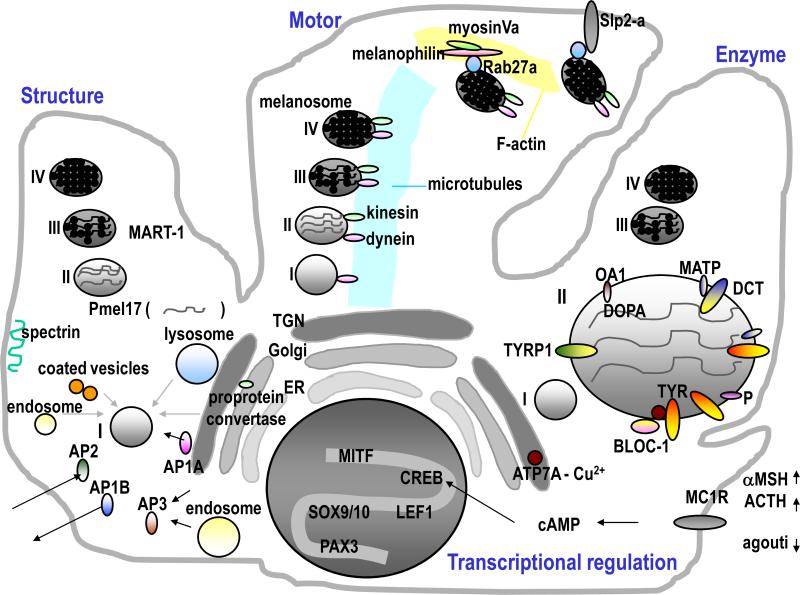
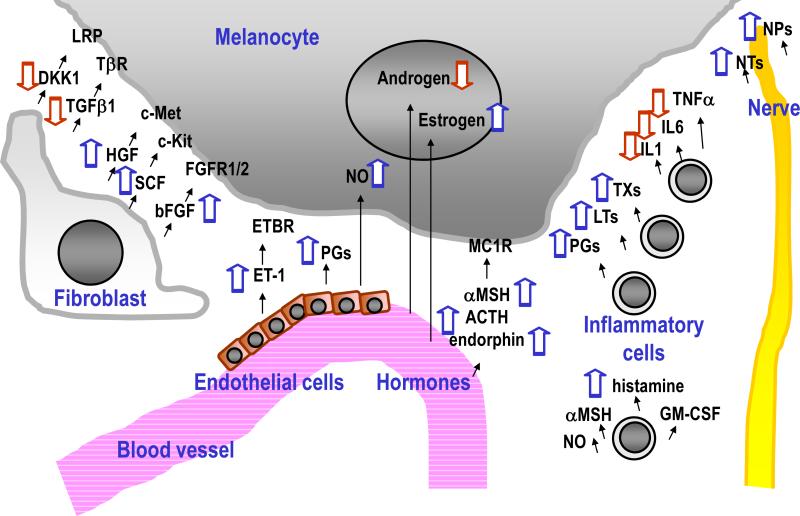
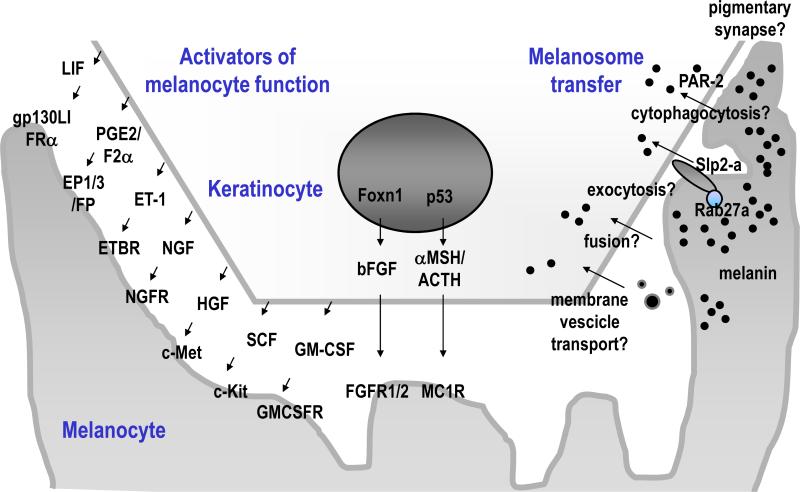
More than 150 genes have been identified that affect skin color either directly or indirectly, and we review current understanding of physiological factors that regulate skin pigmentation. We focus on melanosome biogenesis, transport and transfer, melanogenic regulators in melanocytes, and factors derived from keratinocytes, fibroblasts, endothelial cells, hormones, inflammatory cells, and nerves. Enzymatic components of melanosomes include tyrosinase, tyrosinase-related protein 1, and dopachrome tautomerase, which depend on the functions of OA1, P, MATP, ATP7A, and BLOC-1 to synthesize eumelanins and pheomelanins. The main structural component of melanosomes is Pmel17/gp100/Silv, whose sorting involves adaptor protein 1A (AP1A), AP1B, AP2, and spectrin, as well as a chaperone-like component, MART-1. During their maturation, melanosomes move from the perinuclear area toward the plasma membrane. Microtubules, dynein, kinesin, actin filaments, Rab27a, melanophilin, myosin Va, and Slp2-a are involved in melanosome transport. Foxn1 and p53 up-regulate skin pigmentation via bFGF and POMC derivatives including alpha-MSH and ACTH, respectively. Other critical factors that affect skin pigmentation include MC1R, CREB, ASP, MITF, PAX3, SOX9/10, LEF-1/TCF, PAR-2, DKK1, SCF, HGF, GM-CSF, endothelin-1, prostaglandins, leukotrienes, thromboxanes, neurotrophins, and neuropeptides. UV radiation up-regulates most factors that increase melanogenesis. Further studies will elucidate the currently unknown functions of many other pigment genes/proteins. (c) 2009 International Union of Biochemistry and Molecular Biology, Inc.
现已鉴定出150多个直接或间接影响肤色的基因,我们综述了目前对调节皮肤色素沉着的生理因素的认识。我们重点关注黑素小体的生物发生、运输和转移、黑素细胞中的黑素生成调节因子,以及来自角质形成细胞、成纤维细胞、内皮细胞、激素、炎症细胞和神经的因素。黑素小体的酶成分包括酪氨酸酶、酪氨酸酶相关蛋白1和多巴色素互变异构酶,它们依赖于OA1、P、MATP、ATP7A和BLOC-1的功能来合成真黑素和褐黑素。黑素小体的主要结构成分是Pmel17/gp100/Silv,其分选涉及衔接蛋白1A(AP1A)、AP1B、AP2和血影蛋白,以及一种伴侣样成分MART-1。在成熟过程中,黑素小体从核周区域向质膜移动。微管、动力蛋白、驱动蛋白、肌动蛋白丝、Rab27a、黑素亲和蛋白、肌球蛋白Va和Slp2-a参与黑素小体运输。Foxn1和p53分别通过bFGF和包括α-MSH和促肾上腺皮质激素在内的POMC衍生物上调皮肤色素沉着。其他影响皮肤色素沉着的关键因素包括MC1R、CREB、ASP、MITF、PAX3、SOX9/10、LEF-1/TCF、PAR-2、DKK1、SCF、HGF、GM-CSF、内皮素-1、前列腺素、白三烯、血栓素、神经营养因子和神经肽。紫外线辐射上调了大多数增加黑素生成的因素。进一步的研究将阐明许多其他色素基因/蛋白质目前未知的功能。(c)2009国际生物化学与分子生物学联盟公司