Pujol Josep M, Eisenberg Joseph E, Haas Charles N, Koopman James S
Department of Epidemiology, University of Michigan, Ann Arbor, Michigan, United States of America.
PLoS Comput Biol. 2009 Jun;5(6):e1000399. doi: 10.1371/journal.pcbi.1000399. Epub 2009 Jun 5.
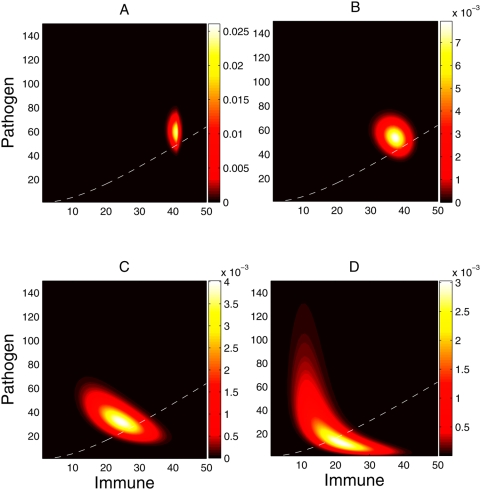
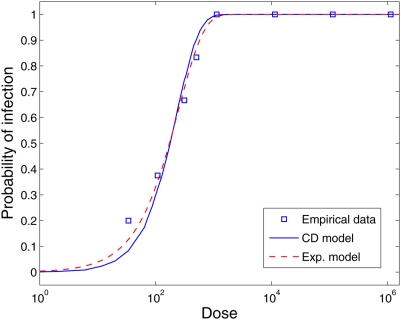
Characterizing infectivity as a function of pathogen dose is integral to microbial risk assessment. Dose-response experiments usually administer doses to subjects at one time. Phenomenological models of the resulting data, such as the exponential and the Beta-Poisson models, ignore dose timing and assume independent risks from each pathogen. Real world exposure to pathogens, however, is a sequence of discrete events where concurrent or prior pathogen arrival affects the capacity of immune effectors to engage and kill newly arriving pathogens. We model immune effector and pathogen interactions during the period before infection becomes established in order to capture the dynamics generating dose timing effects. Model analysis reveals an inverse relationship between the time over which exposures accumulate and the risk of infection. Data from one time dose experiments will thus overestimate per pathogen infection risks of real world exposures. For instance, fitting our model to one time dosing data reveals a risk of 0.66 from 313 Cryptosporidium parvum pathogens. When the temporal exposure window is increased 100-fold using the same parameters fitted by our model to the one time dose data, the risk of infection is reduced to 0.09. Confirmation of this risk prediction requires data from experiments administering doses with different timings. Our model demonstrates that dose timing could markedly alter the risks generated by airborne versus fomite transmitted pathogens.
将感染性表征为病原体剂量的函数是微生物风险评估不可或缺的一部分。剂量反应实验通常一次性给受试者施用剂量。对所得数据的现象学模型,如指数模型和贝塔-泊松模型,忽略了剂量时间,并假设每个病原体的风险是独立的。然而,现实世界中接触病原体是一系列离散事件,其中同时发生或先前的病原体到达会影响免疫效应器与新到达病原体结合并杀死它们的能力。我们对感染确立之前这段时间内免疫效应器与病原体的相互作用进行建模,以捕捉产生剂量时间效应的动态过程。模型分析揭示了暴露积累的时间与感染风险之间的反比关系。因此,一次性剂量实验的数据会高估现实世界接触中每种病原体的感染风险。例如,将我们的模型应用于一次性给药数据显示,313个微小隐孢子虫病原体导致的感染风险为0.66。当使用我们的模型根据一次性剂量数据拟合的相同参数将时间暴露窗口增加100倍时,感染风险降至0.09。要证实这种风险预测需要来自不同时间给药实验的数据。我们的模型表明,剂量时间可显著改变空气传播与 fomite传播病原体产生的风险。