Choudhry Mashkoor A, Chaudry Irshad H
Department of Surgery, Burn and Shock Trauma Institute, Loyola University Chicago Medical Center, Maywood, IL 60153, USA.
J Emerg Trauma Shock. 2008 Jul;1(2):81-7. doi: 10.4103/0974-2700.43187.
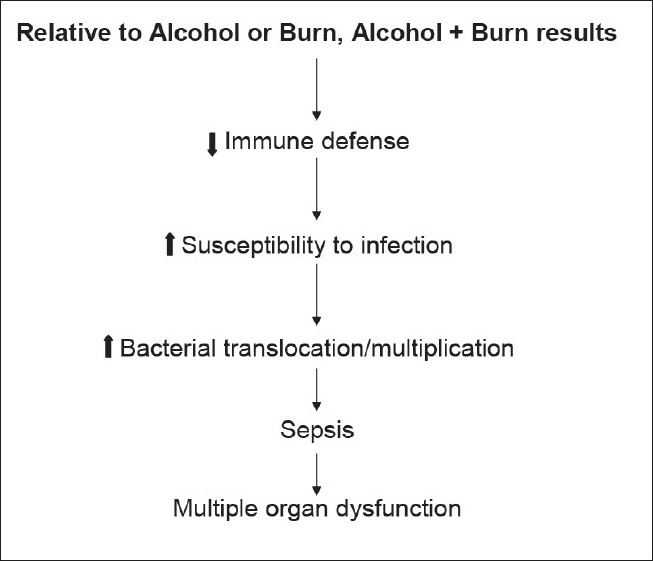
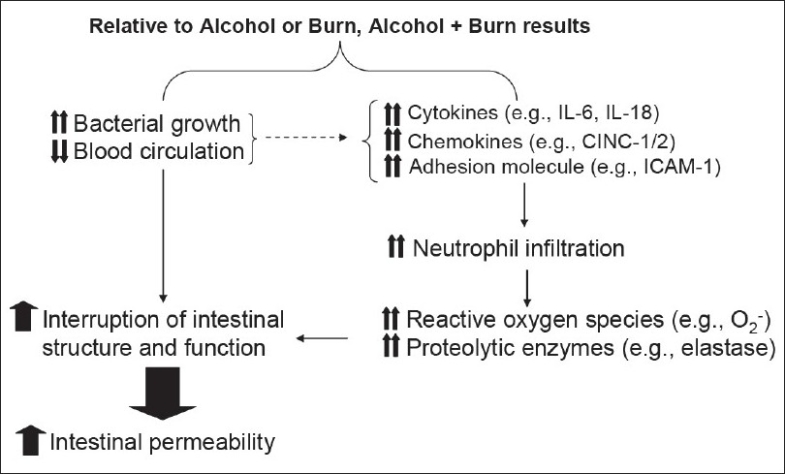
A significant number of burn and other traumatic injuries are reported to occur under the influence of alcohol (EtOH) intoxication. Despite this overwhelming association between EtOH intoxication and injury, relatively little attention has been paid to determining the role of EtOH in post-injury pathogenesis. This article reviews studies which have evaluated the impact of EtOH on post-burn intestinal immunity and barrier functions. The findings from these studies suggest that while a smaller burn injury by itself may not have an adverse effect on host defense, when combined with prior EtOH intoxication it may become detrimental. Experimental data from our laboratory further supports the notion that EtOH intoxication before burn injury suppresses intestinal immune defense, impairs gut barrier functions, and increases bacterial growth. This results in increased bacterial translocation which may contribute to post injury pathogenesis. Altogether, the studies reviewed in this article suggest that EtOH intoxication at the time of injury is a risk factor, and therefore blood EtOH should be checked in burn/trauma patients at the time of hospital admission.
据报道,大量烧伤及其他创伤性损伤发生在酒精(EtOH)中毒的影响下。尽管EtOH中毒与损伤之间存在这种压倒性的关联,但对于确定EtOH在损伤后发病机制中的作用却相对较少关注。本文回顾了评估EtOH对烧伤后肠道免疫和屏障功能影响的研究。这些研究的结果表明,虽然较小的烧伤本身可能对宿主防御没有不利影响,但与先前的EtOH中毒相结合时可能会变得有害。我们实验室的实验数据进一步支持了这样的观点,即烧伤前的EtOH中毒会抑制肠道免疫防御、损害肠道屏障功能并增加细菌生长。这导致细菌移位增加,这可能有助于损伤后发病机制。总之,本文回顾的研究表明,损伤时的EtOH中毒是一个危险因素,因此在烧伤/创伤患者入院时应检查血液中的EtOH含量。