Kirkpatrick Pamela, van Teijlingen Edwin
The Robert Gordon University, The school of Nursing and Midwifery, Garthdee Road, Aberdeen, AB10 7QG, Scotland, UK.
Open Nurs J. 2009 Jun 23;3:25-32. doi: 10.2174/1874434600903010025.
This paper reflects on the language and translation challenges faced and interventions used whilst undertaking cross-cultural public health research in Nepal using translators.
The growth in cross-cultural studies and international research highlights the use of translators and the associated challenges for researchers with regard to cultural and linguistic issues when collecting data in one language and analysing and reporting in another. The specific challenges when using translators are frequently overlooked in the research literature and translators and the interpretation processes omitted from the research methodology and/or discussion.
The experiences and challenges for an English-speaking nurse researcher working with a team of translators in a cross-cultural study on the sexual and reproductive health (SRH) of young people in Nepal, in 2006, is explored in this paper. The paper employs a case study approach.
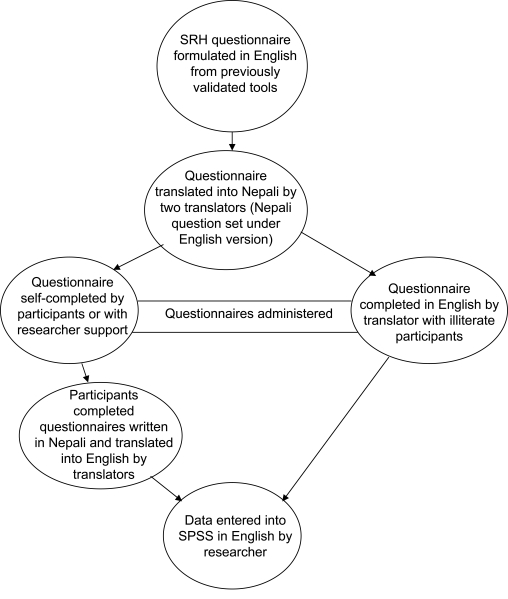
Data were collected over four weeks observing the settings, and the SRH knowledge and practices of participants in two villages in Kathmandu Valley were identified using a questionnaire, which was administered as a structured interview, and from the nurse researcher's field notes. This provided information on the translation and interpretation events. Stages in the research process where error could occur are identified in the researchers model and the interventions taken to minimise these are discussed which clarify perspectives and opinions when researching in the field.
Reflecting on translation and interpretation challenges during the data collection process in a language which the nurse researcher does not speak, can help reduce (or avoid) potential mistakes and error. The paper reflects on a model of translation processes which emerged during fieldwork which helps understand what events happened and what actions were taken to obtain the most accurate data. Using a model such as this for cross cultural fieldwork may be useful for both novice and established researchers.
本文反思了在尼泊尔使用翻译人员进行跨文化公共卫生研究时所面临的语言和翻译挑战以及所采用的干预措施。
跨文化研究和国际研究的增长凸显了翻译人员的使用以及研究人员在以一种语言收集数据并以另一种语言进行分析和报告时在文化和语言问题方面面临的相关挑战。研究文献中经常忽略使用翻译人员时的具体挑战,并且翻译人员及口译过程在研究方法和/或讨论中被省略。
本文探讨了一位讲英语的护士研究人员在2006年针对尼泊尔年轻人性与生殖健康(SRH)开展的一项跨文化研究中与一组翻译人员合作时的经历和挑战。本文采用案例研究方法。
在四周时间里收集数据,观察相关场景,并通过问卷调查(以结构化访谈的形式进行)以及护士研究人员的实地记录,确定加德满都谷地两个村庄参与者的性与生殖健康知识及行为。这提供了有关翻译和口译事件的信息。在研究人员的模型中确定了研究过程中可能出现错误的阶段,并讨论了为尽量减少这些错误而采取的干预措施,这些措施在实地研究时澄清了观点和意见。
反思在护士研究人员不懂的语言的数据收集过程中的翻译和口译挑战,有助于减少(或避免)潜在的错误。本文反思了实地调查期间出现的一种翻译过程模型,该模型有助于理解发生了哪些事件以及采取了哪些行动来获取最准确的数据。将这样的模型用于跨文化实地研究可能对新手和资深研究人员都有用。