Institute of Social Medicine, School of Medicine University of Belgrade, Dr Subotica 15, 11000 Belgrade, Serbia.
Institute of Medical Statistics and Informatics, School of Medicine University of Belgrade, Dr Subotica 15, 11000 Belgrade, Serbia.
Popul Health Metr. 2009 Aug 5;7:12. doi: 10.1186/1478-7954-7-12.
Based on the global predictions majority of deaths will be collectively caused by cancer, cardiovascular diseases, and traffic accidents over the coming 25 years. In planning future national health policy actions, inter - regional assessments play an important role. The purpose of the study was to analyze similarities and differences in premature mortality between Serbia, EURO A, EURO B, and EURO C regions in 2000.
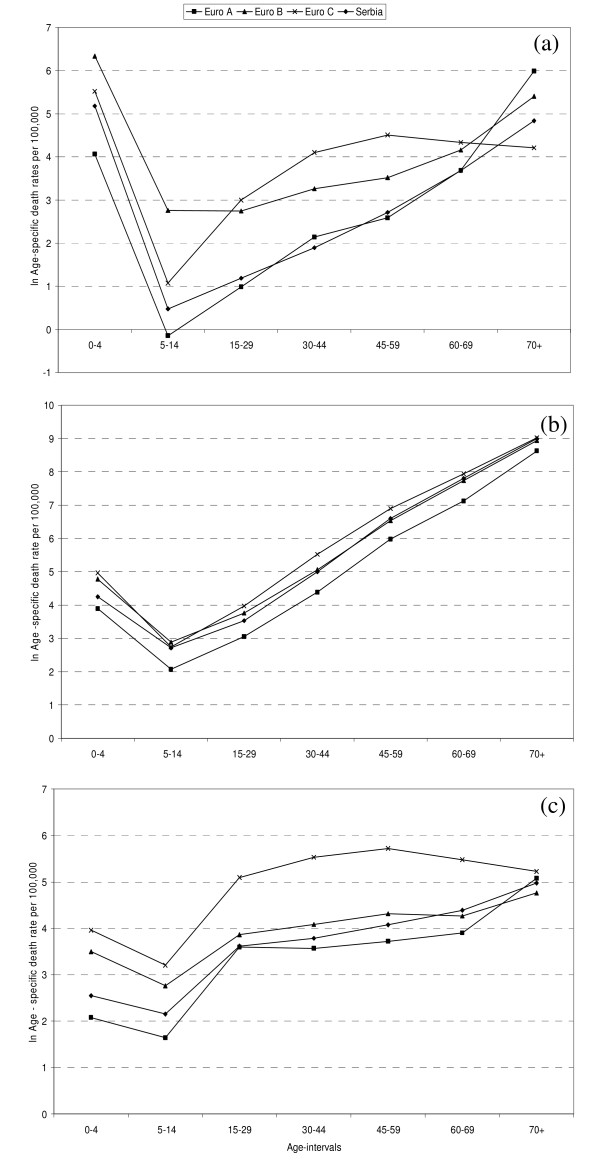
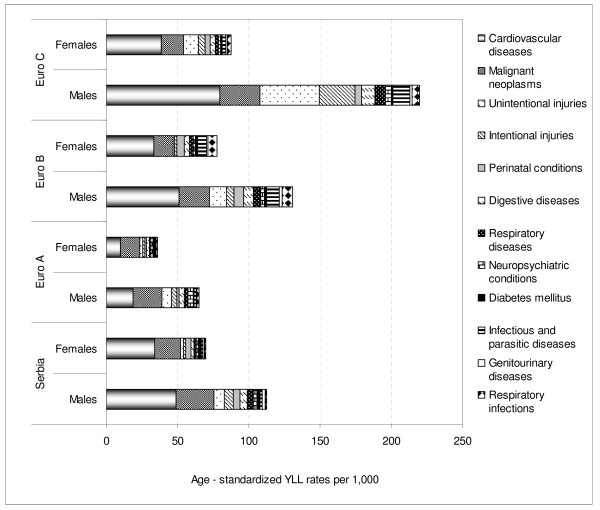
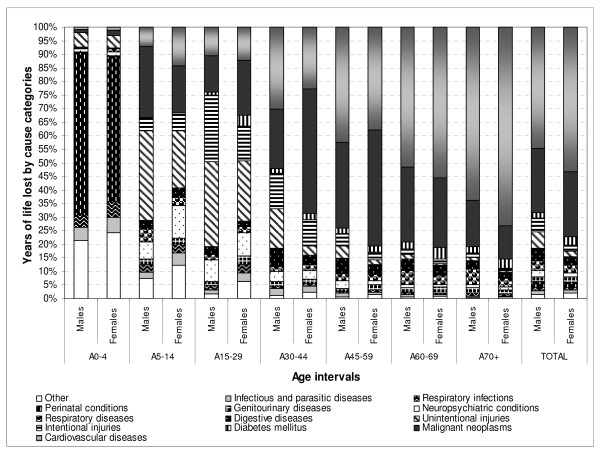
Mortality and premature mortality patterns were analysed according to cause of death, by gender and seven age intervals. The study results are presented in relative (%) and absolute terms (age-specific and age-standardized death rates per 100,000 population, and age-standardized rates of years of life lost - YLL per 1,000). Direct standardization of rates was undertaken using the standard population of Europe. The inter-regional comparison was based on a calculation of differences in YLL structures and with a ratio of age-standardized YLL rates per 1,000. A multivariate generalized linear model was used to explore mortality of Serbia and Europe sub-regions with ln age-specific death rates. The dissimilarity was achieved with a p </= 0.05.
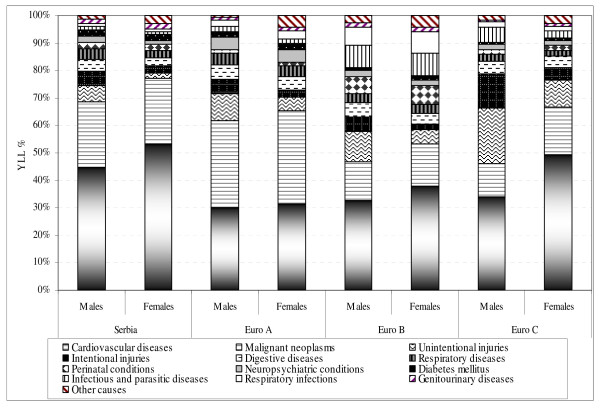
According to the mortality pattern, Serbia was similar to EURO B, but with a lower average YLL per death case. YLL patterns indicated similarities between Serbia and EURO A, while SRR YLL had similarities between Serbia and EURO B. Compared to all Europe sub-regions, Serbia had a major excess of premature mortality in neoplasms and diabetes mellitus. Serbia had lost more years of life than EURO A due to cardiovascular, genitourinary diseases, and intentional injuries. Yet, Serbia was not as burdened with communicable diseases and injuries as were EURO B and EURO C.
With a premature mortality pattern, Serbia is placed in the middle position of the Europe triangle. The main excess of YLL in Serbia was due to cardiovascular, malignant diseases, and diabetes mellitus. The results may be used for assessment of unacceptable social risks resulting from health inequalities. Within intentions to reduce an unfavourable premature mortality gap, it is necessary to reconsider certain local polices and practices as well as financial and human resources incorporated in the prevention of disease and injury burden.
根据全球预测,在未来 25 年内,癌症、心血管疾病和交通事故将导致大多数死亡。在规划未来的国家卫生政策行动时,区域间评估发挥着重要作用。本研究的目的是分析 2000 年塞尔维亚、欧洲 A、欧洲 B 和欧洲 C 地区之间过早死亡的相似性和差异。
根据死亡原因、性别和七个年龄区间分析死亡率和过早死亡率模式。研究结果以相对(%)和绝对(年龄特异性和年龄标准化每 10 万人死亡率、每 1000 人损失的年龄标准化寿命年率 - YLL)表示。使用欧洲标准人口对率进行直接标准化。区域间比较是基于 YLL 结构差异和每 1000 人年龄标准化 YLL 率的比率计算的。使用对数年龄特异性死亡率的广义线性模型探索塞尔维亚和欧洲次区域的死亡率。差异的显著性水平为 p </= 0.05。
根据死亡率模式,塞尔维亚与欧洲 B 相似,但每个死亡病例的平均 YLL 较低。YLL 模式表明塞尔维亚与欧洲 A 相似,而 SRR YLL 则与欧洲 B 相似。与所有欧洲次区域相比,塞尔维亚的肿瘤和糖尿病的过早死亡率过高。由于心血管疾病、泌尿生殖系统疾病和故意伤害,塞尔维亚失去的生命年数超过了欧洲 A。然而,塞尔维亚的传染病和伤害负担不如欧洲 B 和欧洲 C 那么严重。
根据过早死亡模式,塞尔维亚处于欧洲三角的中间位置。塞尔维亚 YLL 主要过剩是由于心血管疾病、恶性疾病和糖尿病。这些结果可用于评估因健康不平等而导致的不可接受的社会风险。在减少不利的过早死亡率差距的意图下,有必要重新考虑某些地方政策和做法以及预防疾病和伤害负担所涉及的财务和人力资源。