Bradley Una, Spence Michelle, Courtney C Hamish, McKinley Michelle C, Ennis Cieran N, McCance David R, McEneny Jane, Bell Patrick M, Young Ian S, Hunter Steven J
Regional Centre for Endocrinology and Diabetes, Royal Victoria Hospital, Belfast, U.K.
Diabetes. 2009 Dec;58(12):2741-8. doi: 10.2337/db09-0098. Epub 2009 Aug 31.
Low-fat hypocaloric diets reduce insulin resistance and prevent type 2 diabetes in those at risk. Low-carbohydrate, high-fat diets are advocated as an alternative, but reciprocal increases in dietary fat may have detrimental effects on insulin resistance and offset the benefits of weight reduction.
We investigated a low-fat (20% fat, 60% carbohydrate) versus a low-carbohydrate (60% fat, 20% carbohydrate) weight reduction diet in 24 overweight/obese subjects ([mean +/- SD] BMI 33.6 +/- 3.7 kg/m(2), aged 39 +/- 10 years) in an 8-week randomized controlled trial. All food was weighed and distributed, and intake was calculated to produce a 500 kcal/day energy deficit. Insulin action was assessed by the euglycemic clamp and insulin secretion by meal tolerance test. Body composition, adipokine levels, and vascular compliance by pulse-wave analysis were also measured.
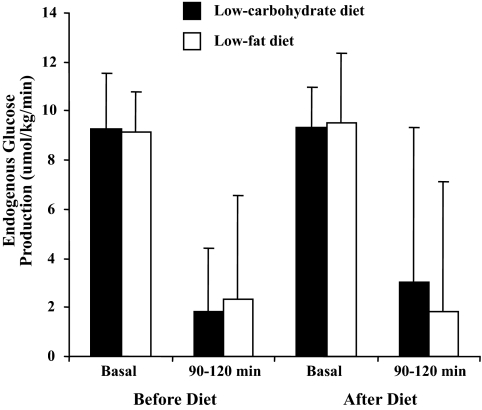
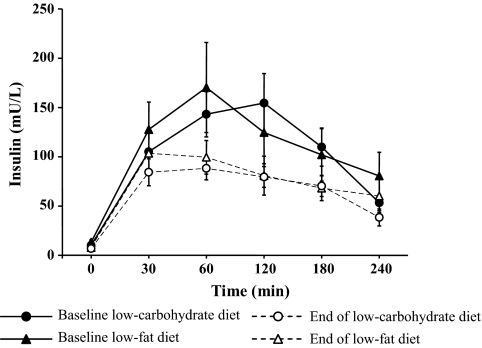
Significant weight loss occurred in both groups (P < 0.01), with no difference between groups (P = 0.40). Peripheral glucose uptake increased, but there was no difference between groups (P = 0.28), and suppression of endogenous glucose production was also similar between groups. Meal tolerance-related insulin secretion decreased with weight loss with no difference between groups (P = 0.71). The change in overall systemic arterial stiffness was, however, significantly different between diets (P = 0.04); this reflected a significant decrease in augmentation index following the low-fat diet, compared with a nonsignificant increase within the low-carbohydrate group.
This study demonstrates comparable effects on insulin resistance of low-fat and low-carbohydrate diets independent of macronutrient content. The difference in augmentation index may imply a negative effect of low-carbohydrate diets on vascular risk.
低脂低热量饮食可降低胰岛素抵抗,并预防高危人群患2型糖尿病。低碳水化合物、高脂肪饮食被提倡作为一种替代方案,但膳食脂肪的相应增加可能会对胰岛素抵抗产生有害影响,并抵消减重带来的益处。
在一项为期8周的随机对照试验中,我们对24名超重/肥胖受试者([平均±标准差]BMI 33.6±3.7kg/m²,年龄39±10岁)进行了低脂(20%脂肪,60%碳水化合物)与低碳水化合物(60%脂肪,20%碳水化合物)减重饮食的研究。所有食物均称重并分配,计算摄入量以产生每天500千卡的能量缺口。通过正常血糖钳夹技术评估胰岛素作用,通过进餐耐量试验评估胰岛素分泌。还测量了身体成分、脂肪因子水平以及通过脉搏波分析评估的血管顺应性。
两组均出现显著体重减轻(P<0.01),组间无差异(P = 0.40)。外周葡萄糖摄取增加,但组间无差异(P = 0.28),内源性葡萄糖生成的抑制在组间也相似。与进餐耐量相关的胰岛素分泌随体重减轻而下降,组间无差异(P = 0.71)。然而,不同饮食之间总体全身动脉僵硬度的变化存在显著差异(P = 0.04);这反映出低脂饮食后增强指数显著降低,而低碳水化合物组则无显著增加。
本研究表明,低脂和低碳水化合物饮食对胰岛素抵抗具有相似的影响,与宏量营养素含量无关。增强指数的差异可能意味着低碳水化合物饮食对血管风险有负面影响。