Pneumology, CHU Sart Tilman, Liège, Belgium.
Int J Clin Pract. 2009 Oct;63(10):1479-88. doi: 10.1111/j.1742-1241.2009.02185.x.
To study the effectiveness and safety of budesonide/formoterol (Symbicort) Maintenance And Reliever Therapy (Symbicort SMART, AstraZeneca, Södertalje, Sweden), a simplified management approach with one inhaler compared with conventional best practice (CBP) with multiple inhalers in patients with persistent asthma.
Open-label randomised controlled parallel group trial, 6-month treatment.
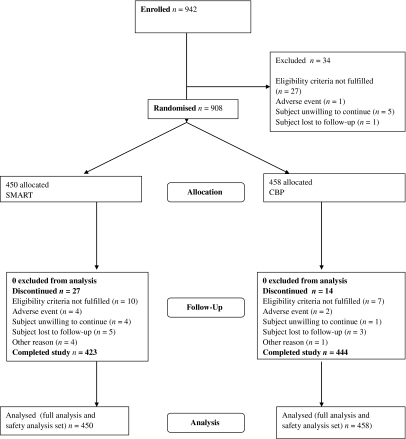
A total of 908 patients > or = 12 years of age, with persistent asthma receiving treatment with inhaled corticosteroids (ICS), either alone or in conjunction with long-acting beta(2)-agonist.
Time to first severe asthma exacerbation and number of severe asthma exacerbations.
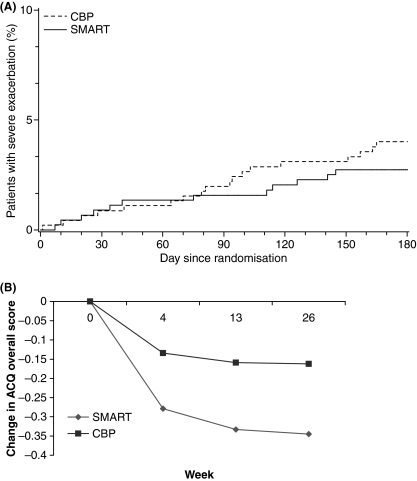
No difference between groups was seen in time to first severe exacerbation (p = 0.75). Exacerbation rates were low in both groups. A total of 12 patients in the Symbicort SMART group experienced a total of 14 severe asthma exacerbations, and 19 patients in the CBP group experienced a total of 25 severe asthma exacerbations (annual rate 0.07 vs. 0.13 p = 0.09). The mean daily dose of ICS expressed in BDP equivalent was significantly lower in the Symbicort SMART group (including as-needed use) vs. in the CBP group (749 microg vs. 1059 microg; p < 0.0001). Mean scores in Asthma Control Questionnaire, 5 question version improved significantly in the SMART group compared with the CBP group (p = 0.0026). Symbicort SMART and CBP were equally well tolerated. The mean drug cost/patient/month was significantly lower for the patients in the Symbicort SMART group compared with patients receiving CBP (51.3 euros vs. 66.5 euros; p < 0.0001).
In Belgian patients, a simplified regimen using budesonide/formoterol maintenance and reliever therapy was at least as effective at improving clinical control compared with CBP with a significantly lower ICS dose and significantly lower drug costs.
研究布地奈德/福莫特罗(信必可都保,阿斯利康制药有限公司,瑞典 Södertalje)维持和缓解治疗(Symbicort SMART)与常规最佳实践(CBP)相比,在患有持续性哮喘的患者中,使用一种吸入器进行简化管理的有效性和安全性。
开放性标签随机对照平行组试验,6 个月的治疗。
共 908 名年龄≥12 岁的患者,接受吸入性皮质类固醇(ICS)治疗,包括单独使用 ICS 或与长效β2-激动剂联合使用。
首次严重哮喘加重的时间和严重哮喘加重的次数。
两组之间首次严重加重的时间无差异(p=0.75)。两组的加重率都较低。Symbicort SMART 组有 12 例患者共发生 14 次严重哮喘加重,CBP 组有 19 例患者共发生 25 次严重哮喘加重(年发生率分别为 0.07 和 0.13,p=0.09)。Symbicort SMART 组的布地奈德日剂量(等效于 BDP)显著低于 CBP 组(包括按需使用)(749μg 对 1059μg;p<0.0001)。与 CBP 组相比,SMART 组哮喘控制问卷(5 题版)的平均评分显著改善(p=0.0026)。Symbicort SMART 和 CBP 的耐受性相当。Symbicort SMART 组患者的平均药物费用/月/人显著低于 CBP 组(51.3 欧元对 66.5 欧元;p<0.0001)。
在比利时患者中,与 CBP 相比,使用布地奈德/福莫特罗维持和缓解治疗的简化方案在改善临床控制方面至少同样有效,且 ICS 剂量显著降低,药物成本显著降低。