Speech, Language & Hearing Sciences, Boston University, Boston, MA 02215, USA.
Int J Lang Commun Disord. 2010 Jul-Aug;45(4):494-509. doi: 10.3109/13682820903222783.
Children with specific language impairments (SLI) repeat nonwords less accurately than typically developing children, suggesting a phonological deficit. Much work has attempted to explain these results in terms of a phonological memory deficit. However, subsequent work revealed that these results might be explained better as a deficit in phonological sensitivity.
This study used a nonword repetition task to examine how children with SLI extract phonological regularities from their language input.
METHODS & PROCEDURES: Eighteen English-speaking children with SLI (7;3-10;6) and 18 age-matched controls participated in two English nonword repetition tasks. Three- and four-syllable nonwords varied in a single phonotactic frequency manipulation, either consonant frequency or phoneme co-occurrence frequency, while all other factors were held constant. Repetitions were scored in terms of accuracy as either the percentage of phonemes correctly produced or phoneme co-occurrences (diphones) correctly produced. In addition, onset-to-onset reaction times and repetition durations were measured.
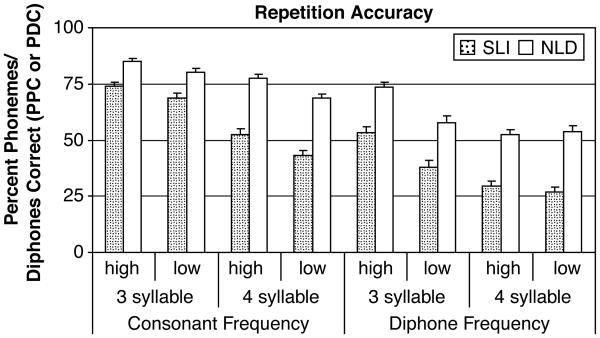
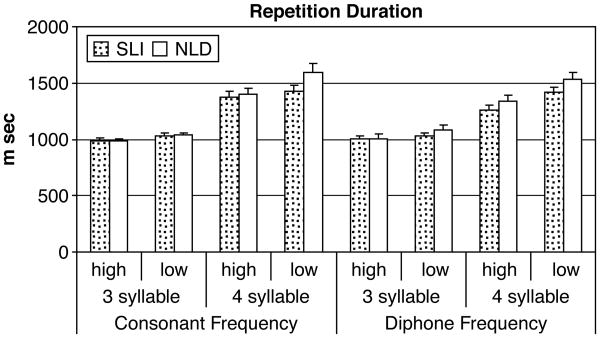
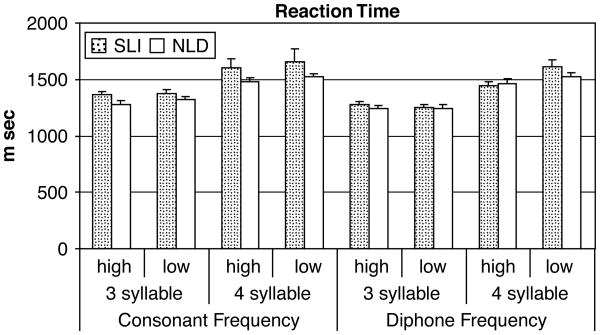
OUTCOMES & RESULTS: Accuracy results revealed significant group, length, and phonotactic frequency effects. Children with SLI repeated nonwords less accurately than age-matched peers, and all children repeated three-syllable nonwords and those with higher frequency phonotactic patterns more accurately. However, phonotactic frequency by group interactions were not significant. Timing results were mixed, with group reaction time differences for co-occurrence frequency, but not consonant frequency, and no group repetition duration differences.
CONCLUSIONS & IMPLICATIONS: While children with SLI were less accurate overall, non-significant interactions indicate that both groups of children were comparably affected by differences in consonant and diphone frequency.
与正常发育儿童相比,患有特定语言障碍(SLI)的儿童对非词的重复准确性较低,这表明存在语音缺陷。许多研究试图从语音记忆缺陷的角度来解释这些结果。然而,随后的研究表明,这些结果可能更好地解释为语音敏感性缺陷。
本研究使用非词重复任务来研究患有 SLI 的儿童如何从语言输入中提取语音规则。
18 名英语为母语的 SLI 儿童(7;3-10;6)和 18 名年龄匹配的对照组儿童参加了两项英语非词重复任务。三音节和四音节非词在单个语音规则频率操作中变化,即辅音频率或音素共现频率,而其他所有因素保持不变。重复次数的准确性评分以正确产生的音素百分比或正确产生的音素共现(双音)百分比表示。此外,还测量了起始到起始的反应时间和重复持续时间。
准确性结果显示出显著的组间、长度和语音规则频率效应。患有 SLI 的儿童的非词重复准确性低于年龄匹配的同龄人,所有儿童对三音节非词和高频语音规则模式的重复准确性更高。然而,组间语音规则频率的交互作用并不显著。时间结果喜忧参半,在共现频率方面存在组间反应时间差异,但在辅音频率方面没有差异,并且没有组间重复持续时间差异。
尽管儿童总体上的准确性较低,但无显著的交互作用表明,两组儿童都受到辅音和双音频率差异的影响。