Centre de Recherche du Centre Hospitalier de l’Université de Montréal, Université de Montréal, Québec, Canada.
Health Policy Plan. 2010 Sep;25(5):393-405. doi: 10.1093/heapol/czq007. Epub 2010 Feb 25.
Data aggregation in national information systems begins at the district level. Decentralization has given districts a lead role in health planning and management, therefore validity of administrative-based estimates at that level is important to improve the performance of immunization information systems.
To assess the validity of administrative-based immunization estimates and their usability for planning and monitoring activities at district level.
DTP3 and measles coverage rates from administrative sources were compared with estimates from the EPI cluster survey (ECS) and Demographic and Health Survey (DHS) carried out in 2003 at national and regional levels. ECS estimates were compared with administrative rates across the 52 districts, which were classified into three groups: those where administrative rates were underestimating, overestimating or concordant with ECS estimates (differences within 95% CI of ECS rate).
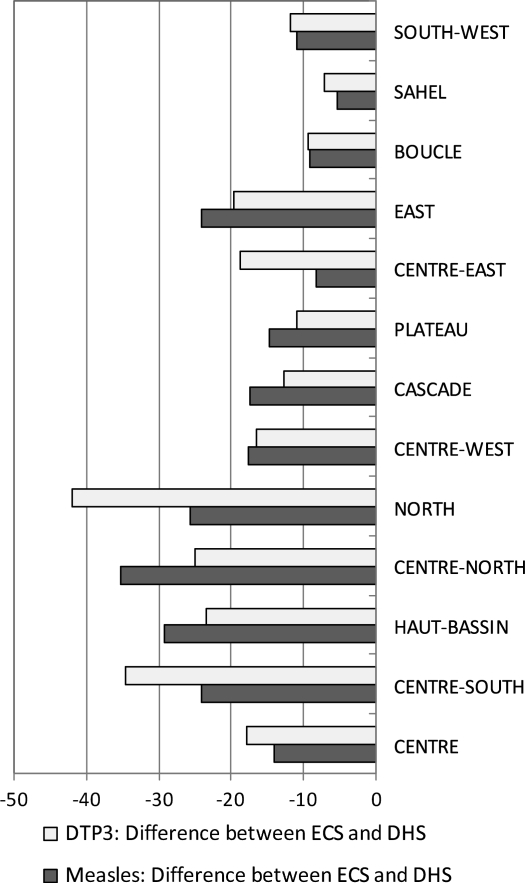
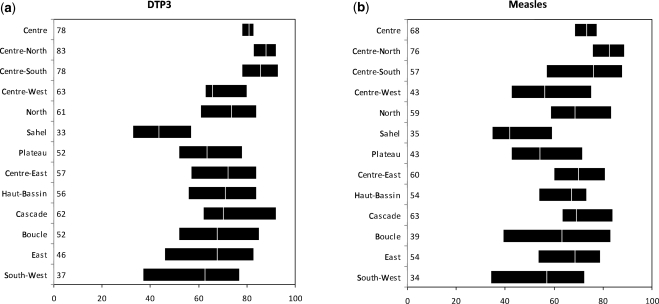
National rates provided by administrative data and ECS are similar (74% and 71% for DTP3 and 68% and 66% for measles, respectively); DHS estimates are much lower. Regional administrative data show large discrepancies when compared against ECS and DHS data (differences sometimes reaching 30 percentage points). At district level, geographical area is correlated with over- or underestimation by administrative sources, which overestimate DTP3 and measles coverage in remote areas. Underestimation is observed in districts near urban and highly populated centres. Over- and underestimation are independent of the antigen under consideration.
Variability in immunization coverage across districts highlights the limitations of using nationally aggregated indicators. If district data are to be used in monitoring and planning immunization programmes as intended by decentralization, heterogeneity in their validity must be reduced. The authors recommend: (1) strengthening administrative data systems; (2) implementing indicators that are insensitive to population mobility; (3) integrating surveys into monitoring processes at the subnational level; (4) actively promoting the use of coverage information by local personnel and district-level staff.
国家信息系统的数据汇总始于地区一级。权力下放使地区在卫生规划和管理方面发挥了主导作用,因此该级别基于行政的估计的有效性对于改进免疫信息系统的绩效非常重要。
评估基于行政的免疫估计的有效性及其在地区一级规划和监测活动中的可用性。
2003 年在国家和区域两级开展的国家扩大免疫规划(EPI) 监测系统(ECS)和人口与健康调查(DHS)的估计数与来自行政来源的 DTP3 和麻疹覆盖率进行比较。ECS 估计数与 52 个区的行政率进行比较,这些区分为三组:行政率低估、高估或与 ECS 估计数相符(差异在 ECS 率的 95%置信区间内)的区。
行政数据和 ECS 提供的国家率相似(DTP3 分别为 74%和 71%,麻疹分别为 68%和 66%);DHS 估计数要低得多。与 ECS 和 DHS 数据相比,区域行政数据显示出很大的差异(有时差异达到 30 个百分点)。在地区一级,地理区域与行政来源的高估或低估相关,在偏远地区高估 DTP3 和麻疹覆盖率,在靠近城市和人口稠密中心的地区则低估。高估和低估与所考虑的抗原无关。
各地区免疫覆盖率的差异突出表明,使用全国汇总指标存在局限性。如果要按照权力下放的意图在监测和规划免疫规划中使用地区数据,就必须减少其有效性的变异性。作者建议:(1)加强行政数据系统;(2)实施对人口流动不敏感的指标;(3)在国家以下各级监测进程中纳入调查;(4)积极促进当地人员和地区一级工作人员使用覆盖率信息。