Jongejan F
Department of Tropical Veterinary Medicine and Protozoology, Institute of Infectious Diseases and Immunology, Utrecht, The Netherlands.
Infect Immun. 1991 Feb;59(2):729-31. doi: 10.1128/iai.59.2.729-731.1991.
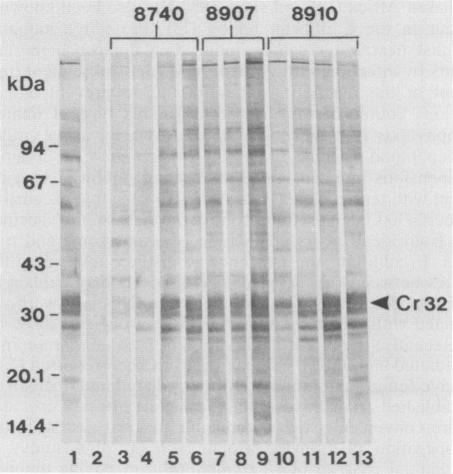
A Senegalese (S) stock of Cowdria ruminantium was passaged on bovine umbilical endothelial cells with an average interval of 13.9 days (range, 8 to 34 days) between passages. The virulence of infected bovine umbilical endothelial cultures was tested in susceptible goats and sheep by intravenous inoculation of culture supernatant from passages 2 (51 days in vitro), 3 (69 days), 11 (229 days), 14 (264 days), and 16 (291 days). Both animals inoculated with passages 2 and 3 died of heartwater. However, clinical reactions were completely absent in goats and sheep that were inoculated with C. ruminantium from passages 11, 14, and 16. High antibody titers were detected, with immunofluorescence in all vaccinated animals, and a strong signal was found against a 32-kDa Cowdria protein in Western blots (immunoblots). Moreover, the vaccinated animals proved solidly immune when challenged with virulent Cowdria sp.-infected blood stabilate (S strain), whereas all control goats died. No attenuation of a second Cowdria stock (W) was achieved after 226 days in culture, at which time passage 17 was tested in a recipient goat which died of typical heartwater. This is the first report of vaccination with live attenuated C. ruminantium. These attenuated organisms may replace vaccination with virulent blood currently in use in areas where heartwater is endemic.
一株来自塞内加尔的反刍兽考德里氏体(Cowdria ruminantium)毒株在牛脐静脉内皮细胞上进行传代培养,传代间隔平均为13.9天(范围为8至34天)。通过对第2代(体外培养51天)、第3代(69天)、第11代(229天)、第14代(264天)和第16代(291天)培养物的上清液进行静脉接种,在易感山羊和绵羊中测试感染牛脐静脉内皮细胞培养物的毒力。接种第2代和第3代培养物的动物均死于心水病。然而,接种第11代、第14代和第16代反刍兽考德里氏体的山羊和绵羊未出现任何临床反应。在所有接种动物中均检测到高抗体滴度,通过免疫荧光检测到,并且在蛋白质印迹法(免疫印迹)中发现针对一种32 kDa反刍兽考德里氏体蛋白的强信号。此外,当用强毒反刍兽考德里氏体感染的血液冻干株(S株)进行攻击时,接种动物表现出稳固的免疫力,而所有对照山羊均死亡。在培养226天后,第二株反刍兽考德里氏体毒株(W)未实现减毒,此时在一只受体山羊中测试第17代培养物,该山羊死于典型的心水病。这是关于用减毒活反刍兽考德里氏体进行疫苗接种的首次报道。这些减毒生物体可能会取代目前在有地方流行心水病的地区使用的强毒血液疫苗。